Basic Fractions
What is a fraction?
Definition
A fraction represents part of a whole. It is written using two integers:
- Numerator – the number of parts you have
- Denominator – the total number of equal parts the whole is divided into
Example: \( \frac{3}{4} \) means “three out of four equal parts”.
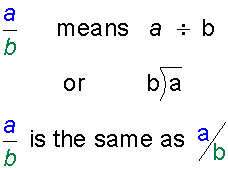
The top number (numerator) is divided (÷) by the bottom number (denominator).
\[ \frac{Numerator}{Denominator} \]
What fraction of these counters is yellow?
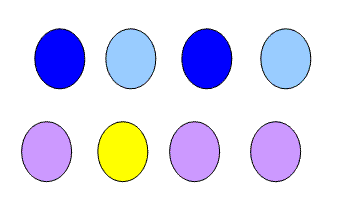
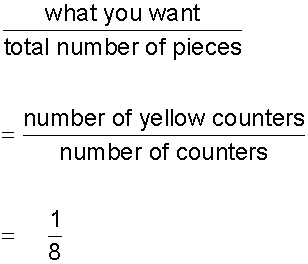
One eighth — or one in eight — of these counters is yellow.
Common fractions are written in the form:
Types of fractions
Mixed number
A whole number combined with a proper fraction.
Example: \( 2\frac{1}{3} \)
Unit fraction
Numerator = 1.
Example: \( \frac{1}{8} \)
Equivalent fractions
Different fractions that represent the same value.
Example: \( \frac{1}{2} = \frac{2}{4} = \frac{50}{100} \)
Simplified fraction
A fraction where numerator and denominator have no common factors except 1.
Example: \( \frac{12}{18} = \frac{2}{3} \)
Proper Fractions
A proper fraction has a smaller numerator than denominator.
Numerator < denominator.
This represents a value less than 1.

Improper Fractions
An improper fraction has a larger numerator than denominator.
Numerator ≥ denominator.
This represents a value equal to or greater than 1.
Simplifying Fractions
To simplify (or cancel) a fraction, look for a whole number which divides exactly into both the top number (numerator) and the bottom number (denominator).
Keep repeating until you cannot continue — remembering that even numbers can always be divided by 2, and numbers ending in 5 or 0 can be divided by 5.
Examples
What if you don’t know your tables?
Try dividing top and bottom by 2, 3, 5, or 10.
Prime Factor Method
(This method uses prime factors.)
- Divide by each prime number in turn until you cannot divide exactly.
- Write the number as the product of its prime factors.
- Cancel out matching factors.
- Multiply what remains.
Simplify \( \frac{36}{54} \)
Converting Improper Fractions to Mixed Numbers
Divide the numerator (top) by the denominator (bottom). Write the quotient, then put the remainder over the denominator. Simplify if possible.
Examples
Converting Mixed Numbers to Improper Fractions
Multiply the whole number by the denominator (bottom). Add the numerator (top). Write this answer over the denominator.
Examples
\( 2\tfrac{1}{3} = \frac{2 \times 3 + 1}{3} = \frac{7}{3} \)
\( 4\tfrac{5}{6} = \frac{4 \times 6 + 5}{6} = \frac{29}{6} \)
Calculating Fractions of Amounts
To calculate \( \frac{a}{b} \text{ of } C \)
Divide C by the denominator, then multiply by the numerator.
\( \frac{C}{b} \times a \)
" Divide by the bottom, times by the top"
Examples
Find \( \frac{2}{5} \) of £45:
\( \frac{2}{5} \times 45 = 2 \times \frac{45}{5} = 2 \times 9 = 18 \)
So the answer is £18.
Find \( \frac{3}{8} \) of 648:
\( \frac{3}{8} \times 648 = 3 \times \frac{648}{8} = 3 \times 81 = 243 \)
So the answer is 243.
Find \( \frac{1}{7} \) of 649:
\( \frac{1}{7} \times 649 = 649 \div 7 = 92.714285\ldots \)
So the answer is \( \displaystyle 92\tfrac{5}{7} \).
Find \( \frac{3}{5} \) of 650:
\( \frac{3}{5} \times 650 = 3 \times \frac{650}{5} = 3 \times 130 = 390 \)
So the answer is 390.
Find \( \frac{2}{3} \) of 650:
\( \frac{2}{3} \times 650 = 2 \times \frac{650}{3} = 2 \times 216.\overline{6} = 433.\overline{3} \)
So the answer is \( \displaystyle 433\tfrac{1}{3} \).
Learn
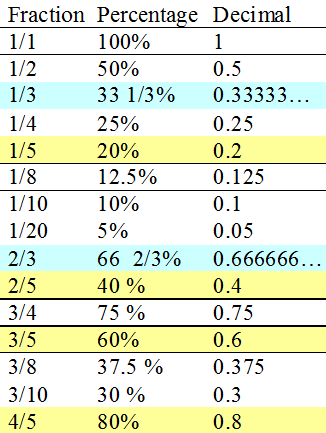
Fractions Drill Questions
As an Amazon Associate I earn from qualifying purchases.