Maths Mutt HOME

Fraction Operations

Adding Fractions

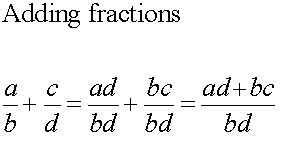
Make sure the denominators (bottom numbers) are the same by finding the Lowest Common Multiple. LCM

Add the numerators (top numbers).

Leave the bottom numbers alone.

Simplify if possible.

Convert to a mixed number if needed.

Examples

\[ \frac{1}{6} + \frac{1}{6} \] \[ = \frac{2}{6} \] \[ = \frac{1}{3} \]
\[ \frac{3}{10} + \frac{1}{10} \] \[ = \frac{4}{10} \] \[ = \frac{2}{5} \]
\[ \frac{5}{12} + \frac{7}{12} \] \[ = \frac{12}{12} \] \[ = 1 \]
\( \frac{3}{8} + \frac{2}{5} = \frac{3 \times 5}{8 \times 5} + \frac{2 \times 8}{5 \times 8} = \frac{15}{40} + \frac{16}{40} = \frac{31}{40} \)

Subtraction is Similar

Make sure the denominators (bottom numbers) are the same by finding the Lowest Common Multiple. LCM

Subtract the numerators (top numbers).

Leave the bottom numbers alone.

Simplify if possible.

Convert to a mixed number if needed.

Examples

\[ \frac{5}{8} - \frac{1}{8} \] \[ = \frac{4}{8} \] \[ = \frac{1}{2} \]
\[ \frac{7}{12} - \frac{5}{12} \] \[ = \frac{2}{12} \] \[ = \frac{1}{6} \]
\( \frac{3}{4} - \frac{2}{3} = \frac{3 \times 3}{4 \times 3} - \frac{2 \times 4}{3 \times 4} = \frac{9}{12} - \frac{8}{12} = \frac{1}{12} \)

Vedic Method

This is an ancient method from India. (More information)
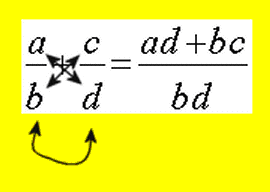
Vedic cross-multiplication diagram 1
Vedic cross-multiplication diagram 2

Multiply bottom numbers and put in the sign.

Multiply top left by bottom right.

Multiply bottom left by top right.

Add numerators

Convert to a mixed number if needed.

Examples

\[ \frac{3}{4} + \frac{2}{5} \] \[ = \frac{(3 \times 5) + (4 \times 2)}{4 \times 5} \] \[ = \frac{15 + 8}{20} \] \[ = \frac{23}{20} \] \[ = 1 \frac{3}{20} \]
\[ \frac{5}{6} + \frac{7}{8} \] \[ = \frac{(5 \times 8) + (6 \times 7)}{6 \times 8} \] \[ = \frac{40 + 42}{48} \] \[ = \frac{82}{48} \] \[ = \frac{41}{24} \] \[ = 1 \frac{17}{24} \]
\[ \frac{9}{10} + \frac{11}{12} \] \[ = \frac{(9 \times 12) + (10 \times 11)}{10 \times 12} \] \[ = \frac{108 + 110}{120} \] \[ = \frac{218}{120} \] \[ = \frac{109}{60} \] \[ = 1 \frac{49}{60} \]
\[ \frac{4}{7} + \frac{5}{9} \] \[ = \frac{(4 \times 9) + (7 \times 5)}{7 \times 9} \] \[ = \frac{36 + 35}{63} \] \[ = \frac{71}{63} \] \[ = 1 \frac{8}{63} \]

Subtraction is similar:

\[ \frac{7}{9} - \frac{4}{15} \] \[ = \frac{(7 \times 15) - (9 \times 4)}{9 \times 15} \] \[ = \frac{105 - 36}{135} \] \[ = \frac{69}{135} \] \[ = \frac{23}{45} \]
\[ \frac{11}{14} - \frac{3}{8} \] \[ = \frac{(11 \times 8) - (14 \times 3)}{14 \times 8} \] \[ = \frac{88 - 42}{112} \] \[ = \frac{46}{112} \] \[ = \frac{23}{56} \]

Multiplying Fractions

Simple Fractions

Multiply the top numbers.
Multiply the bottom numbers.
Write as a single fraction.
Simplify if you can.

Examples

\[ \frac{2}{3} \times \frac{1}{4} \] \[ = \frac{2 \times 1}{3 \times 4} \] \[ = \frac{2}{12} \] \[ = \frac{1}{6} \]
\[ \frac{3}{5} \times \frac{2}{3} \] \[ = \frac{3 \times 2}{5 \times 3} \] \[ = \frac{6}{15} \] \[ = \frac{2}{5} \]
\[ \frac{4}{7} \times \frac{3}{8} \] \[ = \frac{4 \times 3}{7 \times 8} \] \[ = \frac{12}{56} \] \[ = \frac{3}{14} \]

If you spot that you can simplify first:

Simplify
Multiply top line            S M M S
Multiply bottom line
Simplify again if necessary

Examples

\[ \frac{6}{14} \times \frac{7}{9} \] \[ = \frac{3}{7} \times \frac{7}{9} \quad (\text{simplify}) \] \[ = \frac{3 \times 7}{7 \times 9} \] \[ = \frac{3}{9} \] \[ = \frac{1}{3} \]
\[ \frac{8}{15} \times \frac{5}{12} \] \[ = \frac{8}{3 \times 5} \times \frac{5}{12} \] \[ = \frac{8}{3} \times \frac{1}{12} \] \[ = \frac{8}{36} \] \[ = \frac{2}{9} \]
\[ \frac{9}{16} \times \frac{4}{27} \] \[ = \frac{9}{4 \times 4} \times \frac{4}{27} \] \[ = \frac{9}{4} \times \frac{1}{27} \] \[ = \frac{9}{108} \] \[ = \frac{1}{12} \]

Multiplying Mixed Number Fractions

Change from a mixed number to an improper fraction.
Simplify if possible.
Multiply the top numbers.
Multiply the bottom numbers.        S M M S
Simplify again if necessary.
Convert back to a mixed number if needed.

Examples

\[ 2 \tfrac{1}{3} \times \frac{3}{4} \] \[ = \frac{7}{3} \times \frac{3}{4} \] \[ = \frac{7 \times 3}{3 \times 4} \] \[ = \frac{21}{12} \] \[ = \frac{7}{4} \] \[ = 1 \tfrac{3}{4} \]
\[ 1 \tfrac{2}{5} \times 2 \tfrac{1}{3} \] \[ = \frac{7}{5} \times \frac{7}{3} \] \[ = \frac{49}{15} \] \[ = 3 \tfrac{4}{15} \]
\[ 3 \tfrac{1}{2} \times 1 \tfrac{3}{4} \] \[ = \frac{7}{2} \times \frac{7}{4} \] \[ = \frac{49}{8} \] \[ = 6 \tfrac{1}{8} \]

Dividing Fractions

The inverse of a fraction is that fraction turned upside down.

\[ \text{Inverse of } \frac{a}{b} \text{ is } \frac{b}{a} \]

To divide a fraction, multiply it by its inverse:

Turn the fraction to the right of the ÷ sign upside down.
Change the ÷ sign to ×.
Multiply the fractions as normal.

Examples

\[ \frac{3}{4} \div \frac{2}{5} \] \[ = \frac{3}{4} \times \frac{5}{2} \] \[ = \frac{15}{8} \] \[ = 1 \tfrac{7}{8} \]
\[ \frac{5}{6} \div \frac{1}{3} \] \[ = \frac{5}{6} \times 3 \] \[ = \frac{15}{6} \] \[ = \frac{5}{2} \] \[ = 2 \tfrac{1}{2} \]
\[ \frac{7}{9} \div \frac{14}{27} \] \[ = \frac{7}{9} \times \frac{27}{14} \] \[ = \frac{7 \times 27}{9 \times 14} \] \[ = \frac{189}{126} \] \[ = \frac{3}{2} \] \[ = 1 \tfrac{1}{2} \]
\[ \frac{3x}{4y} \div \frac{9x^2}{2y^3} \] \[ = \frac{3x}{4y} \times \frac{2y^3}{9x^2} \] \[ = \frac{3x \cdot 2y^3}{4y \cdot 9x^2} \] \[ = \frac{6x y^3}{36 x^2 y} \] \[ = \frac{6 y^2}{36 x} \] \[ = \frac{y^2}{6x} \]

Alternatively

This is a method from South America.

\[ \frac{\frac{a}{b}}{\frac{c}{d}} = \frac{a}{b} \times \frac{d}{c} \]

Examples

\[ \frac{1}{4} \div \frac{2}{3} \] \[ = \frac{\frac{1}{4}}{\frac{2}{3}} \] \[ = \frac{1 \times 3}{4 \times 2} \] \[ = \frac{3}{8} \]
\[ 4\tfrac{1}{4} \div 2\tfrac{2}{3} \] \[ = \frac{\frac{17}{4}}{\frac{8}{3}} \] \[ = \frac{17 \times 3}{4 \times 8} \] \[ = \frac{51}{32} \] \[ = 1\tfrac{19}{32} \]

Fractions Drill Questions

As an Amazon Associate I earn from qualifying purchases.

Scruffs Shetland logo © Alexander Forrest