Factors
The factors of a number are all the numbers which divide into it exactly. Factors can be thought of as the “atoms” of the number, since factor pairs multiply together to make the number.
Every factor has a partner.
When algebra is involved, remember to consider all combinations.
Highest Common Factor (HCF)
The largest factor that two or more numbers have in common is called the HCF.
Find the HCF of 12 and 32
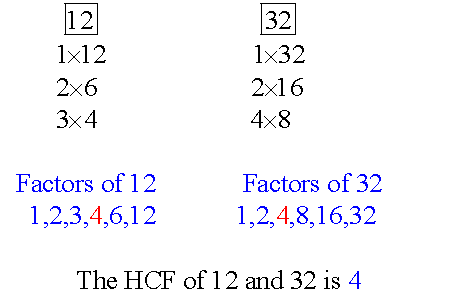
Alternatively,
\[ \begin{align*} 12 &= 2 \times 2 \times 3 \\ 32 &= 2 \times 2 \times 2 \times 2 \times 2 \end{align*} \] Common factors: \(2 \times 2\) \[ \text{HCF} = 4 \]Find the HCF of 45 and 27
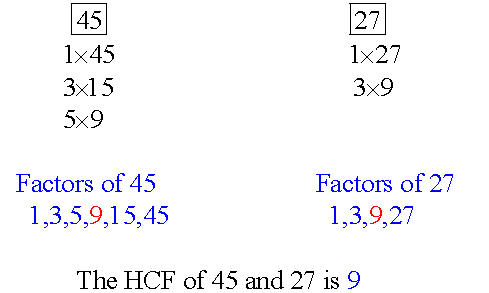
Alternatively,
Find the HCF of \(36x\) and \(12x^2\)
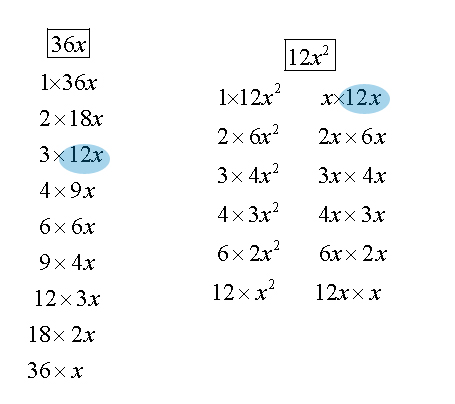
Alternatively,
Prime Factors
Prime numbers can only be divided exactly by themselves or 1.
First fifteen prime numbers:
2, 3, 5, 7, 11, 13, 17, 19, 23, 29, 31, 37, 41, 43, 47
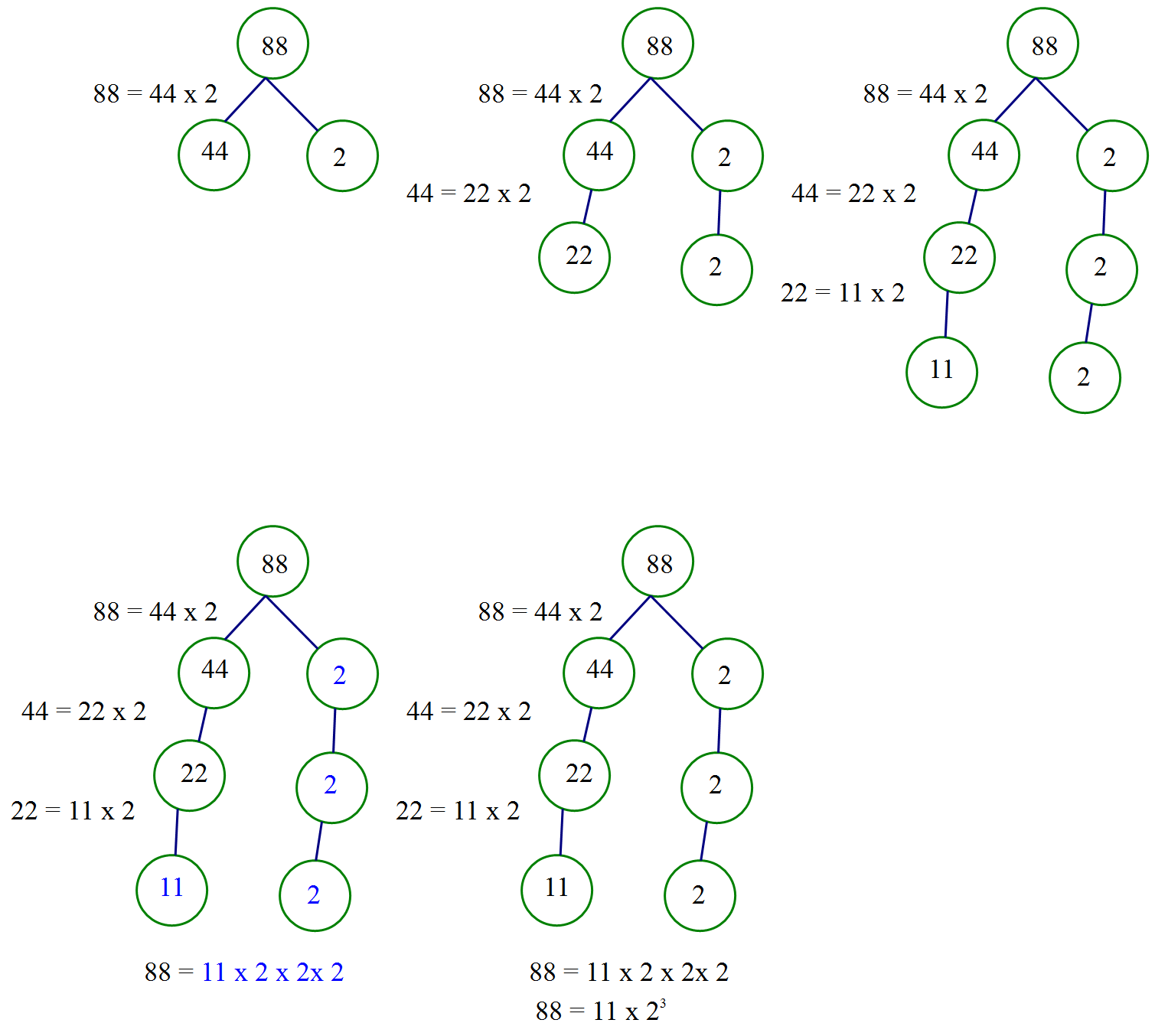
- Split the number using a prime factor.
- Continue until only primes remain.
- Write the result as a product of primes.
Write 88 as a product of its prime factors.
Multiples
A multiple of a number can be exactly divided by that number. Multiples can be thought of as “building blocks” made by the number.
Multiples of 5: 5, 10, 15, 20, …
Multiples of 12: 12, 24, 36, 48, …
Multiples of \(3x^2\): \(3x^2, 6x^2, 9x^2, 12x^2, …\)
Multiples of Fractions
- Multiples of \( \tfrac{1}{8} \): \( \tfrac{1}{8},\; \tfrac{2}{8},\; \tfrac{3}{8},\; \tfrac{4}{8},\; \tfrac{5}{8},\; \tfrac{6}{8},\; \tfrac{7}{8},\; \tfrac{8}{8},\; \tfrac{9}{8},\; \tfrac{10}{8} \)
- Multiples of \( \tfrac{1}{5} \): \( \tfrac{1}{5},\; \tfrac{2}{5},\; \tfrac{3}{5},\; \tfrac{4}{5},\; \tfrac{5}{5},\; \tfrac{6}{5},\; \tfrac{7}{5},\; \tfrac{8}{5},\; \tfrac{9}{5},\; \tfrac{10}{5} \)
- Multiples of \( \tfrac{1}{20} \): \( \tfrac{1}{20},\; \tfrac{2}{20},\; \tfrac{3}{20},\; \tfrac{4}{20},\; \tfrac{5}{20},\; \tfrac{6}{20},\; \tfrac{7}{20},\; \tfrac{8}{20},\; \tfrac{9}{20},\; \tfrac{10}{20} \)
Lowest Common Multiple (LCM)
The LCM of two or more numbers is the lowest number which is a multiple of all of them.
Find the LCM of 6 and 8
Multiples of 6: 6, 12, 18, 24, 30, 36, …
Multiples of 8: 8, 16, 24, 32, 40, …
The LCM is 24.
Mixing
HCF of Fractions
The HCF (Highest Common Factor) of fractions is found using the rule:
\( \text{HCF of fractions} = \dfrac{\text{HCF of numerators}}{\text{LCM of denominators}} \)
Steps
- Find the HCF of the numerators.
- Find the LCM of the denominators.
- Form a new fraction using: \( \dfrac{\text{HCF of numerators}}{\text{LCM of denominators}} \)
Example: Find the HCF of \( \tfrac{3}{4},\; \tfrac{4}{9},\; \tfrac{7}{12} \)
Step 1: HCF of numerators \( 3,\; 4,\; 7 \) is \( 1 \).
Step 2: LCM of denominators \( 4,\; 9,\; 12 \) is \( 36 \).
Step 3: Form the HCF:
\( \text{HCF} = \dfrac{1}{36} \)
Final Answer: \( \tfrac{1}{36} \)
Place in order, smallest first: \( \frac{7}{8} , \frac{4}{5} , \frac{11}{20} \)
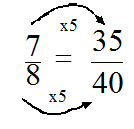
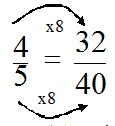
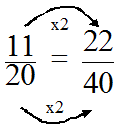
Solution:
Books
Printed resources available at Amazon
Multiples, Factors and Primes

Multiples, Factors and Primes (Look Ups)
Ideal as a reference for setting questions or checking answers in a home‑schooling environment.
- Listings of the first 100 multiples of the numbers from 0 to 50
- Listings of prime numbers below 10,000
- Listings of the factors of the numbers from 1 to 1200
As an Amazon Associate I earn from qualifying purchases.