Equivalent Fractions
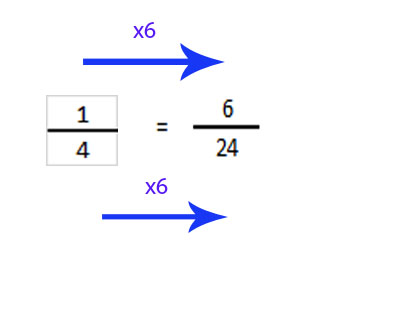
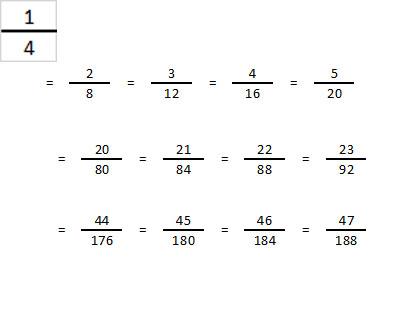
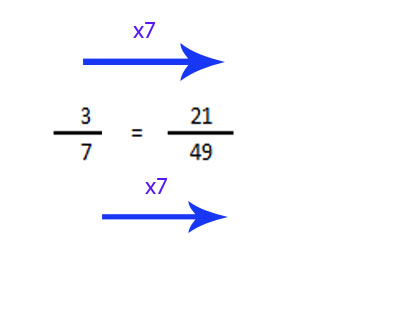
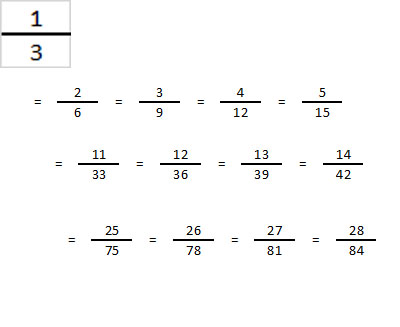
An equivalent fraction is found by scaling a fraction.
To do this, multiply the numerator and denominator by the same number.
Visual Fractions
These fractions all represent parts of a whole:
\[
\frac{1}{2},\ \frac{1}{4},\ \frac{1}{8},\ \frac{1}{16},\ \frac{1}{32},\ \frac{1}{64}
\]
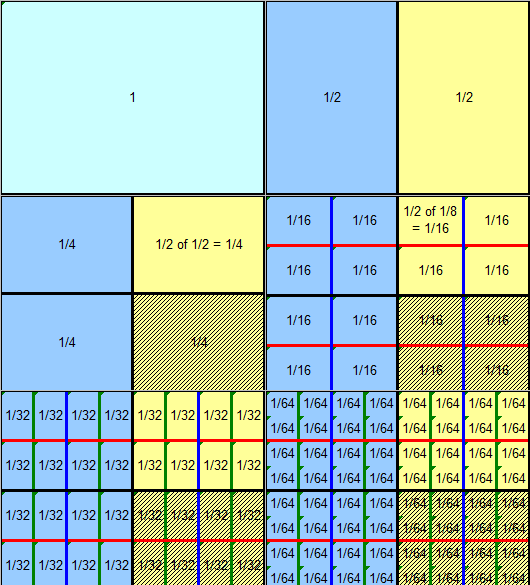
Cutting a whole into two equal parts gives two halves.
\[
\frac{1}{2} + \frac{1}{2} = 1 \text{ whole}
\]
\[
\text{so } 2 \times \frac{1}{2} = 1
\]
Cutting a whole into four equal parts gives four quarters.
\[
\frac{1}{4} + \frac{1}{4} + \frac{1}{4} + \frac{1}{4} = 1 \text{ whole}
\]
\[
\text{so } 4 \times \frac{1}{4} = 1
\]
Cutting a half into two equal parts gives two quarters.
\[
\frac{1}{4} + \frac{1}{4} = \frac{1}{2}
\]
\[
\text{so } \frac{2}{4} = \frac{1}{2}
\]
\[
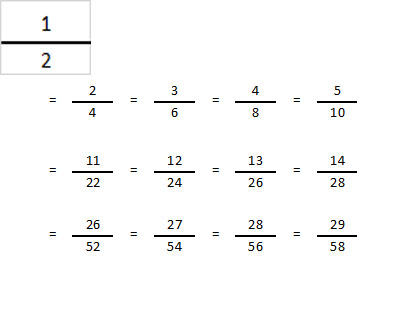
\frac{1}{2} = \frac{2}{4} = \frac{3}{6} = \frac{4}{8} = \frac{5}{10}
\]
Cutting a whole into eight equal parts gives eight eighths.
\[
8 \times \frac{1}{8} = 1
\]
These fractions are based on thirds:
\[
\frac{1}{3},\ \frac{1}{6},\ \frac{1}{9}
\]

These fractions are based on fifths:
\[
\frac{1}{5},\ \frac{1}{10},\ \frac{1}{20}
\]

Fractions Drill Questions
As an Amazon Associate I earn from qualifying purchases.