Removing Brackets
Everything inside the bracket must be multiplied by everything outside the bracket.
Examples
Single Brackets
\[
3(x + 4) = 3x + 12
\]
\[
5(2x - 7) = 10x - 35
\]
\[
-2(3x + 5) = -6x - 10
\]
\[
4(x - 9) = 4x - 36
\]
Pairs of Brackets
Example
Expand:
\[ (x+2)(x-4) \]Use distributive law:
\[ (x+2)(x-4) = x(x-4) + 2(x-4) \]Expand each part:
\[ x(x-4) = x^2 - 4x \] \[ 2(x-4) = 2x - 8 \]Combine and simplify:
\[ x^2 - 4x + 2x - 8 = x^2 - 2x - 8 \] General expansion:
\[
(a + b)(c + d) = ac + ad + bc + bd
\]
Is there an easier way?
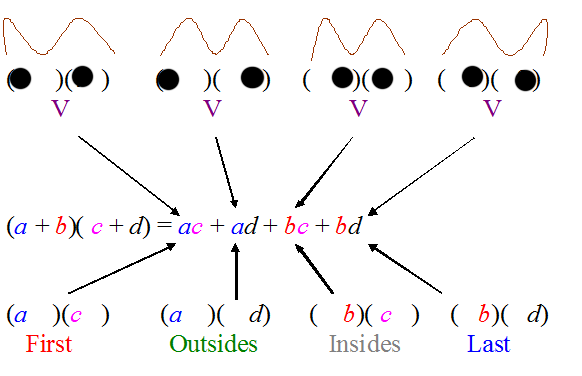
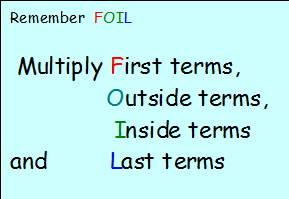
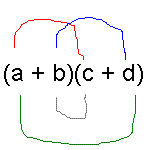
Example
\[
(x+3)(x+5)
\]
\[
\text{FOIL: First, Outer, Inner, Last}
\]
\[
= x\cdot x \;+\; x\cdot 5 \;+\; 3\cdot x \;+\; 3\cdot 5
\]
\[
= x^2 + 5x + 3x + 15
\]
\[
= x^2 + 8x + 15
\]
Example
\[
(2x - 7)(x + 4)
\]
\[
\text{FOIL: First, Outer, Inner, Last}
\]
\[
= (2x)(x) \;+\; (2x)(4) \;+\; (-7)(x) \;+\; (-7)(4)
\]
\[
= 2x^2 + 8x - 7x - 28
\]
\[
= 2x^2 + x - 28
\]
Trinomials
A trinomial is an algebraic expression made up of three terms, usually involving powers of a variable. When multiplying or expanding expressions, trinomials appear naturally — especially when you multiply a binomial by another binomial or when you expand something like or . To expand a trinomial, you multiply each term carefully and then collect like terms.
Example
Expand \( (x+2)(3x+2)^2 \)
\[ (x+2)(3x+2)^2 \] \[ = (x+2)(3x+2)(3x+2) \] \[ = (x+2)(3x^2 + 6x + 6x + 4) \] \[ = (x+2)(3x^2 + 12x + 4) \] \[ = x \times 3x^2 + x \times 12x + x \times 4 + 2 \times 3x^2 + 2 \times 12x + 2 \times 4 \] \[ = 3x^3 + 12x^2 + 4x + 6x^2 + 24x + 8 \] \[ = 3x^3 + 18x^2 + 28x + 8 \]General Result
Factorising
(Bringing back brackets)
Find the HCF and place it outside the brackets.
Examples
\[
12x + 18 = 6(2x + 3)
\]
\[
15x^2 - 10x = 5x(3x - 2)
\]
\[
21x^3 + 14x^2 = 7x^2(3x + 2)
\]
The Difference of Two Squares
\[
a^2 - b^2 = (a - b)(a + b)
\]
Examples
\[
x^2 - 25 = (x - 5)(x + 5)
\]
\[
4x^2 - 49 = (2x - 7)(2x + 7)
\]
\[
9a^2 - 16b^2 = (3a - 4b)(3a + 4b)
\]
\[
25x^2 - y^2 = (5x - y)(5x + y)
\]