Strategy for Factorising Quadratics
\(ax^2 + bx + c\)
- Write down the factor pairs of the coefficient of \(x^2\), a.
- Write down the factor pairs of the constant term, c.
- List all possible combinations of these factor pairs.
- Pick the correct combination by cross‑multiplying, adding, and comparing with the coefficient of \(x\), b.
- Read across to get the contents of the brackets.
- Check by expanding the brackets.
- Write out the final solution.
Worked Examples
Factorise \(x^2 + 4x + 3\)
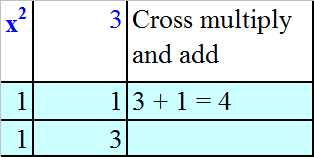
Read across: \((x + 1)(x + 3)\)
So \(x^2 + 4x + 3 = (x + 1)(x + 3)\)
Factorise \(x^2 + x - 6\)
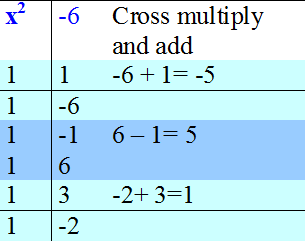
Read across: \((x - 2)(x + 3)\)
So \(x^2 + x - 6 = (x - 2)(x + 3)\)
Factorise \(x^2 - 3x - 10\)
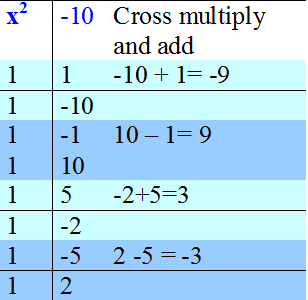
Read across \((x - 5)(x + 2)\)
So \(x^2 - 3x - 10 = (x - 5)(x + 2)\)
Factorise \(1 - x - 2x^2\)
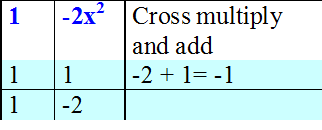
Read across \((1 + x)(1 - 2x)\)
So \(1 - x - 2x^2 = ((1 + x)(1 - 2x)\)
Factorise \(6x^2 + 23x + 10\)
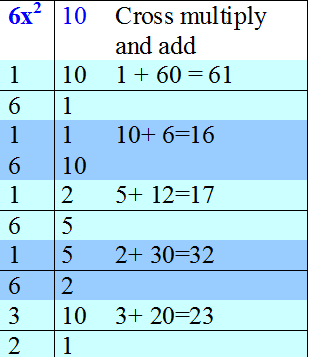
\((3x + 10)(2x + 1)\)
So \(6x^2 + 23x + 10 = (2x + 1)(3x + 10)\)
General Patterns
- \(ax^2 + bx + c\) factorises into the form \((\;\; + \;\;)(\;\; + \;\;)\)
- \(ax^2 - bx + c\) factorises into the form \((\;\; - \;\;)(\;\; - \;\;)\)
- \(ax^2 + bx - c\) factorises into the form \((\;\; - \;\;)(\;\; + \;\;)\)
- \(ax^2 - bx - c\) factorises into the form \((\;\; - \;\;)(\;\; + \;\;)\)
Alternative methodInteractive Quadratic Factoriser