Exponentials
What is an Exponential?
An exponential is a power, otherwise known as an index.
A base number \(a \) is raised to a power \(x \), the exponent.
\(5^3\) has base 5, exponent 3.
The inverse of an exponential function is the logarithmic function.
If \(y = a^x\), then \(x = \log_a y\).
Exponential Equations
To solve an exponential equation, take logs of both sides to the same base.
Scientific calculators usually have buttons for:
log (base 10) and ln (base \(e = 2.71828\ldots\)).
Method 1: Using Logarithms
\[ 4^x = 64 \] Take logs: \[ \log(4^x) = \log 64 \] Bring the power down: \[ x\log 4 = \log 64 \] Solve: \[ x = \frac{\log 64}{\log 4} \] Since \(64 = 4^3\): \[ x = 3 \]Solution: \(x = 3\).
Method 2: Without Logs
\[ 4^x = 64 \] Rewrite with base 2: \[ 4 = 2^2,\qquad 64 = 2^6 \] So: \[ 4^x = (2^2)^x = 2^{2x} \] The equation becomes: \[ 2^{2x} = 2^6 \] Equate indices: \[ 2x = 6 \] \[ x = 3 \]The Natural Base \(e\)
The natural base \(e\) uses Euler’s number \(e = 2.71828182\ldots\)
\(y = e^x\) has the special property:
The inverse of \(y = e^x\) is \(x = \ln y\).
Graphing Exponential and Logarithmic functions Excel – Exponential/log graphs
Growth Functions
A growth function is one where the output increases rapidly.
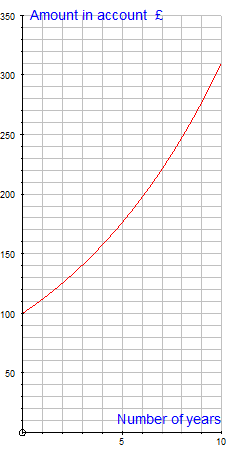
£100 is deposited at 12% per annum.
Show that \(A(n) = 100 \times 1.12^n\).
Then find the amount after 10 years.
Building the Compound Interest Formula
\[ A(0) = 100 = 100 \times 1.12^0 \] \[ A(1) = 100 \times 1.12 = 100 \times 1.12^1 \] \[ A(2) = (100 \times 1.12)\times 1.12 = 100 \times 1.12^2 \] \[ A(3) = (100 \times 1.12 \times 1.12)\times 1.12 = 100 \times 1.12^3 \] \[ A(n) = 100 \times 1.12 \times 1.12 \times \dots \times 1.12 \](with \(n\) factors of \(1.12\))
\[ A(n) = 100 \times 1.12^n \]Evaluating the Formula
\[ A(n) = 100 \cdot 1.12^n \]Find \(A(10)\):
\[ A(10) = 100 \cdot 1.12^{10} \] \[ = 100 \cdot 3.10584820834420916224 \] \[ = 310.584820834420916224 \] \[ \approx 310.58 \]There is £310.58 in the account after 10 years.
The account growth looks like this:
A factory targets 1.5% growth per year.
Production in 2003: 18000 units.
Production in 2005: 18515 units.
Was the target met?
Expected Output
\[ \text{Expected growth factor} = 1.015^2 = 1.030225 \] \[ \text{Expected production} = 18000 \cdot 1.030225 = 18544.05 \]Actual Output
\[ \text{Actual} = 18515 \]The actual production is slightly below the expected value.
Comparison & Conclusion
\[ 18515 \;\lt \; 18544.05 \]The expected output was not reached.
Target not met.
Decay Functions
A decay function is one where the output decreases rapidly.
12,000 gallons of oil are spilled.The clean up crew manage to clean 60 % of the oil each week.
a) How much oil is left after 1 week ?
b) How many weeks of cleaning are needed until only 10 gallons remain?
a)
Since 60% is cleaned each week, 40% of the oil is left
After 1 week of cleaning there is 4,800 gallons of oil left.
b)
\[ 12000 \cdot 0.4^t = 10 \]
Solution: \(t \approx 7.74\) weeks.
Half Life
The decay of a radioactive source is given by:
where N is the number of radioactive atoms present at time t , λ is the transformation decay constant and No is the original starting value.
The half-life of carbon-14 is 5,730 ± 40 years and is used for radio carbon dating
Find the decay constant \(\lambda\) of Carbon 14.
Log–Linear Graphs
Log scale on the y-axis only
If a graph has a logarithmic y-axis but an ordinary x-axis, then a straight line \(\log y = (\log b)x + \log a\) confirms a relationship of the form \(y = ab^x\).
If \(y = ab^x\) then \(\log y = \log a + x\log b\).
This is because of the log laws.
Compare with \(Y = mx + c\), where \(Y = \log y\), \(m = \log b\), \(c = \log a\).
Find the equation of the graph below in the form \(y = ab^x\).
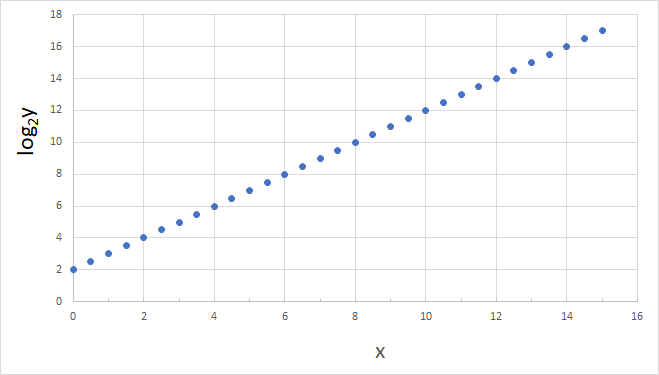
The points (0,2), (2,4), (6,8), (10,12) lie on this graph.
So \(c = 2\), \(m = 1\).
Thus, comparing with the straight‑line form
\[ \log_2 y = (\log_2 b)\,x + \log_2 a, \] we identify: \[ \log_2 b = m = 1 \] \[ b = 2^1 = 2 \]Likewise:
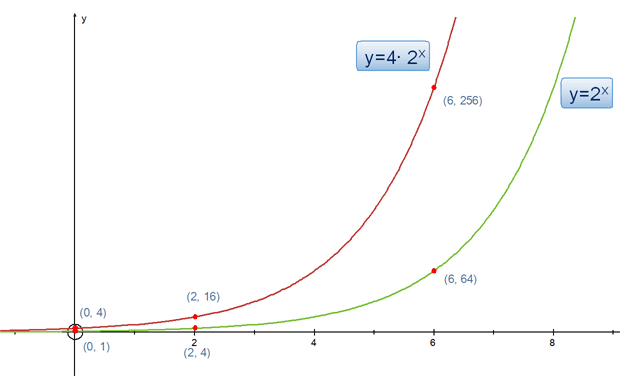
\[ \log_2 a = c = 2 \] \[ a = 2^2 = 4 \]Putting all together, a = 4, b = 2 so writing in the form y=abx the graph is
Comparing with y = 2x , it can be clearly seen that the graph has been scaled by a factor of 4 in the y direction.
Log–Log Graphs
Log scale on both axes
A straight line on a log–log graph satisfies \(\log y = b\log x + \log a\), which corresponds to \(y = ax^b\).
If \(y = ax^b\) then \(\log y = b\log x + \log a\).
This is because:
Compare with \(Y = mX + c\), where \(Y = \log y\), \(X = \log x\), \(m = b\), \(c = \log a\).
Show that the log–log graph below has equation:
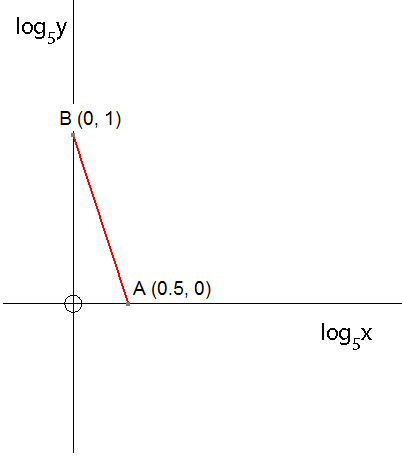
Gradient of BA:
Line cuts the x‑axis at \((0,1)\), so:
\[ c = 1 \]Graph is of the form \(Y = nX + c\), where \(Y = \log_5 y\), \(X = \log_5 x\), and \(c = \log_5 a\).
Books
Printed resources available at Amazon
Exponentials and Logarithms

Exponentials and Logarithms (Revision)
These notes are suitable as a revision aid for anyone studying exponentials and logarithms.
Topics include:
- Exponentials
- Growth functions
- Decay functions
- Graphs: log scale on Y‑axis only
- Graphs: log scale on both axes
- Logarithms
- Logarithmic equations
- Graphs of exponential and log functions
- Exponential functions
- Logarithmic functions
- Shifting log graphs
As an Amazon Associate I earn from qualifying purchases.