Logarithms
What is a Logarithm?
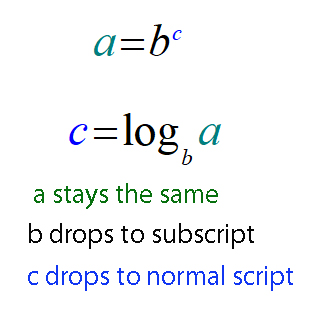
If \(a\), \(b\) and \(c\) are real numbers where \(a = b^c\) and \(b > 1\), then the power \(c\) is called the logarithm of the number \(a\) to the base \(b\), and \(c = \log_b a\).
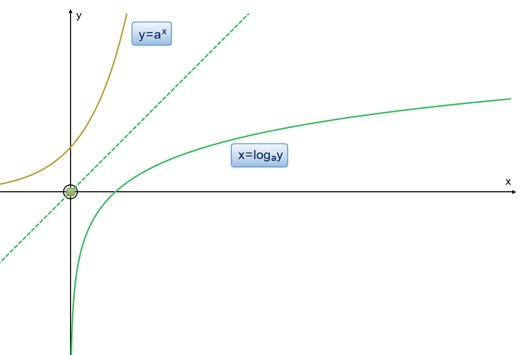
The exponential function \(f(x) = a^x\) has an inverse function \(f^{-1}(x) = \log_a x\), obtained by reflecting the graph in the line \(y = x\).
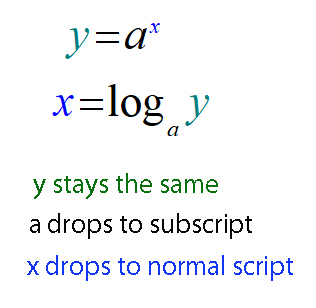
If \(y = a^x\), then \(x = \log_a y\).
Number Base Tables
Base 10
← Increasing Base 10 Decreasing →
| Thousands | Hundreds | Tens | Units | Tenths |
|---|---|---|---|---|
| 1000 | 100 | 10 | 1 | 0.1 |
| \(10^3\) | \(10^2\) | \(10^1\) | \(10^0\) | \(10^{-1}\) |
| \(1000 = 10^3\) | \(100 = 10^2\) | \(10 = 10^1\) | \(1 = 10^0\) | \(0.1 = 10^{-1}\) |
| \(3 = \log_{10} 1000\) | \(2 = \log_{10} 100\) | \(1 = \log_{10} 10\) | \(0 = \log_{10} 1\) | \(-1 = \log_{10} 0.1\) |
Base 2
← Increasing Base 2 Decreasing →
| Eights | Fours | Twos | Units | Halves |
|---|---|---|---|---|
| 8 | 4 | 2 | 1 | \(\tfrac{1}{2}\) |
| \(2^3\) | \(2^2\) | \(2^1\) | \(2^0\) | \(2^{-1}\) |
| \(8 = 2^3\) | \(4 = 2^2\) | \(2 = 2^1\) | \(1 = 2^0\) | \(\tfrac{1}{2} = 2^{-1}\) |
| \(3 = \log_2 8\) | \(2 = \log_2 4\) | \(1 = \log_2 2\) | \(0 = \log_2 1\) | \(-1 = \log_2 0.5\) |
Base 3
← Increasing Base 3 Decreasing →
| Twenty‑sevens | Nines | Threes | Units | Thirds |
|---|---|---|---|---|
| 27 | 9 | 3 | 1 | \(\tfrac{1}{3}\) |
| \(3^3\) | \(3^2\) | \(3^1\) | \(3^0\) | \(3^{-1}\) |
| \(27 = 3^3\) | \(9 = 3^2\) | \(3 = 3^1\) | \(1 = 3^0\) | \(\tfrac{1}{3} = 3^{-1}\) |
| \(3 = \log_3 27\) | \(2 = \log_3 9\) | \(1 = \log_3 3\) | \(0 = \log_3 1\) | \(-1 = \log_3 \tfrac{1}{3}\) |
Scientific calculators usually have buttons for:
Common logarithms: log (base 10)
Natural logarithms: ln (base \(e\))
Converting Between Bases
Proof
Let \[ a = b^{\,c} \qquad\text{and}\qquad x = a^{\,d}. \] Then \[ c = \log_{b} a \qquad\text{and}\qquad d = \log_{a} x. \] Now \[ x = a^{d} \] \[ x = (b^{c})^{d} \] \[ x = b^{cd} \] So \[ cd = \log_{b} x. \] Substitute \(c = \log_{b} a\) and \(d = \log_{a} x\): \[ (\log_{b} a)(\log_{a} x) = \log_{b} x. \] Therefore \[ \log_{a} x = \frac{\log_{b} x}{\log_{b} a}. \]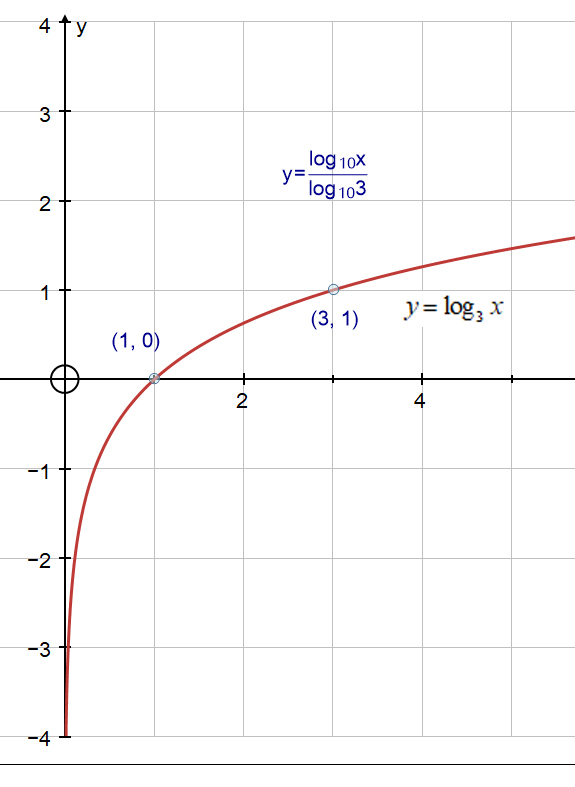
Evaluate \(\log_{3} 81\).
If a calculator is allowed:
Otherwise:
\[ \text{Let } x = \log_{3} 81 \] Then \[ 3^{x} = 81 \] \[ 3^{4} = 81 \quad\Rightarrow\quad \log_{3} 81 = 4 \]Note:
Log Laws

Rule 1
\[ \log_{a}(xy) = \log_{a} x + \log_{a} y \]Rule 2
\[ \log_{a}\!\left(\frac{x}{y}\right) = \log_{a} x - \log_{a} y \]Rule 3
\[ \log_{a}\!\left(x^{\,n}\right) = n\,\log_{a} x \]Rule 4
\[ \log_{a}\!\left(\frac{1}{x}\right) = -\log_{a} x \]Logarithmic Equations
Find the value of \(x\)
\[ \log_{a} 16 \;-\; 3\log_{a} x \;=\; \log_{a} 2 \] \[ \Rightarrow\; \log_{a} 16 \;-\; \log_{a}(x^{3}) = \log_{a} 2 \] \[ \Rightarrow\; \log_{a}\!\left(\frac{16}{x^{3}}\right) = \log_{a} 2 \] \[ \Rightarrow\; \frac{16}{x^{3}} = 2 \] \[ \Rightarrow\; 16 = 2x^{3} \] \[ \Rightarrow\; 8 = x^{3} \] \[ \Rightarrow\; x = \sqrt[3]{8} \] \[ \Rightarrow\; x = 2 \]Find the value of \(x\)
\[ \log_{9}(x-4)\;-\;\log_{9}(x-8)\;=\;\frac12 \] \[ \Rightarrow\; \log_{9}\!\left(\frac{x-4}{x-8}\right) =\frac12 \] \[ \Rightarrow\; \log_{9}\!\left(\frac{x-4}{x-8}\right) =\log_{9}\!\left(9^{1/2}\right) \] \[ \Rightarrow\; \log_{9}\!\left(\frac{x-4}{x-8}\right) =\log_{9}(3) \] \[ \Rightarrow\; \frac{x-4}{x-8}=3 \] \[ \Rightarrow\; x-4 = 3(x-8) \] \[ \Rightarrow\; x-4 = 3x - 24 \] \[ \Rightarrow\; 20 = 2x \] \[ \Rightarrow\; x = 10 \] \[ \Rightarrow\; 3(x-8) = x-4 \] \[ \Rightarrow\; 3x - 24 = x - 4 \] \[ \Rightarrow\; 2x = 20 \] \[ \Rightarrow\; x = 10 \]Find the value of \(x\)
\[ \log_{4} x \;+\; \log_{16} x = 15 \] \[ \log_{4} x \;+\; \frac{\log_{4} x}{\log_{4} 16} = 15 \] \[ \log_{4} x \;+\; \frac{\log_{4} x}{2} = 15 \] \[ \frac{3}{2}\,\log_{4} x = 15 \] \[ \log_{4} x = \frac{15 \cdot 2}{3} \] \[ \log_{4} x = 10 \] \[ x = 4^{10} \] \[ x = 1\,048\,576 \]Books
Printed resources available at Amazon
Exponentials and Logarithms

Exponentials and Logarithms (Revision)
These notes are suitable as a revision aid for anyone studying exponentials and logarithms.
Topics include:
- Exponentials
- Growth functions
- Decay functions
- Graphs: log scale on Y‑axis only
- Graphs: log scale on both axes
- Logarithms
- Logarithmic equations
- Graphs of exponential and log functions
- Exponential functions
- Logarithmic functions
- Shifting log graphs
As an Amazon Associate I earn from qualifying purchases.