Trigonometry with Bearings
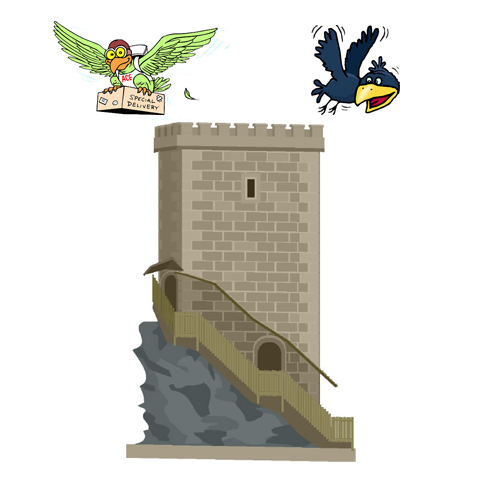
Carrier pigeons and crows are used to deliver communications from a base with co-ordinates (0,0)
Question 1
A carrier pigeon delivers a message to a fort which bears \(315^\circ\) from the base.
The pigeon flies at 50 km/h.
How far north and west of the base is the pigeon after 1 hour?
Give answers to 1 decimal place, then in rationalised surd form.
Sketch the journey :
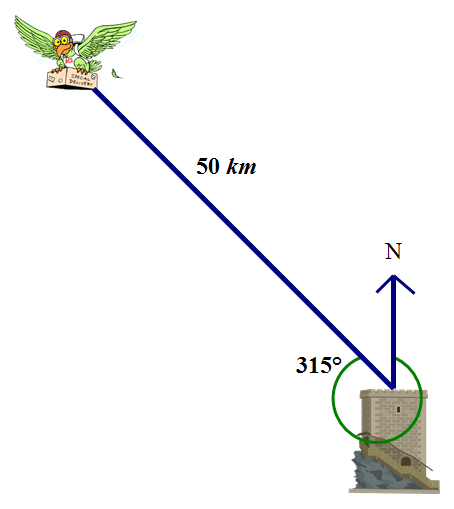
Split the bearing into known angles:
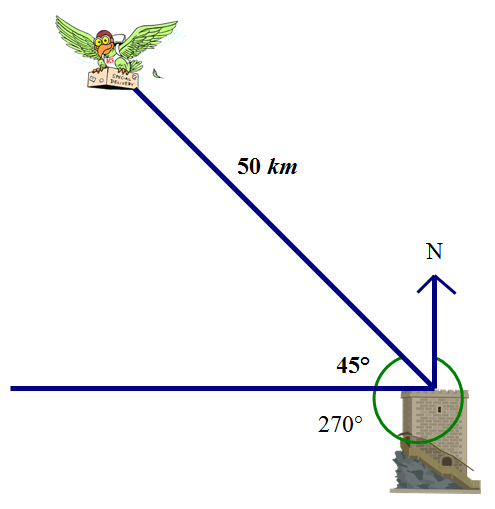
This gives a right‑angled triangle, so we can use simple trigonometry.
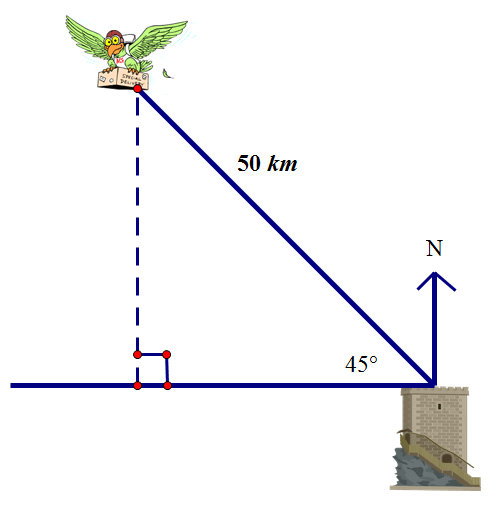
Now find the x and y components:
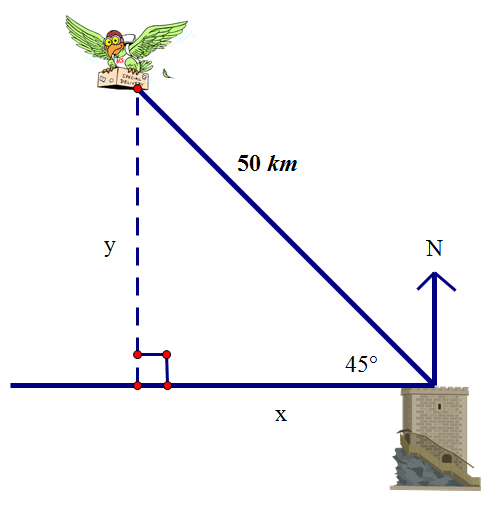
Northward distance
\[ \begin{alignedat}{2} \sin\theta &= \frac{\text{opposite}}{\text{hypotenuse}} \\[1.2em] \sin 45^\circ &= \frac{y}{50} \\[1.2em] 50\sin 45^\circ &= y \\[1.2em] y &= 35.355 \\[1.2em] y &= 35.4\ \text{km (1 d.p.)} \end{alignedat} \]
Using exact values:
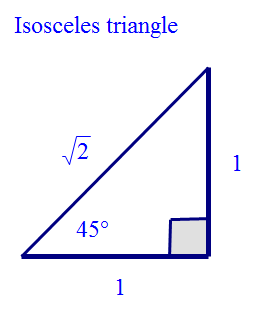
\[ \begin{alignedat}{2} \sin\theta &= \frac{\text{opposite}}{\text{hypotenuse}} \\[1.4em] \sin 45^\circ &= \frac{1}{\sqrt{2}} \\[1.4em] \sin 45^\circ &= \frac{1}{\sqrt{2}} \times \frac{\sqrt{2}}{\sqrt{2}} = \frac{\sqrt{2}}{2} \end{alignedat} \]
\[ \begin{alignedat}{2} \cos\theta &= \frac{\text{adjacent}}{\text{hypotenuse}} \\[1.4em] \cos 45^\circ &= \frac{1}{\sqrt{2}} \\[1.4em] \cos 45^\circ &= \frac{1}{\sqrt{2}} \times \frac{\sqrt{2}}{\sqrt{2}} = \frac{\sqrt{2}}{2} \end{alignedat} \]
Westward distance
\[ \begin{alignedat}{2} \cos\theta &= \frac{\text{adjacent}}{\text{hypotenuse}} \\[1.2em] \cos 45^\circ &= \frac{x}{50} \\[1.2em] 50\cos 45^\circ &= x \\[1.2em] x &= 35.355 \\[1.2em] x &= 35.4\ \text{km (1 d.p.)} \end{alignedat} \]
After 1 hour , the pigeon is 35.4 km , \( 25\sqrt{2} \text{km} \) North and 35.4 km ,\( 25\sqrt{2} \text{km} \) , West of the base.
Question 2
Write down the exact co‑ordinates of the pigeon, given that the base has co‑ordinates \((0,0)\).
Note that the x‑coordinate is negative, since the pigeon is west of the origin.
Co‑ordinates of pigeon are \[ (-25\sqrt{2},\; 25\sqrt{2}) \]
Question 3
A crow delivers a message to a fort which bears \(135^\circ\) from the same base.
The crow flies at 100 km/h.
How far south and east of the base is the crow after 1 hour?
Give answers to 1 decimal place, then in rationalised surd form.
Sketch the journey :
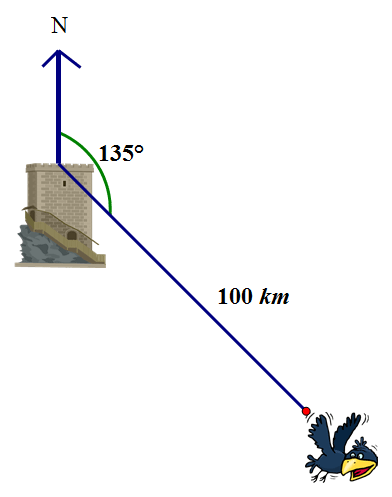
Split the bearing into known angles:
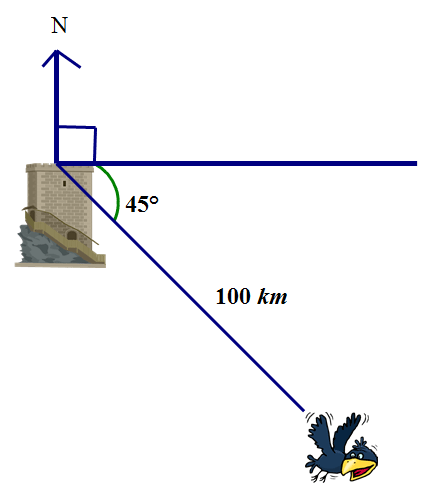
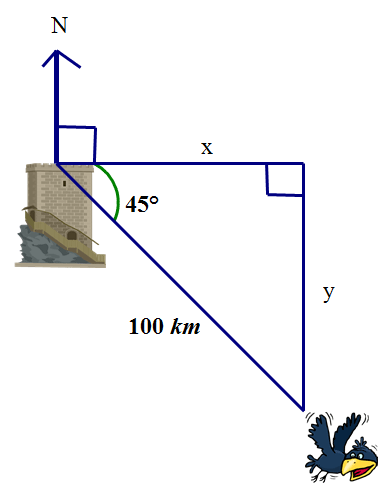
Southward distance
\[ \begin{alignedat}{2} \sin\theta &= \frac{\text{opposite}}{\text{hypotenuse}} \\[1.4em] \sin 45^\circ &= \frac{y}{100} \\[1.4em] 100\sin 45^\circ &= y \\[1.2em] y &= 70.7106 \\[1.2em] y &= 70.7\ \text{km (1 d.p.)} \end{alignedat} \]
Or in rationalised surd form:
Eastward distance
\[ \begin{alignedat}{2} \cos\theta &= \frac{\text{adjacent}}{\text{hypotenuse}} \\[1.4em] \cos 45^\circ &= \frac{x}{100} \\[1.4em] 100\cos 45^\circ &=x \\[1.2em] x &= 70.7106 \\[1.2em] x &= 70.7\ \text{km (1 d.p.)} \end{alignedat} \]
Or in rationalised surd form:
After 1 hour , the crow is 70.7 km , \( 50\sqrt{2} \text{km} \) South and 70.7 km ,\( 50\sqrt{2} \text{km} \) , East of the base.
Question 4
Write down the exact co‑ordinates of the crow, given that the base has co‑ordinates \((0,0)\).
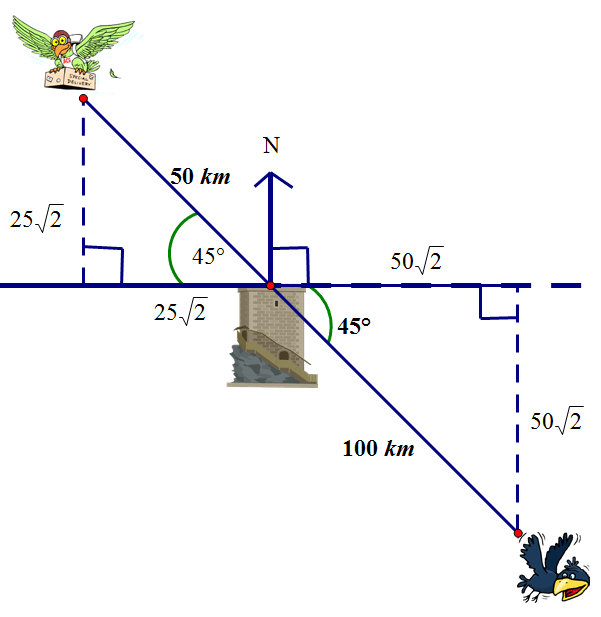
Note that the y‑coordinate is negative, since the crow is south of the origin.
Notice that the two bearings form vertically opposite angles
Using vectors
Question 5
Another pigeon leaves the base and flies for \(2\frac{1}{2}\) hours at 50 km/h on a bearing of \(075^\circ\).
How far is the pigeon from the crow?
Give your answers to 1 decimal place, and then in rationalised surd form.
First, calculate how far the pigeon travels
\[ \begin{alignedat}{2} d &= st \\[1.2em] &= 50\ \text{km/h} \times 2.5\ \text{h} \\[1.2em] &= 125\ \text{km} \end{alignedat} \]
Remember that bearings are measured clockwise from North!
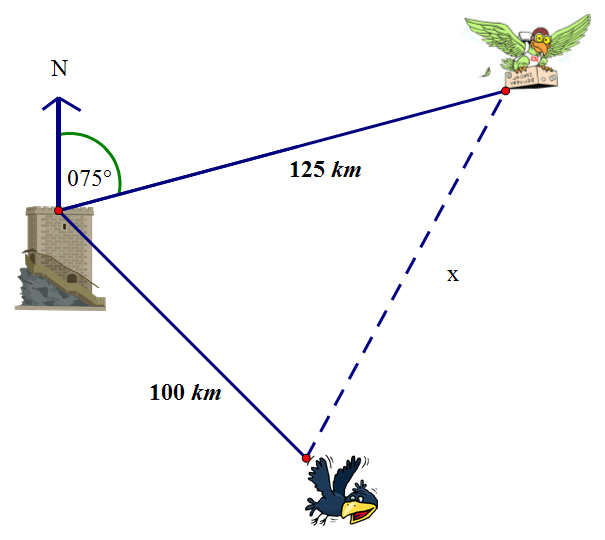
Split the bearing into known angles:
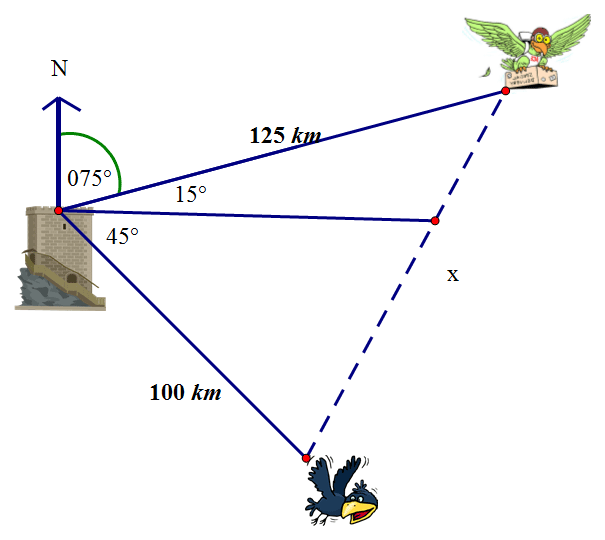
Which leaves:
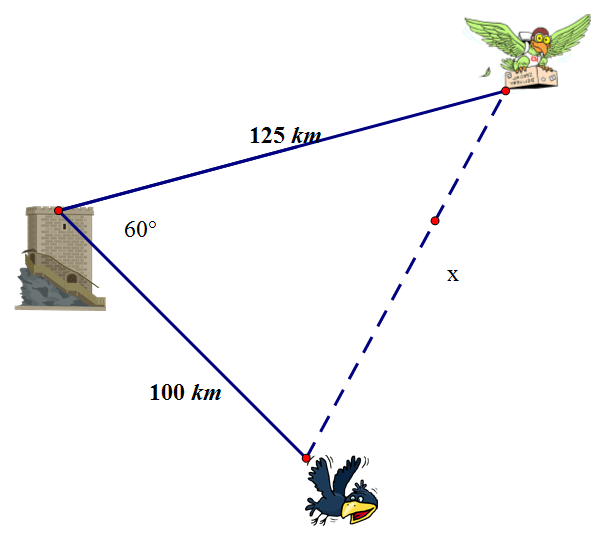
Since there are no right angles available, it is necessary to use either the Sine Rule or the Cosine Rule.
But which one is needed?
Here, two sides and an included angle (SAS) are known.
Use the Cosine Rule.
\[ \begin{alignedat}{2} a^{2} &= b^{2} + c^{2} - 2bc\cos A \\[1.4em] a^{2} &= 100^{2} + 125^{2} - 2 \times 100 \times 125 \times \cos 60^\circ \\[1.4em] a^{2} &= 10000 + 15625 - 12500 \\[1.2em] a^{2} &= 13125 \\[1.2em] a &= \sqrt{13125} \\[1.2em] a &= 114.564 \\[1.2em] a &= 114.6\ \text{km (1 d.p.)} \end{alignedat} \]
And in rationalised surd form:
\[ \begin{alignedat}{2} a^{2} &= b^{2} + c^{2} - 2bc\cos A \\[1.4em] a^{2} &= 100^{2} + 125^{2} - 2 \times 100 \times 125 \times \cos 60^\circ \\[1.4em] a^{2} &= 10000 + 15625 - 25000 \times \frac{1}{2} \\[1.2em] a^{2} &= 25625 - 12500 \\[1.2em] a^{2} &= 13125 \\[1.4em] a &= \sqrt{13125} \\[1.2em] a &= \sqrt{625 \times 21} \\[1.2em] a &= \sqrt{625}\,\sqrt{21} \\[1.2em] a &= 25\sqrt{21}\ \text{km} \end{alignedat} \]
After 2 1/2 hours , the second pigeon is 114.6 km , \( 25\sqrt{21} \text{km} \) from the crow.
Question 6
What are the co‑ordinates of the pigeon, correct to 1 decimal place, given that the base has co‑ordinates \((0,0)\)?
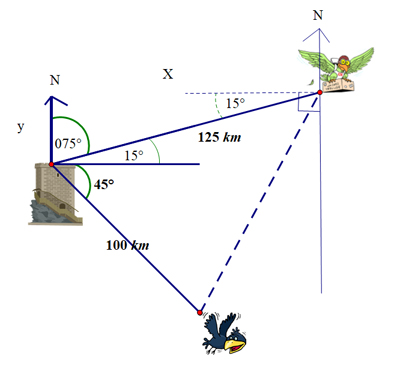
The co‑ordinates of the second pigeon (to 1 d.p.) are:
\[ (120.7, 32.4) \]Question 7
What bearing does the pigeon need to fly to reach the crow?
Give your answer correct to 1 decimal place.
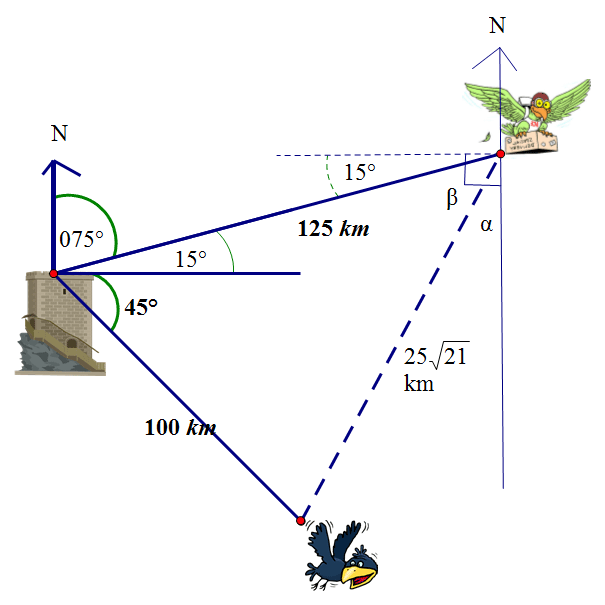
The bearing will be \(180^\circ + \alpha^\circ\), where:
Use the second form of the Cosine Rule to find \(\beta^\circ\):
\[ \begin{alignedat}{2} \cos A &= \frac{c^{2} + b^{2} - a^{2}}{2bc} \\[1.4em] \cos \alpha &= \frac{125^{2} + (25\sqrt{21})^{2} - 100^{2}} {2 \times 125 \times 25\sqrt{21}} \\[1.4em] \cos \alpha &= \frac{15625 + 13125 - 10000}{6250\sqrt{21}} \\[1.4em] \cos \alpha &= \frac{18750}{6250\sqrt{21}} \\[1.4em] \alpha &= \cos^{-1}\!\left( \frac{18750}{6250\sqrt{21}} \right) \\[1.4em] \alpha &= 49.106^\circ \\[1.2em] \alpha &= 49.1^\circ\ \text{(1 d.p.)} \end{alignedat} \]
Giving:
So the bearing is:
The pigeon must fly on a bearing of 205.9 degrees.
Alternatively, examining co-ordinates
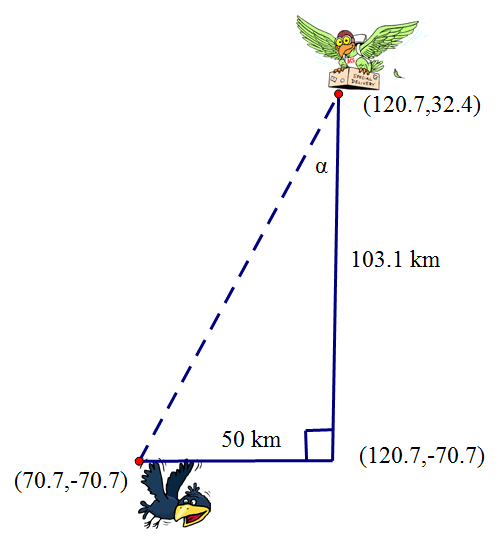
The bearing will be \(180^\circ + \alpha^\circ\).
\[ \begin{alignedat}{2} \tan\alpha &= \frac{\text{opposite}}{\text{adjacent}} \\[1.2em] \tan\alpha &= \frac{50}{103.1} \\[1.2em] \alpha &= \tan^{-1}\!\left(\frac{50}{103.1}\right)^\circ \\[1.2em] \alpha &= 25.8718^\circ \\[1.2em] \alpha &= 25.9^\circ\ \text{(1 d.p.)} \end{alignedat} \]
So the bearing is:
Using Vectors
Question 4 above required the exact co‑ordinates of the crow, given that the base has co‑ordinates \((0,0)\).
This can be demonstrated using the section formula:
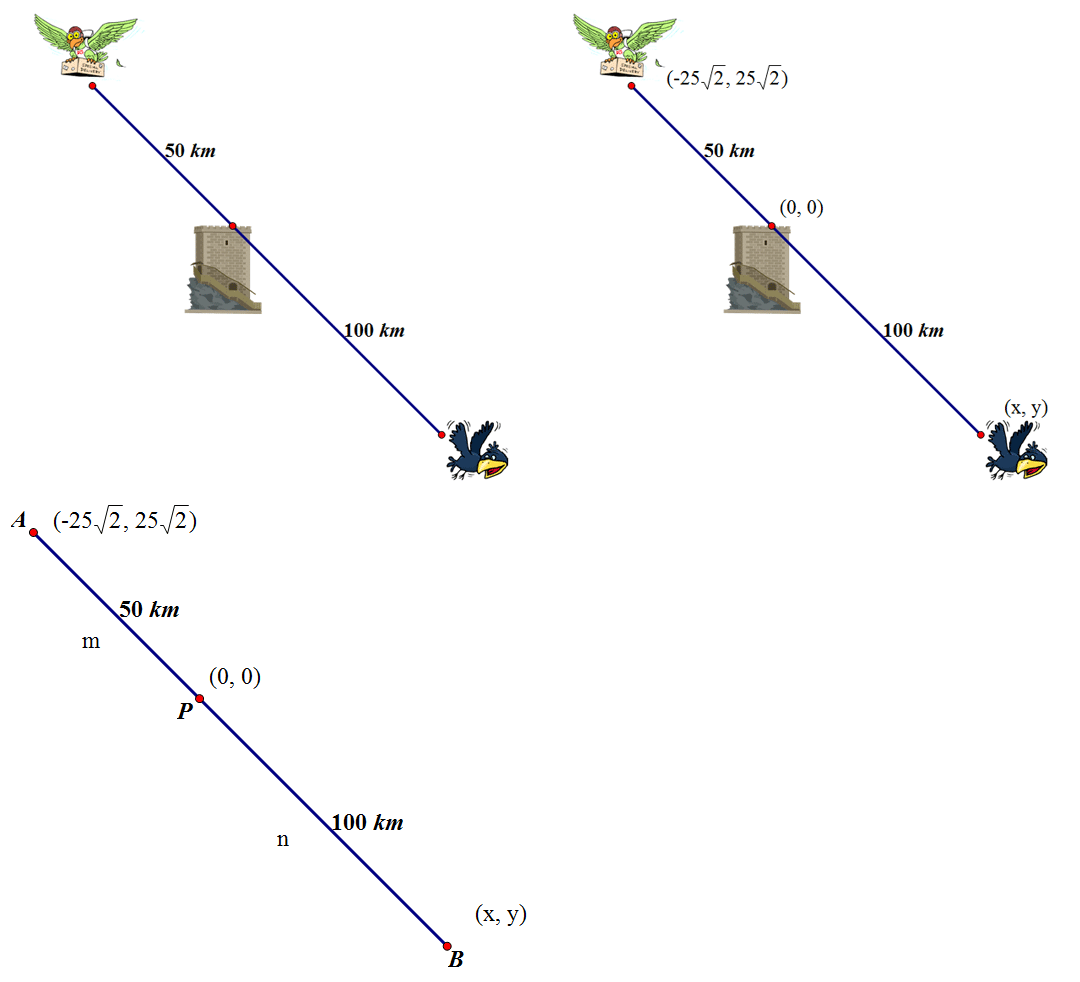
\[ \begin{alignedat}{2} \mathbf{p} &= \frac{n}{m+n}\,\mathbf{a} \;+\; \frac{m}{m+n}\,\mathbf{b} \\[1.4em] \mathbf{p} &= \frac{2}{3}\,\mathbf{a} \;+\; \frac{1}{3}\,\mathbf{b} \\[1.4em] 3\mathbf{p} &= 2\mathbf{a} + \mathbf{b} \\[1.2em] 3\mathbf{p} - 2\mathbf{a} &= \mathbf{b} \\[1.4em] \mathbf{b} &= 3 \begin{pmatrix} 0 \\[0.4em] 0 \end{pmatrix} \;-\; 2 \begin{pmatrix} -25\sqrt{2} \\[0.4em] 25\sqrt{2} \end{pmatrix} \\[1.4em] \mathbf{b} &= \begin{pmatrix} 50\sqrt{2} \\[0.4em] -50\sqrt{2} \end{pmatrix} \\[1.4em] \text{co-ordinates are }\; \left( 50\sqrt{2},\; -50\sqrt{2} \right) \end{alignedat} \]