Indices are sometimes called powers or exponents.
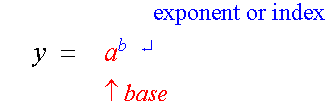
For example, if \(y = 4^2\), then 4 is the base and the power, or index, is 2.
In algebra and higher mathematics, multiplication is sometimes written using a dot:
\(
a \cdot b
\)
instead of the × symbol.
This avoids confusion with the letter \( x \) and keeps expressions clear, especially when variables are involved.
For example:
\[
3 \cdot x \quad \text{is preferred over} \quad 3 \times x
\]
because the × symbol can be mistaken for the variable \( x \).
When numbers and variables are next to each other, the dot is often omitted entirely:
\[
3x = 3 \cdot x
\]
\[
4^2 = 4 \cdot 4 = 16
\]
\[
a^n = \underbrace{a \cdot a \cdot a \cdots a}_{n\ \text{factors}}
\]
Indices obey the following laws.
Rule 1
Rule 1: Product of Powers
\[
a^m \cdot a^n = a^{m+n}
\]
Example
\[
3^2 \cdot 3^4 = 3^{2+4} = 3^6
\]
Rule 2: Quotient of Powers
\[
\frac{a^m}{a^n} = a^{m-n}, \quad a \ne 0
\]
Example
\[
\frac{5^7}{5^3} = 5^{7-3} = 5^4
\]
Rule 3: Power of a Power
\[
(a^m)^n = a^{mn}
\]
Example
\[
(2^3)^4 = 2^{3\cdot4} = 2^{12}
\]
Rule 4: Power of a Product
\[
(a \cdot b)^n = a^n b^n
\]
Example
\[
(2\cdot5)^3 = 2^3 \cdot 5^3 = 8 \cdot 125 = 1000
\]
Rule 5: Power of a Fraction
\[
\left(\frac{a}{b}\right)^n = \frac{a^n}{b^n}, \quad b \ne 0
\]
Example
\[
\left(\frac{3}{4}\right)^2 = \frac{3^2}{4^2} = \frac{9}{16}
\]
Rule 6: Zero Exponent
\[
a^m \cdot a^0 = a^{m+0} = a^m
\]
So \(a^0\) must equal the multiplicative identity.
Conclusion
\[
a^0 = 1 \quad (a \ne 0)
\]
Rule 7: Negative Exponent
\[
a^{-n} = \frac{1}{a^n}, \quad a \ne 0
\]
Follows from the quotient rule:
\[
a^{-n} = a^{0-n} = \frac{a^0}{a^n}
\]
Example
\[
5^{-3} = \frac{1}{5^3} = \frac{1}{125}
\]
Common Mistake
\[
3^2 \times 5^6 \;\ne 15^8
\]
This is incorrect because the rule
\[
(a \cdot b)^n = a^n b^n
\]
only works when the exponents are the same.
Check the values
\[
3^2 \times 5^6 = 140{,}625
\]
\[
15^8 = 25{,}628{,}906{,}25
\]
Conclusion:
The expressions are not equal because the exponents differ.
Examples
\[
x^3 \cdot x^5 = x^{3+5} = x^8
\]
\[
\frac{y^7}{y^2} = y^{7-2} = y^5
\]
\[
(3x^2)^3 = 3^3 \cdot x^{2 \cdot 3} = 27x^6
\]
\[
\left(\frac{2a^3}{b}\right)^2 = \frac{2^2 \cdot a^6}{b^2} = \frac{4a^6}{b^2}
\]
Remember
Basic Powers
\[
x^0 = 1
\]
\[
x^1 = x
\]
\[
x^2 = x \cdot x
\]
\[
x^3 = x \cdot x \cdot x
\]
Negative Powers
\[
x^{-1} = \frac{1}{x}
\]
\[
x^{-2} = \frac{1}{x^2}
\]
\[
x^{-3} = \frac{1}{x^3}
\]
\[
x^{-\frac{a}{b}} = \frac{1}{\sqrt[b]{x^a}}
\]
Fractional Powers
\[
x^{\frac12} = \sqrt{x}
\]
\[
x^{\frac13} = \sqrt[3]{x}
\]
\[
x^{\frac14} = \sqrt[4]{x}
\]
\[
x^{\frac{2}{3}} = \sqrt[3]{x^2}
\]
\[
x^{\frac{7}{4}} = \sqrt[4]{x^7}
\]
\[
x^{\frac{a}{b}} = \sqrt[b]{x^a}
\]
Negative Fractional Powers
\[
x^{-\frac12} = \frac{1}{\sqrt{x}}
\]
\[
x^{-\frac13} = \frac{1}{\sqrt[3]{x}}
\]
\[
x^{-\frac14} = \frac{1}{\sqrt[4]{x}}
\]
\[
x^{-\frac{2}{3}} = \frac{1}{\sqrt[3]{x^2}}
\]
\[
x^{-\frac{7}{4}} = \frac{1}{\sqrt[4]{x^7}}
\]
\[
x^{-\frac{a}{b}} = \frac{1}{\sqrt[b]{x^a}}
\]
A surd is an expression involving unresolved roots of numbers.
\[
\sqrt{2},\quad \sqrt{3},\quad \sqrt{5},\quad \sqrt[3]{7}
\]
To simplify surds, split the number into factors involving square numbers.
Examples
\[
\sqrt{12} = \sqrt{4 \cdot 3} = \sqrt{4} \cdot \sqrt{3} = 2\sqrt{3}
\]
\[
\sqrt{75} = \sqrt{25 \cdot 3} = 5\sqrt{3}
\]
Rule 1
\[
\sqrt{a}\,\cdot\,\sqrt{b} = \sqrt{ab}, \quad a,b \ge 0
\]
Example
\[
\sqrt{3}\,\cdot\,\sqrt{12} = \sqrt{36} = 6
\]
Rule 2
\[
\frac{\sqrt{a}}{\sqrt{b}} = \sqrt{\frac{a}{b}}, \quad b>0
\]
Example
\[
\frac{\sqrt{8}}{\sqrt{2}} = \sqrt{\frac{8}{2}} = \sqrt{4} = 2
\]
Rule 3
\[
k\sqrt{a} + m\sqrt{a} = (k+m)\sqrt{a}
\]
Example
\[
3\sqrt{5} + 2\sqrt{5} = 5\sqrt{5}
\]
Rule 4
\[
\sqrt{a}(\sqrt{a} + \sqrt{b}) = a + \sqrt{ab}
\]
Example
\[
\sqrt{3}(\sqrt{3} + \sqrt{2}) = 3 + \sqrt{6}
\]
Rule 5
\[
\frac{1}{\sqrt{a}} = \frac{\sqrt{a}}{a}, \quad a>0
\]
Rationalising removes the square root from the denominator.
Examples
\[
\frac{1}{\sqrt{3}} = \frac{\sqrt{3}}{3}
\]
\[
\frac{5}{2\sqrt{7}}
= \frac{5}{2\sqrt{7}} \cdot \frac{\sqrt{7}}{\sqrt{7}}
= \frac{5\sqrt{7}}{14}
\]
Rule 6
\[
\frac{1}{a + \sqrt{b}}
= \frac{a - \sqrt{b}}{a^2 - b}
\]
Example
\[
\frac{1}{3 + \sqrt{5}}
= \frac{3 - \sqrt{5}}{(3+\sqrt{5})(3-\sqrt{5})}
= \frac{3 - \sqrt{5}}{9 - 5}
= \frac{3 - \sqrt{5}}{4}
\]
Surds test
Surds are useful when finding exact values.
Example
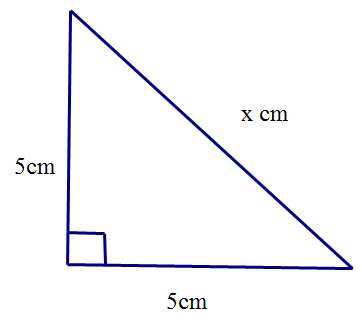
Calculate the exact value of the side marked \(x\) in the following triangle:
By Pythagoras
\[
x^2 = 5^2 + 5^2 = 25 + 25 = 50
\]
\[
x = \sqrt{50} = \sqrt{25 \cdot 2} = 5\sqrt{2}
\]
Example
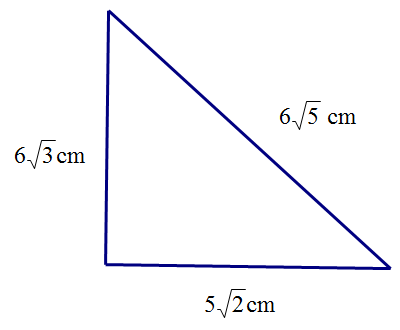
Is the following triangle a right-angled triangle? Justify your answer.
Converse of Pythagoras Check
\[
(\text{hypotenuse})^2 = (6\sqrt{5})^2
\]
\[
= 36 \cdot 5 = 180
\]
\[
(\text{short side})^2 + (\text{other side})^2
\]
\[
= (5\sqrt{2})^2 + (6\sqrt{3})^2
\]
\[
= 25\cdot 2 + 36\cdot 3
\]
\[
= 50 + 108 = 158
\]
\[
180 \ne 158
\]
The two values do not match, so by the converse of Pythagoras the triangle is not right‑angled.
Example
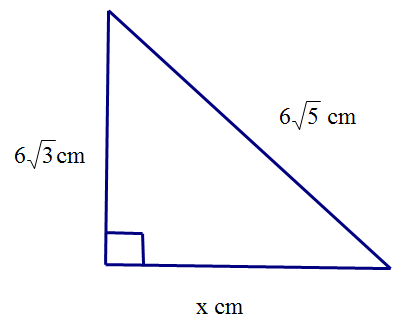
Calculate the exact value of the area of the following triangle. Give your answer in its simplest form.
This requires the base, \(x\) cm, to be found.
Finding the Unknown Side
\[
(6\sqrt{5})^2 = x^2 + (6\sqrt{3})^2
\]
\[
x^2 = (6\sqrt{5})^2 - (6\sqrt{3})^2
\]
\[
= 36\cdot5 \;-\; 36\cdot3
\]
\[
= 180 - 108 = 72
\]
\[
x = \sqrt{72}
\]
\[
= \sqrt{9 \cdot 8}
\]
\[
= \sqrt{9 \cdot 4 \cdot 2}
\]
\[
= 3 \cdot 2 \cdot \sqrt{2}
\]
\[
= 6\sqrt{2}
\]
Area of the Triangle
\[
\text{Area} = \frac12 \times \text{base} \times \text{perpendicular height}
\]
\[
= \frac12 \times 6\sqrt{2} \times 6\sqrt{3}
\]
\[
= \frac12 \times 6 \times 6 \times \sqrt{2\cdot3}
\]
\[
= \frac12 \times 36 \sqrt{6}
\]
\[
= 18\sqrt{6}\ \text{cm}^2
\]
Surds Simplifier