Trigonometry is the study of triangles.
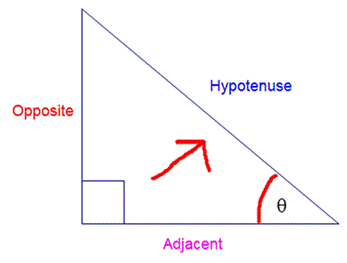
The sides of any right‑angled triangle can be labelled:
- Hypotenuse — always opposite the right angle; the longest side
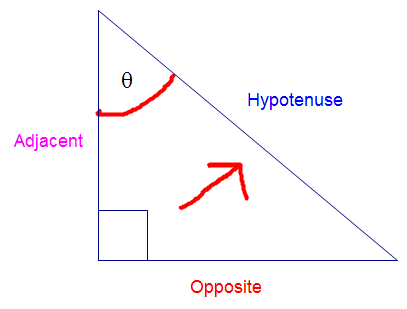
- Adjacent — the side next to the angle being used
- Opposite — the side directly across from the angle being used
Or from the top angle:
Trigonometric Ratios
The ratios of these sides are given special names:
- sine
- cosine
- tangent
These are shortened to sin, cos and tan.
\[ \begin{alignedat}{2} \sin\theta &= \frac{\text{Opposite}}{\text{Hypotenuse}} \qquad\text{remembered as } S\frac{O}{H}\text{ or SOH} \\[1.4em] \cos\theta &= \frac{\text{Adjacent}}{\text{Hypotenuse}} \qquad\text{remembered as } C\frac{A}{H}\text{ or CAH} \\[1.4em] \tan\theta &= \frac{\text{Opposite}}{\text{Adjacent}} \qquad\text{remembered as } T\frac{O}{A}\text{ or TOA} \end{alignedat} \]
Recipe for solving trig problems:
- Sketch the triangle
- Mark the right angle
- Identify the angle to be used or found
- Label Opposite, Adjacent and Hypotenuse
- Choose the correct ratio
- Write down the solution
Always draw a sketch.
Using Sine to Find a Side
A right-angled triangle is shown. Find x, the length of the side GO.
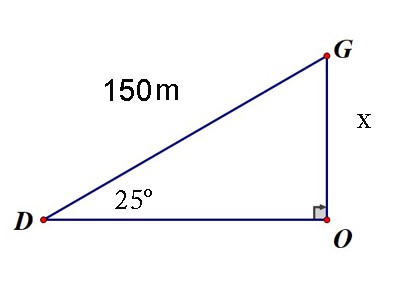
Draw a sketch
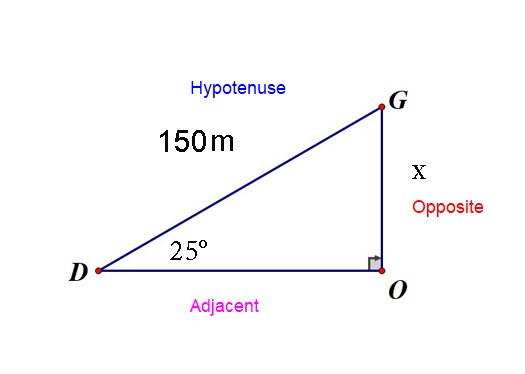
The length of side GO is 63.4 m long . (1 dp)
A right-angled triangle is shown. Find x, the length of the side DG.
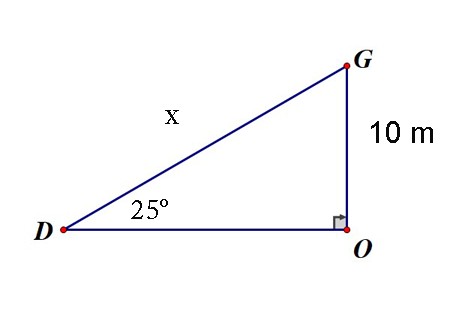
Draw a sketch
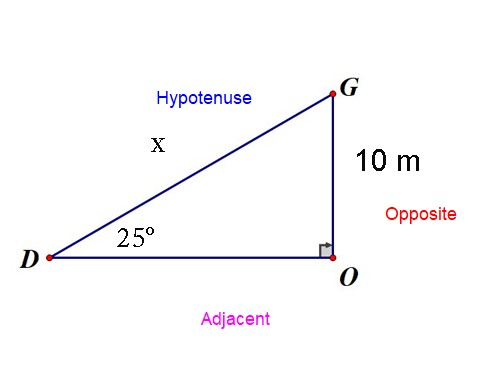
The length of side DG is 23.7 m long . (1 dp)
Using Sine to Find an Angle
A right-angled triangle is shown. Find angle θ degrees.
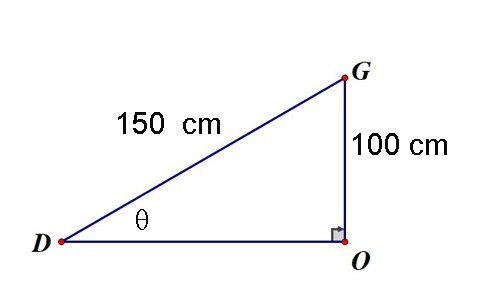
Draw a sketch
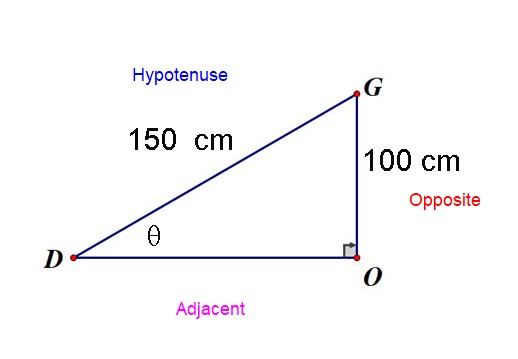 \[
\sin\theta = \frac{\text{Opposite}}{\text{Hypotenuse}}
\]
\[
\sin\theta = \frac{100}{150}
\]
\[
\text{Make sure your calculator is in Degrees mode}
\]
\[
\theta = \sin^{-1}\!\left(\frac{100}{150}\right)
\]
\[
\text{(This is SHIFT–SIN or 2nd–function–SIN on your calculator)}
\]
\[
\theta = 41.8103^\circ
\]
\[
\sin\theta = \frac{\text{Opposite}}{\text{Hypotenuse}}
\]
\[
\sin\theta = \frac{100}{150}
\]
\[
\text{Make sure your calculator is in Degrees mode}
\]
\[
\theta = \sin^{-1}\!\left(\frac{100}{150}\right)
\]
\[
\text{(This is SHIFT–SIN or 2nd–function–SIN on your calculator)}
\]
\[
\theta = 41.8103^\circ
\]
The angle is \(41.8^\circ\) (1dp).
Using Cos to Find a Side
A right-angled triangle is shown. Find x, the length of the side DO.
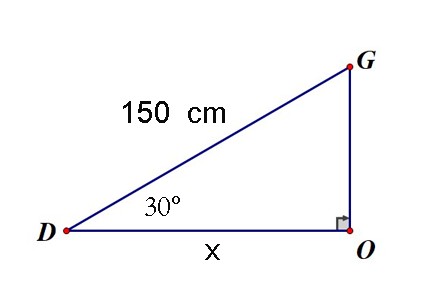
Draw a sketch
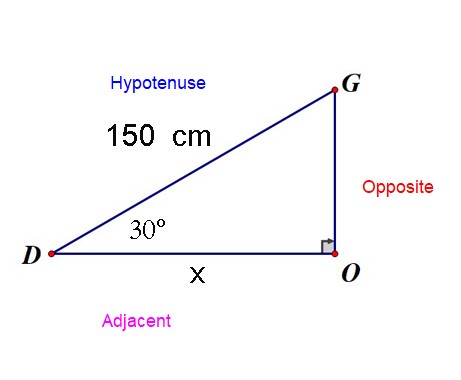
The length of side DO is 129.9 cm long . (1 dp)
Using Cos to Find an Angle
A right-angled triangle is shown. Find angle θ degrees.
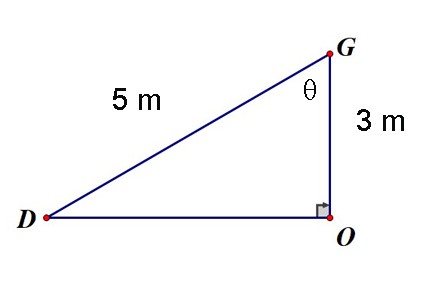
Draw a sketch
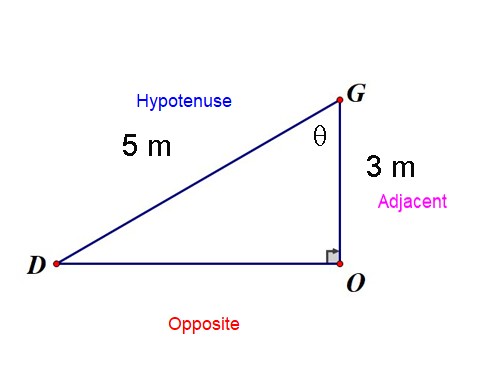
The angle is \(53.1^\circ\) (1dp).
Using Tan to Find a Side
An aircraft is 800 m directly above a tower on a glide path of \(25^\circ\). How far along the the ground from its touchdown point is the aircraft? Give your answer to 1 d.p.
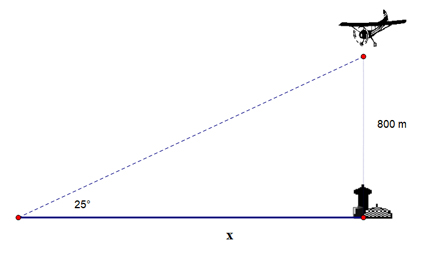
Draw a sketch
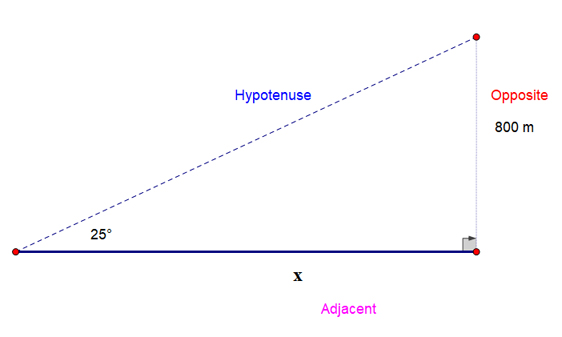
The aircraft is 1715.6 m above the ground.
Using Tan to Find an Angle
An aircraft is 73 m above a building and 200 m from its touchdown point. Calculate the glide‑path angle \(\theta\), correct to 1 decimal place.
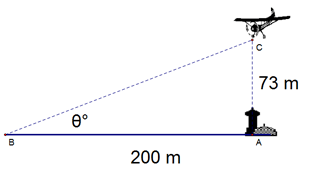
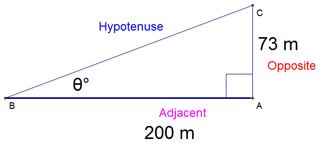
The glide‑path angle is \(20.1^\circ\) (1 d.p.).
Which Ratio Should Be Used?
The following recipe can be used for trig problem solving:
- Sketch the triangle
- Mark the right angle
- Identify the angle to be used or found
- Label Opposite, Adjacent and Hypotenuse
- Write out the ratio
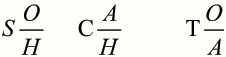
- Two‑Tick Test:
Tick what you know.
Tick what you want.
The ratio with two ticks is the one to use. - Write out the ratio and solve.
- Write down the solution.
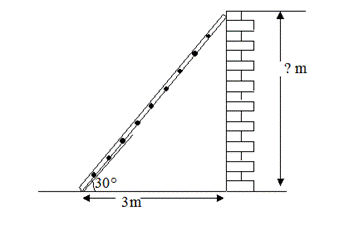
How high up the wall is the ladder? (Give your answer to 2 d.p.)
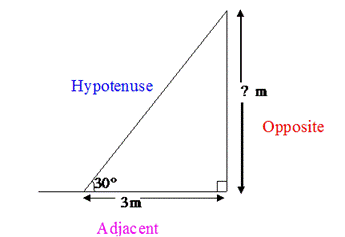
Tick what you know: Adjacent
Tick what you want: Opposite
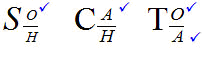
Two ticks → use tangent.
The ladder reaches 1.73 m up the wall (2 d.p.).
R.A Triangle CalculatorFinding the Area of a Triangle
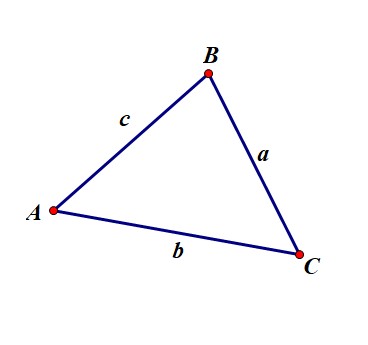
\[ \begin{alignedat}{2} \text{Area}_{\Delta} &= \tfrac12\, bc \sin A \\[0.6em] &= \tfrac12\, ac \sin B \\[0.6em] &= \tfrac12\, ab \sin C \end{alignedat} \]
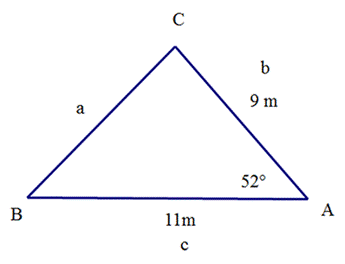
Calculate the area of the triangle shown.
 \[
\text{Area}_{\triangle}
= \tfrac12\, bc \sin A
\]
\[
\text{Area}_{\triangle}
= \tfrac12 \times 9 \times 11 \times \sin 52^\circ
\]
\[
\text{Area}_{\triangle}
= \tfrac12 \times 78.013606
\]
\[
\text{Area}_{\triangle}
= 39.0065
\]
\[
\text{The area of the triangle is } 39\,\text{m}^2
\]
\[
\text{Area}_{\triangle}
= \tfrac12\, bc \sin A
\]
\[
\text{Area}_{\triangle}
= \tfrac12 \times 9 \times 11 \times \sin 52^\circ
\]
\[
\text{Area}_{\triangle}
= \tfrac12 \times 78.013606
\]
\[
\text{Area}_{\triangle}
= 39.0065
\]
\[
\text{The area of the triangle is } 39\,\text{m}^2
\]
The Sine Rule
There must be one complete top and bottom pair for this to work
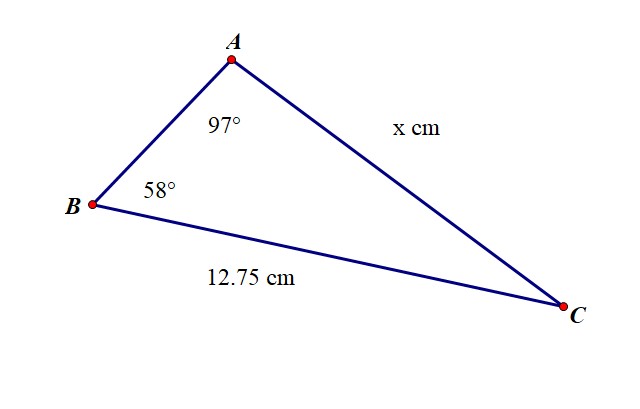
Calculate x, the length of side AC.
 \[
\frac{a}{\sin A}
=
\frac{b}{\sin B}
=
\frac{c}{\sin C}
\]
\[
\frac{12.75}{\sin 97^\circ}
=
\frac{x}{\sin 58^\circ}
=
\frac{c}{\sin C}
\]
\[
12.75 \sin 58^\circ = x \sin 97^\circ
\]
\[
x = \frac{12.75 \sin 58^\circ}{\sin 97^\circ}
\]
\[
x = 10.893
\]
\[
\frac{a}{\sin A}
=
\frac{b}{\sin B}
=
\frac{c}{\sin C}
\]
\[
\frac{12.75}{\sin 97^\circ}
=
\frac{x}{\sin 58^\circ}
=
\frac{c}{\sin C}
\]
\[
12.75 \sin 58^\circ = x \sin 97^\circ
\]
\[
x = \frac{12.75 \sin 58^\circ}{\sin 97^\circ}
\]
\[
x = 10.893
\]
Side AC is 10.89 cm long.
The Cosine Rule
\[ a^{2} = b^{2} +c^{2} - 2bc\cos A \]
Re-arranging
\[ \begin{alignedat}{2} a^{2} &= b^{2} + c^{2} - 2bc\cos A \\[1em] 2bc\cos A + a^{2} &= b^{2} + c^{2} \\[1em] 2bc\cos A &= b^{2} +c^{2} - a^{2} \\[1em] \cos A &= \frac{b^{2} + c^{2} - a^{2}}{2bc} \end{alignedat} \]
\[ \cos A = \frac{b^{2} + c^{2} - a^{2}}{2bc} \]
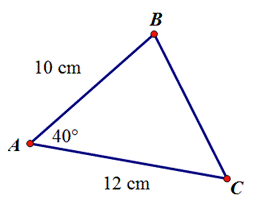
What is the length of BC?
Try the Sine Rule
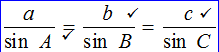
No matching pairs → cannot use the Sine Rule.
Using Cosine Rule
\[ \begin{alignedat}{2} a^{2} &= b^{2} + c^{2} - 2bc\cos A \\[1em] a^{2} &= 12^{2} + 10^{2} - 2 \times 12 \times 10 \times \cos 40^\circ \\[1em] &= 144 + 100 - 240\cos 40^\circ \\[1em] &= 244 - 240\cos 40^\circ \\[1em] &= 60.14933365 \\[1.2em] a &= \sqrt{60.14933365} \\[1em] &= 7.755 \\[1em] a &= 7.8\ \text{cm (nearest cm)} \end{alignedat} \]
Triangle Solver
Enter any combination of sides (a, b, c) and angles (A, B, C). Use degrees for angles.
Which Rule to Use
AAA – 3 angles
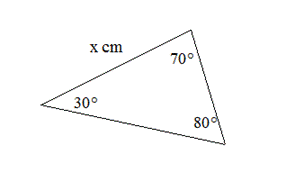
Not enough information.
AAS – 2 angles, 1 side
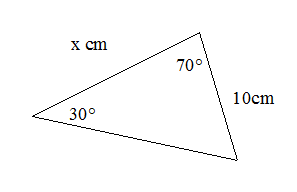
Use the Sine Rule.
ASS – 1 angle (not included), 2 sides
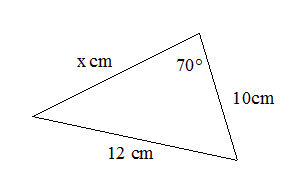
Ambiguous case: Either use the Sine Rule twice, or use the Cosine Rule with the quadratic formula.
Using the Sine Rule:
\[ \begin{alignedat}{2} \frac{a}{\sin A} &= \frac{b}{\sin B} = \frac{c}{\sin C} \\[1.4em] \frac{12}{\sin 70^\circ} &= \frac{10}{\sin B} = \frac{x}{\sin C} \\[1.4em] \frac{12}{\sin 70^\circ} &= \frac{10}{\sin B} \\[1.4em] \sin B &= \frac{10 \sin 70^\circ}{12} \\[1.4em] B &= \sin^{-1}\!\left(\frac{10 \sin 70^\circ}{12}\right) \\[1.4em] B &= 51.543^\circ \end{alignedat} \]
\[ \begin{alignedat}{2} \text{Now find angle } C \text{ by subtracting angles } A \text{ and } B \text{ from } 180^\circ \\[1em] C &= 180^\circ - (70^\circ + 51.54^\circ) \\[0.8em] &= 58.46^\circ \\[1.4em] \text{Substitute back into the Sine Rule} \\[1.2em] \frac{12}{\sin 70^\circ} &= \frac{x}{\sin C} \\[1.2em] x &= \frac{12 \sin C^\circ}{\sin 70^\circ} \\[1.2em] x &= \frac{12 \sin 58.46^\circ}{\sin 70^\circ} \\[1.2em] x &= 10.88\ \text{(2 d.p.)} \end{alignedat} \]
Using the Cosine Rule:
\[ \begin{alignedat}{2} a^{2} &= c^{2} + b^{2} - 2bc\cos A \\[1.2em] 12^{2} &= x^{2} + 10^{2} - 20x\cos 70^\circ \\[1.2em] 144 &= x^{2} + 100 - 20x\cos 70^\circ \\[1.2em] 44 &= x^{2} - 20x\cos 70^\circ \\[1.2em] x^{2} - 20\cos 70^\circ\, x - 44 &= 0 \end{alignedat} \]
Now solve using the quadratic formula:
\[ \begin{alignedat}{2} x &= \frac{-b \pm \sqrt{\,b^{2} - 4ac\,}}{2a} \\[1.4em] x &= \frac{20\cos 70^\circ \pm \sqrt{\left(-20\cos 70^\circ\right)^{2} + 176}}{2} \\[1.4em] x &= \frac{20\cos 70^\circ \pm \sqrt{222.7911114}}{2} \\[1.4em] x &= \frac{20\cos 70^\circ \pm 14.92618878}{2} \end{alignedat} \]
So:
\[ \begin{alignedat}{2} x &= \frac{20\cos 70^\circ + 14.92618878}{2} \\[1em] &= 10.88329582 \end{alignedat} \]
or
\[ \begin{alignedat}{2} x &= \frac{20\cos 70^\circ - 14.92618878}{2} \\[1em] &= -4.04289 \end{alignedat} \]
Discard the negative value — lengths cannot be negative.
x = 10.88 cm (2dp)
SAS – included angle, 2 sides
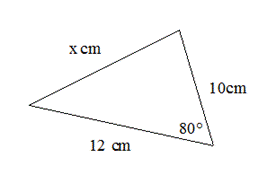
Use the Cosine Rule.
SSS – 3 sides
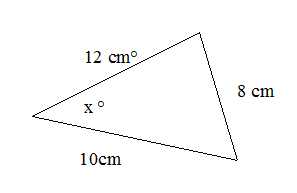
Use the Cosine Rule.
Books
Printed resources available at Amazon
Pocket Revision: Basic Trigonometry Pocket Revision: Basic Trigonometry

Pocket Revision: Basic Trigonometry
This book provides a refresher for basic trigonometry.
Topics include:
- Basic use of Sine, Cosine and Tangent to find sides or angles in right‑angled triangles
- Derivation and examples of the Sine Rule, Cosine Rule and Area of a triangle
As an Amazon Associate I earn from qualifying purchases.