Perimeter, Area and Volume
Perimeter = distance around the edge.
You could walk around the perimeter.
All dimensions must have the same units.
Don't mix cm with m.
Perimeter has plain units.
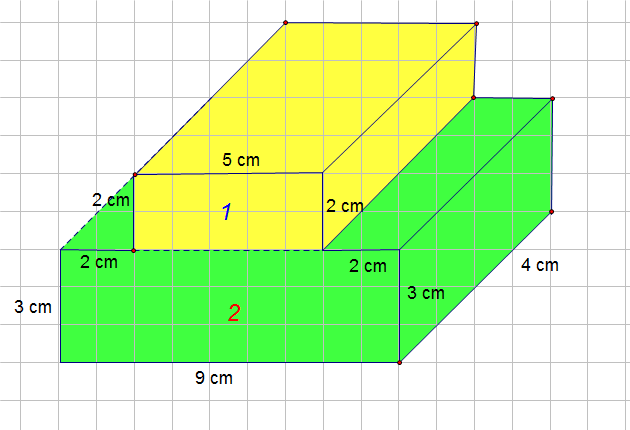
Example
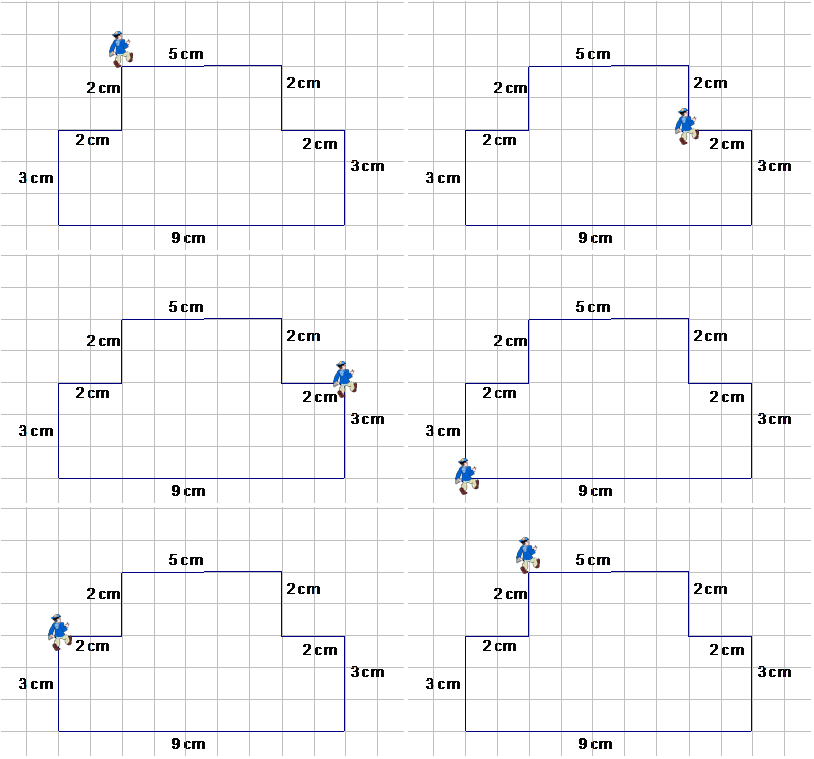
P = 5 + 2 + 2 + 3 + 9 + 3 + 2 + 2 cm = 28 cm
Area = floor space covered.
You could paint an area.
All dimensions must have the same units.
Don't mix cm with m.
Area has units2.
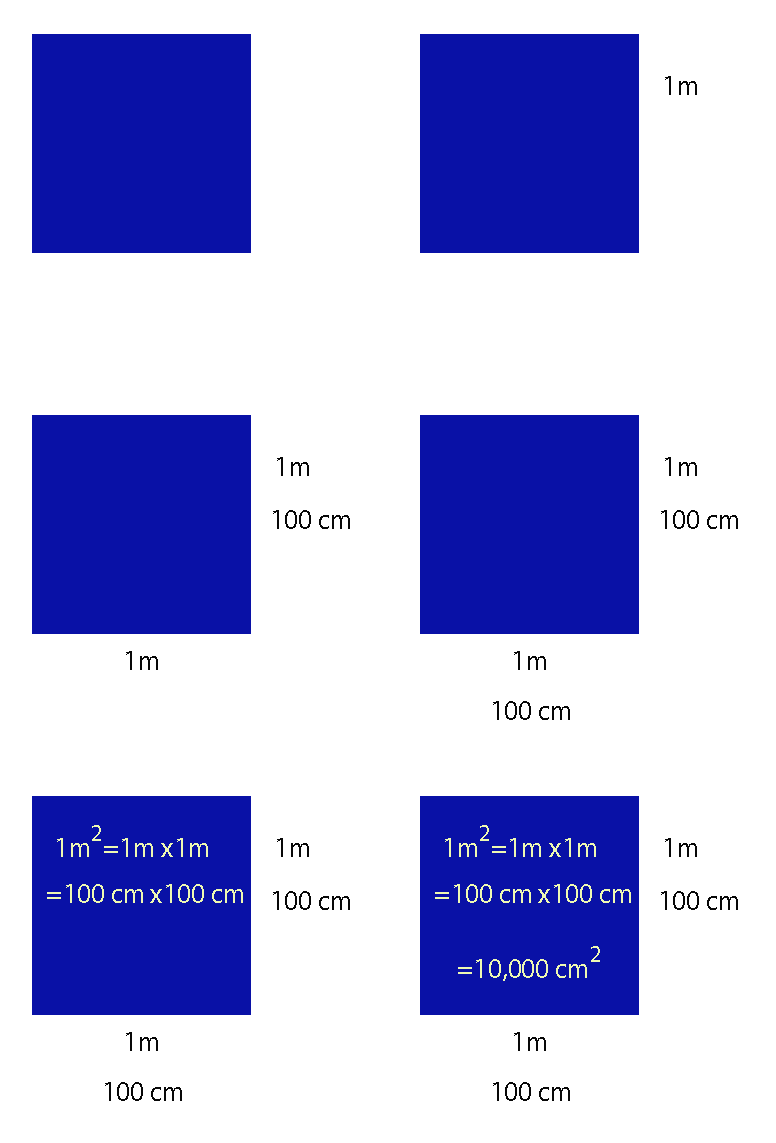
1 m2 = 10,000 cm2
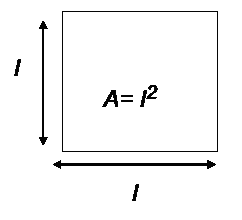
\[
\begin{aligned}
\text{Area} &= \text{length} \times \text{breadth} \\
&= (\text{length})^{2} \\
A_{\square} &= l^{2}
\end{aligned}
\]
Example
Calculate the area of the square:
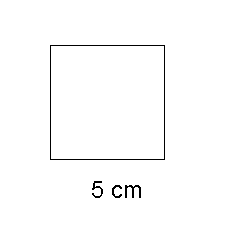
\[
\begin{aligned}
A_{\square} &= l^{2} \\[6pt]
A_{\square} &= 5^{2} \\[6pt]
&= 25\ \text{cm}^{2}
\end{aligned}
\]
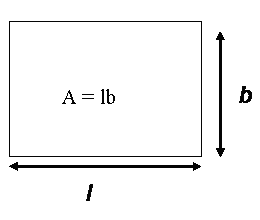
\[
A_{\square} = lb
\]
Example
Calculate the area of the rectangles:
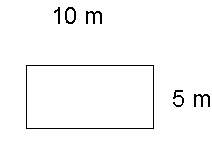 \[
A_{\square} = l\,b
\]
\[
= 10\,m \times 5\,m
\]
\[
= 50\,m^{2}
\]
\[
A_{\square} = l\,b
\]
\[
= 10\,m \times 5\,m
\]
\[
= 50\,m^{2}
\] Example
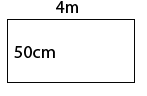
\[
A_{\square} = l\,b
\]
\[
= 4\,m \times 50\,\text{cm}
\]
\[
= 4\,m \times 0.5\,m
\]
\[
= 2\,m^{2}
\]
Area = ½ × base × perpendicular height
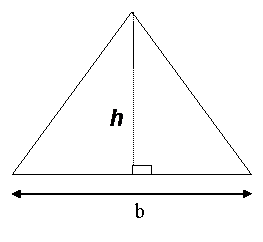
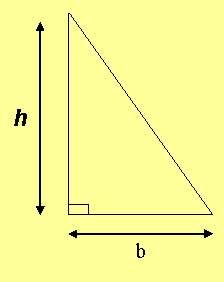
\[
A_{\Delta} = \frac{1}{2} b h
\]
Example
Find the area of the triangle below:
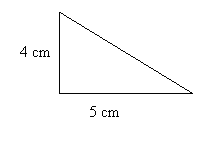
\[
\begin{aligned}
A_{\Delta} &= \tfrac12 b h \\[6pt]
&= \tfrac12 \times 5 \times 4 \\[6pt]
&= \tfrac12 \times 20 \\[6pt]
&= 10\ \text{cm}^{2}
\end{aligned}
\]
Example
What is the base length if the area is 45 cm²?
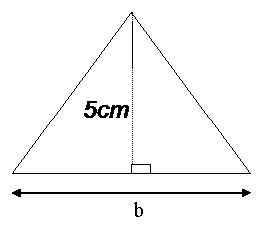
\[
\begin{aligned}
A_{\Delta} &= \tfrac12 b h \\[8pt]
45 &= \tfrac12 \times 5 \times b \\[8pt]
45 &= \frac{5b}{2} \\[8pt]
&\color{green}{(\times 2 \ \text{both sides})} \\[8pt]
90 &= 5b \\[8pt]
&\color{green}(\div 5 \ \text{both sides} )\\[8pt]
18 &= b \\[12pt]
\text{The length of the base is } 18\text{ cm.}
\end{aligned}
\]
Area of a triangle using Trigonometry
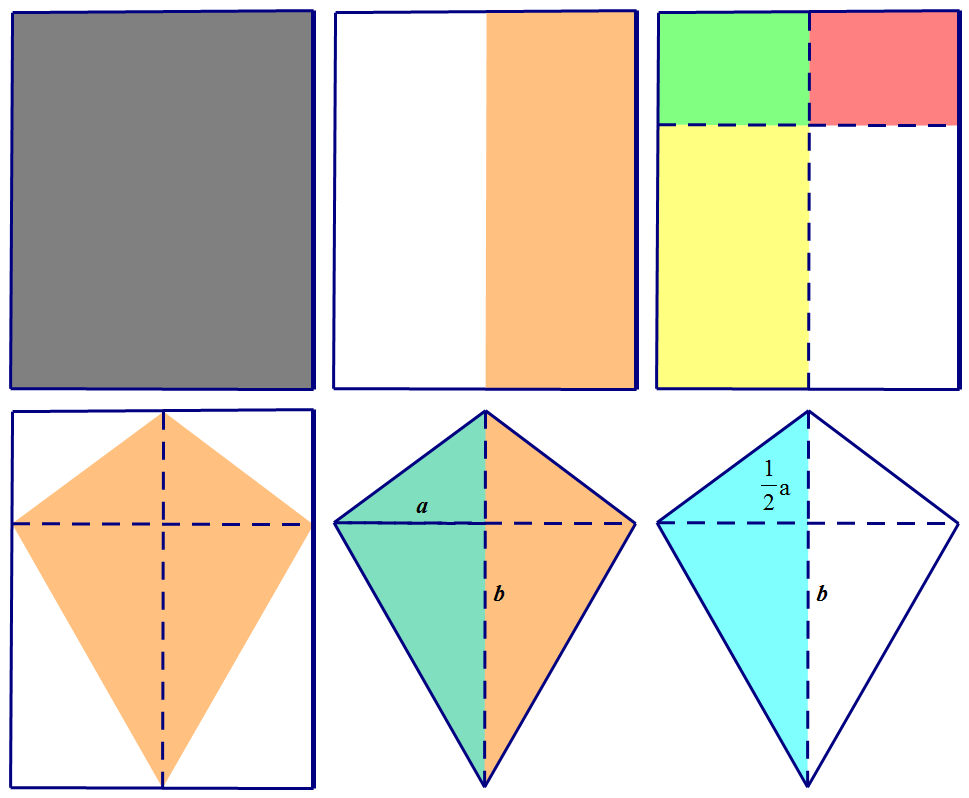
\[
\begin{aligned}
\text{Let } a &= \text{diagonal 1, and } b = \text{diagonal 2} \\[6pt]
\text{and } A_{\Delta} &= \text{ area of blue triangle} \\[10pt]
\text{then }
A_{\Delta} &= \tfrac12 \times \text{base} \times \perp\text{height} \\[8pt]
&= \tfrac12 \times b \times \tfrac12 a \\[8pt]
&= \tfrac14 ab \\[14pt]
\text{Area of kite} &= 2 \times A_{\Delta} \\[8pt]
&= 2 \times \tfrac14 ab \\[8pt]
&= \tfrac12 ab \\[8pt]
&= \tfrac12 \times \text{diagonal 1} \times \text{diagonal 2}
\end{aligned}
\]
\[
A_{\text{kite}}= \frac{1}{2} d_{1} d_{2}
\]
Example
Calculate the area of the kite:
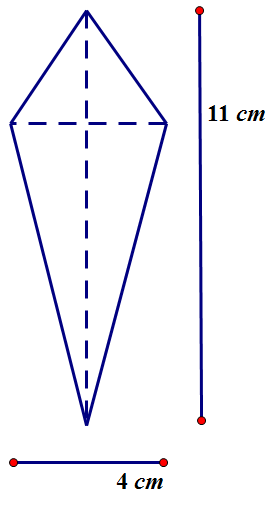
\[
\begin{aligned}
\text{Area}_{\text{kite}}
&= \tfrac12 \times \text{diagonal 1} \times \text{diagonal 2} \\[8pt]
&= \tfrac12 \times 4 \times 11 \\[8pt]
&= \tfrac12 \times 44 \\[8pt]
&= 22\ \text{cm}^{2}
\end{aligned}
\]
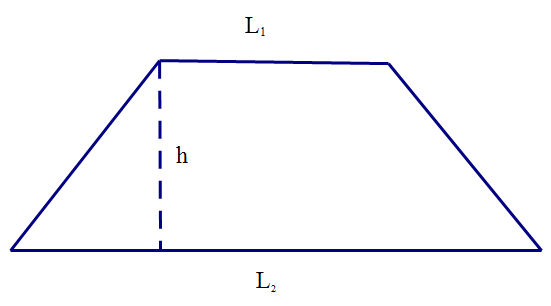
Area = ½ × (sum of parallel sides) × height
\[
A_{\text{trapezium}} = \frac{1}{2}(L_1 + L_2)h
\]
Example
What is the area of this trapezium?
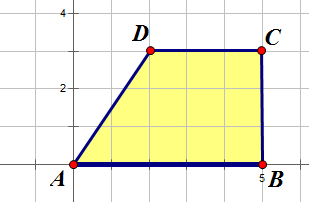
\[
\begin{aligned}
A &= \tfrac12 (L_{1} + L_{2})h \\[8pt]
A &= \tfrac12 (5 + 3)\times 3 \\[8pt]
A &= \tfrac12 \times 8 \times 3 \\[8pt]
A &= 12 \\[12pt]
\text{The area is } 12\ \text{units}^{2}.
\end{aligned}
\]
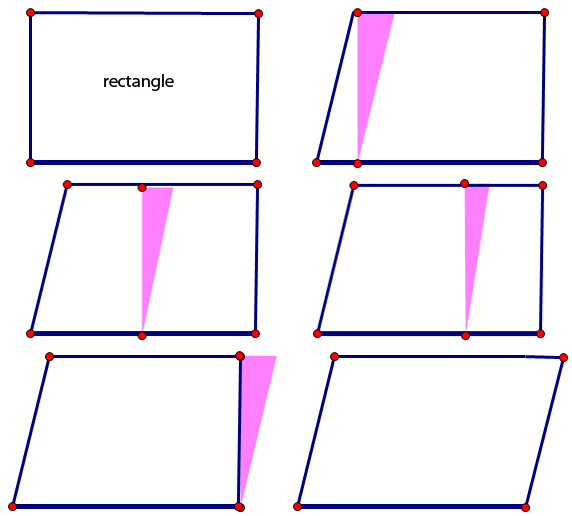
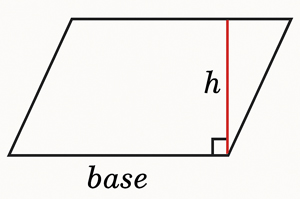
Area = base x perpendicular height
\[
A_{\text{parallelogram}} = bh
\]
Example
Calculate the area of the parallelogram:
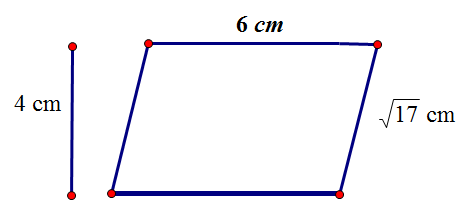
\[
\begin{aligned}
\text{Area} &= \text{base} \times \text{perpendicular height} \\[8pt]
A &= 6 \times 4 \\[8pt]
A &= 24\ \text{cm}^{2}
\end{aligned}
\]
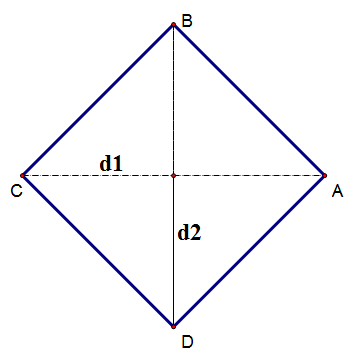
\[
A_{\text{rhombus}} = \frac{1}{2} d_{1} d_{2}
\]
Example
Calculate the area of the rhombus with diagonal lengths as shown:
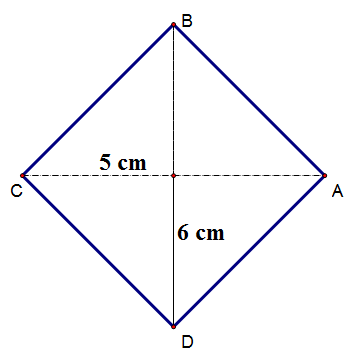
\[
\begin{aligned}
\text{Area of rhombus}
&= \tfrac12 \times \text{diagonal 1} \times \text{diagonal 2} \\[8pt]
&= \tfrac12 \times 5 \times 6 \\[8pt]
&= \tfrac12 \times 30 \\[8pt]
&= 15\ \text{cm}^{2}
\end{aligned}
\]
Volume = capacity held.
You could fill a volume.
All dimensions must have the same units.
Don't mix cm with m.
Volume has units3.
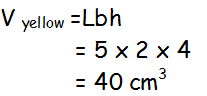
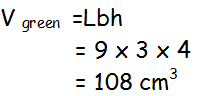
For a cuboid:
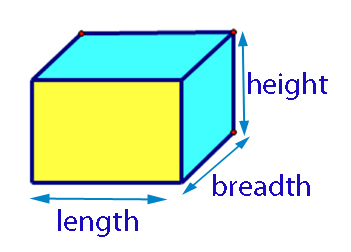
\[
\begin{aligned}
\text{volume} &= \text{length} \times \text{breadth} \times \text{height} \\[8pt]
V_{\text{cuboid}} &= l b h
\end{aligned}
\]
Example
Calculate the volume of the cuboid:
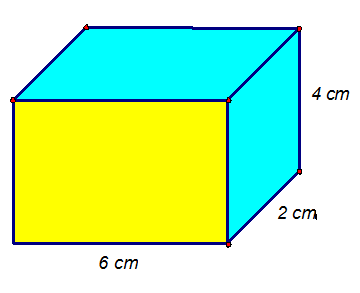
\[
\begin{aligned}
V &= lbh \\
&= 6 \times 2 \times 4 \\
&= 48\,\text{cm}^3
\end{aligned}
\]
For a cube: length, breadth and height are all the same.
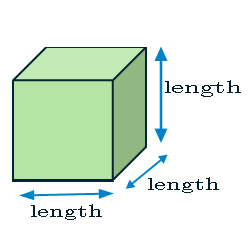
\[
\begin{aligned}
V_{\square} &= l \times b \times h \\
&= l \times l \times l \\
&= l^{3}
\end{aligned}
\]
Example
Calculate the volume of the cube:
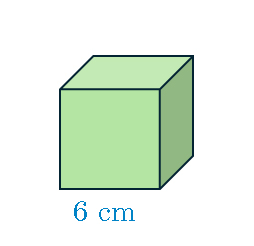
\[
\begin{aligned}
V &= l^3 \\
&= 6 \times 6 \times 6 \\
&= 216\,\text{cm}^3
\end{aligned}
\]
Example
Converting 1 m³ to litres
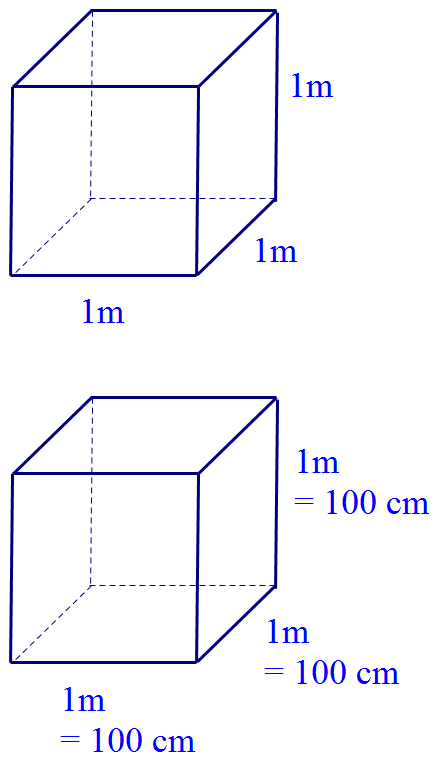
First convert the units:
\[
1\ \text{m}^{3} = 100\ \text{cm} \times 100\ \text{cm} \times 100\ \text{cm}
= 1{,}000{,}000\ \text{cm}^{3}
\]
1 cm³ = 1 ml and 1000 ml = 1 litre.
1,000,000 cm³ = 1000 litres
1 m³ = 1000 litres
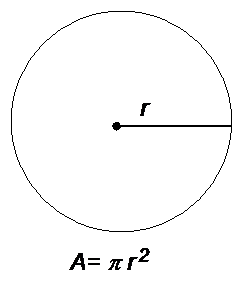
A sphere has volume based on its radius size :
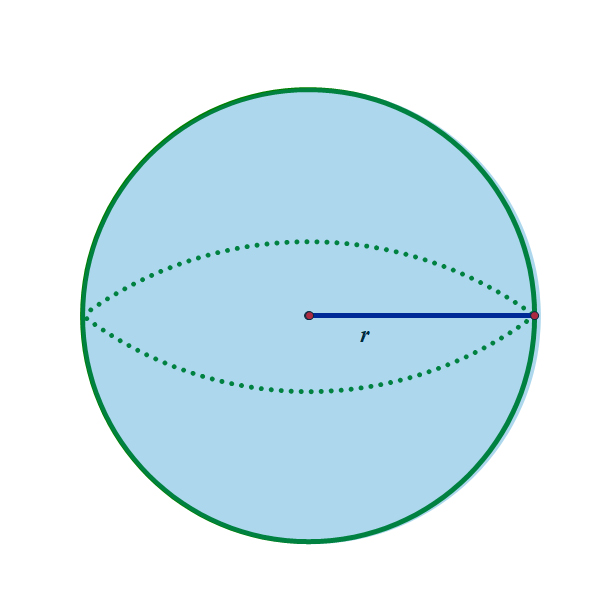
\[
V_{\text{sphere}} = \frac{4}{3}\pi r^{3}
\]
Example
Calculate the volume of the sphere:
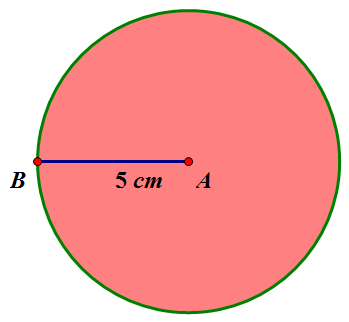
\[
\begin{aligned}
V &= \frac{4}{3}\pi r^{3} \\
&= \frac{4}{3} \times \pi \times 5^{3} \\
&= \frac{4}{3} \times \pi \times 125 \\
&= 523.5987756 \\
&= 523.6\ \text{cm}^3\ (1\ \text{dp}) \\
\text{or}\quad V &\approx 520\ \text{cm}^3\ (2\ \text{sig figs})
\end{aligned}
\]
Example
Calculate the volume of this sphere:
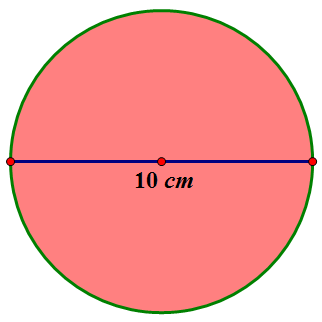
\[
\begin{aligned}
\text{Diameter} &= 10\,\text{cm} \\
\text{so } r &= 5\,\text{cm} \\[6pt]
V &= \frac{4}{3}\pi r^{3} \\
&= \frac{4}{3} \times \pi \times 5^{3} \\
&= \frac{4}{3} \times \pi \times 125 \\
&= 523.5987756 \\[6pt]
&= 500\ \text{cm}^3\ (1\ \text{sig fig})
\end{aligned}
\]
Example
Calculate the diameter of a sphere with volume 700 cm³:
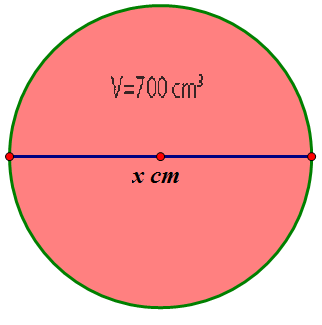
\[
\begin{aligned}
V &= \frac{4}{3}\pi r^{3} \\[6pt]
700 &= \frac{4}{3}\times \pi \times r^{3} \\[6pt]
2100 &= 4 \times \pi \times r^{3} \\[6pt]
\frac{2100}{4\pi} &= r^{3} \\[6pt]
r &= \sqrt[3]{\frac{2100}{4\pi}} \\[6pt]
r &= \sqrt[3]{167.1126902} \\[6pt]
r &= 5.5081168 \\[10pt]
d &= 2r \\[4pt]
d &= 11.01623367 \\[4pt]
&= 11.0\ \text{cm}\ (1\ \text{dp})
\end{aligned}
\]
The volume of a cone depends on its radius and perpendicular height :
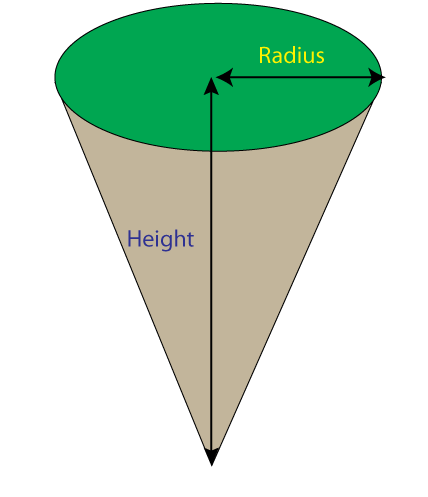
\[
V_{\text{cone}} = \frac{1}{3}\pi r^{2}h
\]
Where r is the radius and h is the perpendicular height.
Example
Calculate the volume of an ice cream cone which has a diameter of 4 cm and height of 6 cm.
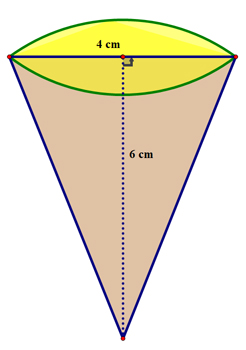
\[
\begin{aligned}
\text{Diameter} &= 4\,\text{cm},\ \text{so } r = 2\,\text{cm} \\[6pt]
V &= \frac{1}{3}\pi r^{2}h \\[6pt]
&= \frac{1}{3} \times \pi \times 2^{2} \times 6 \\[6pt]
&= \frac{1}{3} \times \pi \times 4 \times 6 \\[6pt]
&= 8\pi \\[6pt]
&= 25.132412 \\[6pt]
&= 25.1\ \text{cm}^{3}\ (1\ \text{dp})
\end{aligned}
\]
How many cones can be filled from 1 litre?
1000 cm3 ÷ 25.1 cm 3 = 39.84 → 39 filled cones
Example
Calculate the height of a cone with diameter 4cm and volume 35 ml:
\[
\begin{aligned}
\text{Volume} &= 35\,\text{ml} = 35\,\text{cm}^3 \\[6pt]
D &= 4\,\text{cm}\quad\text{so}\quad r = 2\,\text{cm} \\[6pt]
V &= \frac{1}{3}\pi r^{2}h \\[6pt]
35 &= \frac{1}{3}\times \pi \times 2^{2} \times h \\[6pt]
35 &= \frac{1}{3}\times \pi \times 4 \times h \\[6pt]
105 &= 4\pi h \\[6pt]
\frac{105}{4\pi} &= h \\[6pt]
h &= 8.35563 \\[6pt]
&= 8.4\ \text{cm}\ (1\ \text{dp})
\end{aligned}
\]
The cone is 8.4 cm tall.
Example
Calculate the diameter of a cone with height 8 cm and volume 90 ml:
\[
\begin{aligned}
\text{Volume} &= 90\,\text{ml} = 90\,\text{cm}^3 \\[6pt]
h &= 8\,\text{cm} \\[6pt]
V &= \frac{1}{3}\pi r^{2}h \\[6pt]
90 &= \frac{1}{3}\times \pi \times r^{2} \times 8 \\[6pt]
270 &= 8\pi r^{2} \\[6pt]
\frac{270}{8\pi} &= r^{2} \\[6pt]
r &= \sqrt{\frac{270}{8\pi}} \\[6pt]
&= 3.27764\ \text{cm} \\[10pt]
d &= 2r \\[4pt]
d &= 2 \times 3.27764 \\[4pt]
d &= 6.55529\ \text{cm} \\[4pt]
&= 6.6\ \text{cm}\ (1\ \text{dp})
\end{aligned}
\]
For a prism: Volume = Area × height
\[
V_{\text{prism}} = A h
\]
Example
What is the volume of a prism with area 37 cm² and height 4 cm?
\[
\begin{aligned}
V &= Ah \\[4pt]
&= 37\,\text{cm}^{2} \times 4\,\text{cm} \\[4pt]
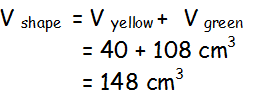
&= 148\,\text{cm}^{3}
\end{aligned}
\]
A cylinder is a circular prism.
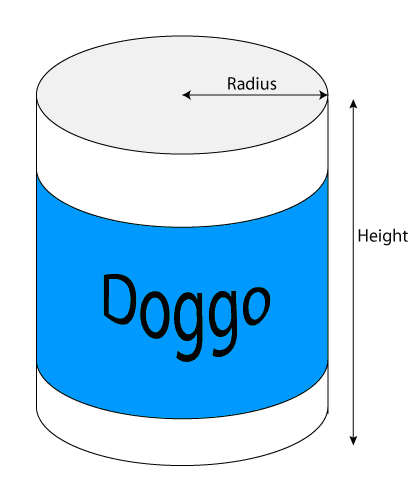
\[
V_{\text{cylinder}} = \pi r^{2}h
\]
Example
Calculate the volume of a tin can with height 0.8 m and diameter 10 cm.
Give your answer correct to 1 significant figure.
\[
\begin{aligned}
\text{Diameter} &= 10\,\text{cm},\ \text{so } r = 5\,\text{cm} \\[6pt]
\text{height} &= 0.8\,\text{m} = 80\,\text{cm} \\[10pt]
V &= \pi r^{2} h \\[6pt]
&= \pi \times 5^{2} \times 80 \\[6pt]
&= \pi \times 25 \times 80 \\[6pt]
&= 2000\pi \\[6pt]
&= 6283.185307\ \text{cm}^{3} \\[6pt]
&= 6000\ \text{cm}^{3}\ (1\ \text{sig fig})
\end{aligned}
\]
Example
Calculate the diameter of a tin can with height 8 cm and volume 90 ml:
\[
\begin{aligned}
\text{Volume} &= 90\,\text{cm}^{3},\quad \text{height} = 8\,\text{cm} \\[6pt]
V &= \pi r^{2} h \\[6pt]
90 &= \pi \times r^{2} \times 8 \\[6pt]
\frac{90}{8\pi} &= r^{2} \\[6pt]
r &= \sqrt{\frac{90}{8\pi}} \\[6pt]
r &= 1.892349\,\text{cm} \\[10pt]
d &= 2r \\[4pt]
&= 3.784698\,\text{cm} \\[4pt]
&= 3.8\,\text{cm}\ (1\ \text{dp})
\end{aligned}
\]
The volume of any pyramid is:
\[
V_{\text{pyramid}} = \frac{1}{3}Ah
\]
Where A is the area of the base and h is the height.
Example
What is the volume of this square‑based pyramid?
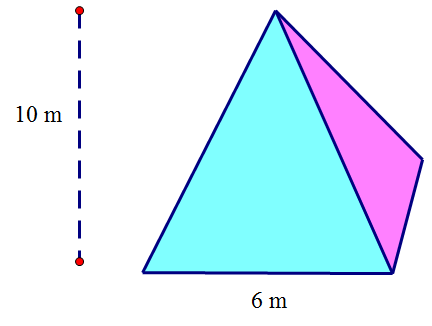
\[
\begin{aligned}
V &= \frac{1}{3}Ah \\[4pt]
&= \frac{1}{3} \times 6 \times 6 \times 10 \\[4pt]
&= \frac{1}{3} \times 36 \times 10 \\[4pt]
&= \frac{1}{3} \times 360 \\[4pt]
&= 120\,\text{m}^{3}
\end{aligned}
\]
Example
What is the volume of this rectangular‑based pyramid?
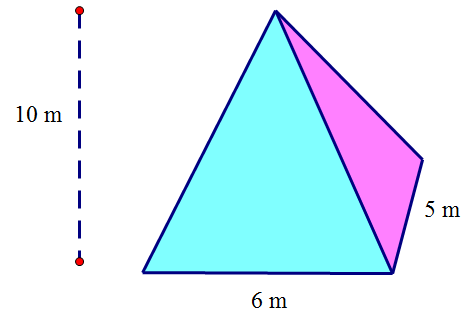
\[
\begin{aligned}
V &= \frac{1}{3}Ah \\[4pt]
&= \frac{1}{3} \times 6 \times 5 \times 10 \\[4pt]
&= \frac{1}{3} \times 30 \times 10 \\[4pt]
&= \frac{1}{3} \times 300 \\[4pt]
&= 100\,\text{m}^{3}
\end{aligned}
\]
Example
What is the volume of this triangular‑based pyramid?
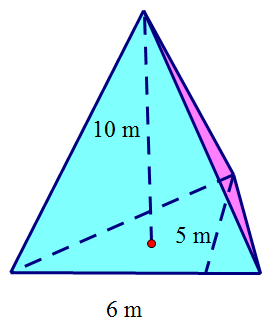
\[
\begin{aligned}
V &= \frac{1}{3}Ah \\[6pt]
&= \frac{1}{3} \times
\left( \frac{1}{2} \times 6 \times 5 \right) \times 10 \\[6pt]
&= \frac{1}{3} \times \frac{1}{2} \times 6 \times 5 \times 10 \\[6pt]
&= \frac{1}{6} \times 6 \times 5 \times 10 \\[6pt]
&= \frac{1}{6} \times 300 \\[6pt]
&= 50\,\text{m}^{3}
\end{aligned}
\]
The surface area is the total external area of the shape.
Example
Find the surface area of the cuboid:
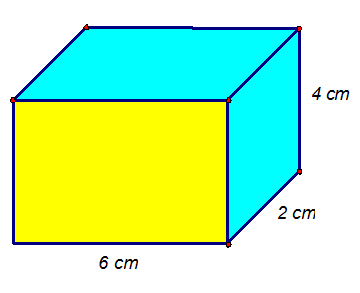
This shape has 6 faces:
- Front and back faces, each 6 cm × 4 cm
- Base and top faces , each 6 cm × 2 cm
- 2 side faces: each 2 cm × 4 cm
Area of each part :
- 2 x 6 cm × 4 cm = 48 cm²
- 2 x 6 cm × 2 cm = 24 cm²
- 2 x 2 cm × 4 cm = 16 cm²
Surface Area = 88 cm²
Surface Area ≠ Volume
- Cut into convenient shapes.
- Find missing dimensions.
- Calculate individual areas.
- Add to find the total.
Remember: all dimensions must have the same units.
Example
Find the area of the shape.
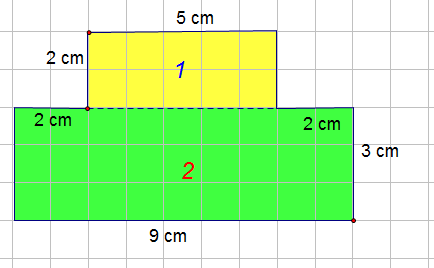
\[
\begin{aligned}
A_{\text{shape}} &= A_1 + A_2 \\
A_1 &= 5 \times 2 = 10\ \text{cm}^2 \\
A_2 &= 9 \times 3 = 27\ \text{cm}^2 \\
\mathbf{A_{\text{shape}} = 37\ \text{cm}^2}
\end{aligned}
\]