Direction Ratios and Cosines
\[
\text{The point }A(a_1,\,a_2,\,a_3)\text{ can be written as the position vector}
\]
\[
\mathbf{a}
=
\begin{pmatrix}
a_1 \\[4pt]
a_2 \\[4pt]
a_3
\end{pmatrix}
\]
\[
\text{The ratio }a_1 : a_2 : a_3\text{ is called the direction ratio.}
\]
\[
\text{Parallel vectors have equal direction ratios.}
\]
\[
\text{The direction cosines are}
\]
\[
\mathbf{u}
=
\begin{pmatrix}
\cos\alpha \\[4pt]
\cos\beta \\[4pt]
\cos\gamma
\end{pmatrix}
\]
\[
\text{where }\mathbf{u}\text{ is a unit vector in the direction of }\mathbf{a}.
\]
\[
\left|\,\mathbf{u}_a\,\right|
=
\left|\,
\frac{1}{\lvert \mathbf{a} \rvert}\,\mathbf{a}
\right|
=
\frac{1}{\lvert \mathbf{a} \rvert}\,\lvert \mathbf{a} \rvert
=
1
\]
Example
Show that A(−1,−8,−2), B(2,−5,4) and C(3,−4,6) are collinear,
and establish the direction cosines of AB.
\[
\overrightarrow{AB}
=
\begin{pmatrix}
2 \\[4pt]
-5 \\[4pt]
4
\end{pmatrix}
-
\begin{pmatrix}
-1 \\[4pt]
-8 \\[4pt]
-2
\end{pmatrix}
=
\begin{pmatrix}
3 \\[4pt]
3 \\[4pt]
6
\end{pmatrix}
\]
\[
\overrightarrow{BC}
=
\begin{pmatrix}
3 \\[4pt]
-4 \\[4pt]
6
\end{pmatrix}
-
\begin{pmatrix}
2 \\[4pt]
-5 \\[4pt]
4
\end{pmatrix}
=
\begin{pmatrix}
1 \\[4pt]
1 \\[4pt]
2
\end{pmatrix}
\]
\[
\overrightarrow{AB}\text{ has direction ratio }3:3:6 = 1:1:2
\]
\[
\overrightarrow{BC}\text{ has direction ratio }1:1:2
\]
\[
\text{The direction ratios are the same, so the vectors are parallel.}
\]
\[
B \text{ is common to both } AB \text{ and } BC,\; \text{so } A,\,B,\,C \text{ are collinear.}
\]
\[
\lvert \overrightarrow{AB} \rvert
=
\sqrt{3^{2} + 3^{2} + 6^{2}}
=
\sqrt{54}
=
3\sqrt{6}
\]
\[
\text{So }
\mathbf{u}_{\overrightarrow{AB}}
=
\frac{3}{3\sqrt{6}}\,\mathbf{i}
+
\frac{3}{3\sqrt{6}}\,\mathbf{j}
+
\frac{6}{3\sqrt{6}}\,\mathbf{k}
\]
\[
=
\frac{1}{\sqrt{6}}\,\mathbf{i}
+
\frac{1}{\sqrt{6}}\,\mathbf{j}
+
\frac{2}{\sqrt{6}}\,\mathbf{k}
\]
\[
\text{direction cosines are}
\]
\[
\cos\alpha = \frac{1}{\sqrt{6}}
\]
\[
\cos\beta = \frac{1}{\sqrt{6}}
\]
\[
\cos\gamma = \frac{2}{\sqrt{6}}
\]
The vector product a × b of 3D vectors
a and b
is a vector perpendicular to the plane containing them.
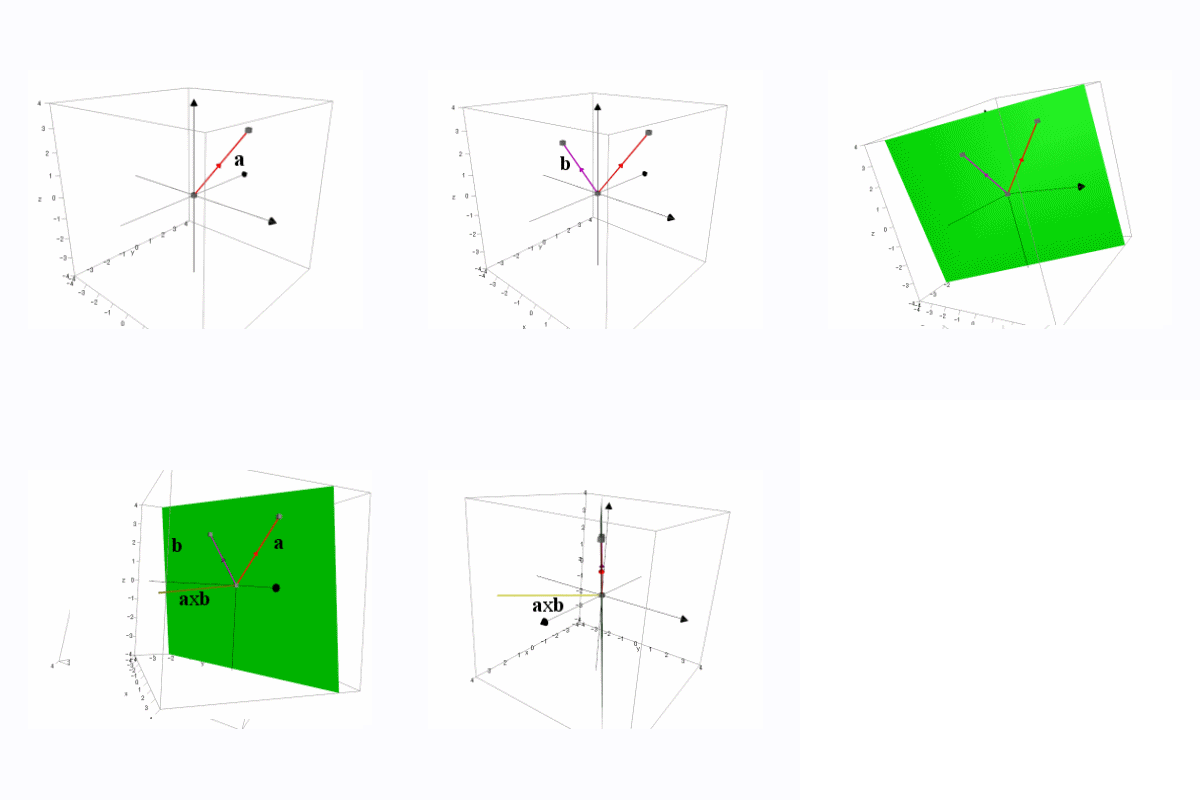
Since the resulting vector is normal to the plane,
it is often called n and has magnitude:
\[
\lvert \mathbf{a} \rvert \, \lvert \mathbf{b} \rvert \, \sin\theta
\]
This gives:
\[
\mathbf{a} \times \mathbf{b}
=
\mathbf{n}\,\lvert \mathbf{a} \rvert \,\lvert \mathbf{b} \rvert \,\sin\theta
\]
The direction of n is found using the
Right Hand Screw Rule.
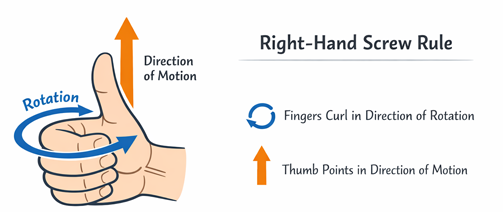
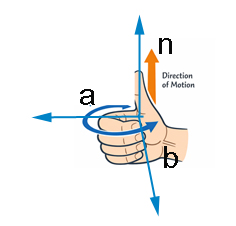
Curl your fingers from a to b;
your thumb points towards n.
Looking at the unit vectors i, j, k:
\[
\mathbf{i}\times\mathbf{j}
=
\mathbf{k}\,\lvert \mathbf{i} \rvert \,\lvert \mathbf{j} \rvert \,\sin\theta
\]
\[
=
\mathbf{k}\,\sin 90^\circ
\]
\[
=
\mathbf{k}
\]
Also:
\[
\mathbf{j}\times\mathbf{k} = \mathbf{i}
\qquad\qquad
\mathbf{k}\times\mathbf{j} = -\mathbf{i}
\]
\[
\mathbf{k}\times\mathbf{i} = \mathbf{j}
\qquad\qquad
\mathbf{i}\times\mathbf{k} = -\mathbf{j}
\]
\[
\mathbf{j}\times\mathbf{i} = -\mathbf{k}
\]
\[
\mathbf{i}\times\mathbf{i}
=
n\,\lvert \mathbf{i} \rvert \,\lvert \mathbf{i} \rvert \,\sin\theta
\]
\[
=
n\,\sin 0
\]
\[
=
0
\]
A vector crossed with itself always gives the zero vector
\[
\mathbf{i}\times\mathbf{i}
=
\mathbf{j}\times\mathbf{j}
=
\mathbf{k}\times\mathbf{k}
=
0
\]
\[
\mathbf{a}\times\mathbf{b} \ne \mathbf{b}\times\mathbf{a}
\]
\[
\mathbf{a}\times\mathbf{b}
=
-(\mathbf{b}\times\mathbf{a})
\]
\[
\mathbf{b}\times\mathbf{a}
=
-\mathbf{a}\times\mathbf{b}
\]
So the vector product is not commutative.
\[
\text{The vector }\mathbf{n}\text{ changes direction.}
\]
\[
\text{Given }\mathbf{a}\ne 0 \text{ and } \mathbf{b}\ne 0,
\]
\[
\text{If }\mathbf{a}\times\mathbf{b}=0,\text{ then }\mathbf{a}\text{ and }\mathbf{b}\text{ have the same direction.}
\]
\[
\text{So }\mathbf{b}=k\mathbf{a}\text{ for some real number }k.
\]
\[
\text{If }k\text{ is real,}
\]
\[
(k\mathbf{a})\times\mathbf{b}
=
\mathbf{a}\times(k\mathbf{b})
=
k(\mathbf{a}\times\mathbf{b}).
\]
\[
\mathbf{a}\times(\mathbf{b}+\mathbf{c})
=
\mathbf{a}\times\mathbf{b}
+
\mathbf{a}\times\mathbf{c}
\]
\[
(\mathbf{a}+\mathbf{b})\times\mathbf{c}
=
\mathbf{a}\times\mathbf{c}
+
\mathbf{b}\times\mathbf{c}
\]
\[
\text{So the vector product is distributive.}
\]
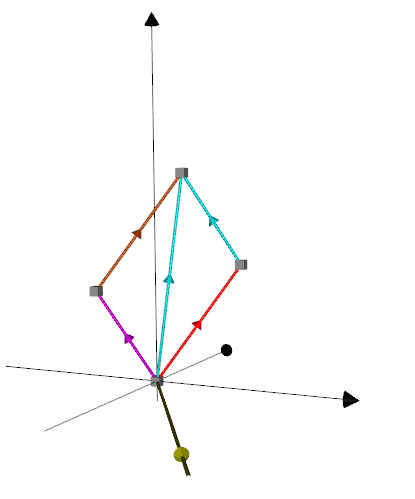
\[
\lvert \mathbf{a}\times\mathbf{b} \rvert
=
\lvert \mathbf{a} \rvert \,\lvert \mathbf{b} \rvert \,\sin\theta
\]
\[
\text{describes the area of the parallelogram}
\]
\[
\text{defined by }\mathbf{a}\text{ and }\mathbf{b}.
\]
Vectors a and b in unit vector form:
\[
\mathbf{a}
=
a_{1}\,\mathbf{i}
+
a_{2}\,\mathbf{j}
+
a_{3}\,\mathbf{k}
\]
\[
\mathbf{b}
=
b_{1}\,\mathbf{i}
+
b_{2}\,\mathbf{j}
+
b_{3}\,\mathbf{k}
\]
\[
\mathbf{a}\times\mathbf{b}
\text{ is the determinant of }
\begin{vmatrix}
\mathbf{i} & \mathbf{j} & \mathbf{k} \\
a_{1} & a_{2} & a_{3} \\
b_{1} & b_{2} & b_{3}
\end{vmatrix}
\]
\[
\therefore\;
\mathbf{a}\times\mathbf{b}
=
\begin{vmatrix}
\mathbf{i} & \mathbf{j} & \mathbf{k} \\
a_{1} & a_{2} & a_{3} \\
b_{1} & b_{2} & b_{3}
\end{vmatrix}
\]
\[
=
(a_{2}b_{3}-a_{3}b_{2})\,\mathbf{i}
-
(a_{1}b_{3}-a_{3}b_{1})\,\mathbf{j}
+
(a_{1}b_{2}-a_{2}b_{1})\,\mathbf{k}
\]
This is why it is also known as the cross product.
\[
\mathbf{a}\times\mathbf{b}
=
(a_{2}b_{3}-a_{3}b_{2})\,\mathbf{i}
-
(a_{1}b_{3}-a_{3}b_{1})\,\mathbf{j}
+
(a_{1}b_{2}-a_{2}b_{1})\,\mathbf{k}
\]
\[
=
(a_{2}b_{3}-a_{3}b_{2})\,\mathbf{i}
+
(a_{3}b_{1}-a_{1}b_{3})\,\mathbf{j}
+
(a_{1}b_{2}-a_{2}b_{1})\,\mathbf{k}
\]
\[
(\mathbf{a}\times\mathbf{b})\cdot\mathbf{a}
=
\begin{pmatrix}
a_{2}b_{3}-a_{3}b_{2} \\
a_{3}b_{1}-a_{1}b_{3} \\
a_{1}b_{2}-a_{2}b_{1}
\end{pmatrix}
\cdot
\begin{pmatrix}
a_{1} \\[4pt]
a_{2} \\[4pt]
a_{3}
\end{pmatrix}
\]
\[
=
a_{1}(a_{2}b_{3}-a_{3}b_{2})
+
a_{2}(a_{3}b_{1}-a_{1}b_{3})
+
a_{3}(a_{1}b_{2}-a_{2}b_{1})
\]
\[
=
a_{1}a_{2}b_{3}
-
a_{1}a_{3}b_{2}
+
a_{2}a_{3}b_{1}
-
a_{2}a_{1}b_{3}
+
a_{3}a_{1}b_{2}
-
a_{3}a_{2}b_{1}
\]
\[
= 0
\]
\[
(\mathbf{a}\times\mathbf{b})\cdot\mathbf{a}
=
(\mathbf{a}\times\mathbf{b})\cdot\mathbf{b}
=
0
\]
To find a unit vector perpendicular to
a and b, calculate:
\[
\mathbf{n}
=
\frac{\mathbf{a}\times\mathbf{b}}
{\lvert\,\mathbf{a}\times\mathbf{b}\,\rvert}
\]
Example
Evaluate:
\[
\mathbf{a}\times\mathbf{b},
\quad\text{where}\quad
\mathbf{a}
=
\begin{pmatrix}
4\\[4pt]
5\\[4pt]
-2
\end{pmatrix}
\quad\text{and}\quad
\mathbf{b}
=
\begin{pmatrix}
2\\[4pt]
-1\\[4pt]
-4
\end{pmatrix}
\]
\[
\mathbf{a}\times\mathbf{b}
=
(a_{2}b_{3}-a_{3}b_{2})\,\mathbf{i}
-
(a_{1}b_{3}-a_{3}b_{1})\,\mathbf{j}
+
(a_{1}b_{2}-a_{2}b_{1})\,\mathbf{k}
\]
\[
=
(5\cdot(-4)-(-2)\cdot(-1))\,\mathbf{i}
+
\big((-2)\cdot 2 - 4\cdot(-4)\big)\,\mathbf{j}
+
\big(4\cdot(-1)-5\cdot 2\big)\,\mathbf{k}
\]
\[
=
(-20 - 2)\,\mathbf{i}
+
(-4 + 16)\,\mathbf{j}
+
(-4 - 10)\,\mathbf{k}
\]
\[
=
-22\,\mathbf{i}
+
12\,\mathbf{j}
-
14\,\mathbf{k}
\]
\[
=
\begin{pmatrix}
-22\\[4pt]
12\\[4pt]
-14
\end{pmatrix}
\]
Note:
\[
(\mathbf{a}\times\mathbf{b})\cdot\mathbf{a}
=
\begin{pmatrix}
-22\\[4pt]
12\\[4pt]
-14
\end{pmatrix}
\cdot
\begin{pmatrix}
4\\[4pt]
5\\[4pt]
-2
\end{pmatrix}
\]
\[
=
-88 + 60 + 28
\]
\[
= 0
\]
Example
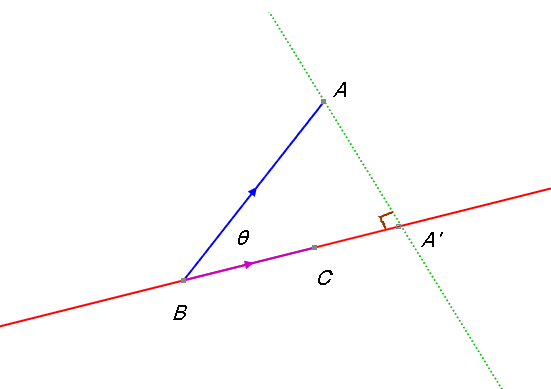
Calculate the distance from A(3,2,1) to the
straight line passing through B(4,5,6) and C(7,8,9).
\[
AA'
=
\lvert \overrightarrow{BA} \rvert \,\sin\theta
\]
\[
=
\frac{
\lvert \overrightarrow{BC} \rvert \,\lvert \overrightarrow{BA} \rvert \,\sin\theta
}{
\lvert \overrightarrow{BC} \rvert
}
\]
\[
=
\frac{
\lvert \overrightarrow{BC} \times \overrightarrow{BA} \rvert
}{
\lvert \overrightarrow{BC} \rvert
}
\]
\[
\overrightarrow{BC}
=
\begin{pmatrix}
7\\[4pt]
8\\[4pt]
9
\end{pmatrix}
-
\begin{pmatrix}
4\\[4pt]
5\\[4pt]
6
\end{pmatrix}
=
\begin{pmatrix}
3\\[4pt]
3\\[4pt]
3
\end{pmatrix}
\]
\[
\overrightarrow{BA}
=
\begin{pmatrix}
3\\[4pt]
2\\[4pt]
1
\end{pmatrix}
-
\begin{pmatrix}
4\\[4pt]
5\\[4pt]
6
\end{pmatrix}
=
\begin{pmatrix}
-1\\[4pt]
-3\\[4pt]
-5
\end{pmatrix}
\]
\[
\therefore\;
\frac{
\lvert\,\overrightarrow{BC}\times\overrightarrow{BA}\,\rvert
}{
\lvert\,\overrightarrow{BC}\,\rvert
}
=
\frac{
\left\lvert\;
\begin{pmatrix}
3\\[4pt]
3\\[4pt]
3
\end{pmatrix}
\times
\begin{pmatrix}
-1\\[4pt]
-3\\[4pt]
-5
\end{pmatrix}
\;\right\rvert
}{
\left\lvert\;
\begin{pmatrix}
3\\[4pt]
3\\[4pt]
3
\end{pmatrix}
\;\right\rvert
}
\]
\[
=
\frac{
\left|
\begin{vmatrix}
\mathbf{i} & \mathbf{j} & \mathbf{k} \\
3 & 3 & 3 \\
-1 & -3 & -5
\end{vmatrix}
\right|
}{
\sqrt{27}
}
=
\frac{
\left| -6\mathbf{i} + 12\mathbf{j} - 6\mathbf{k} \right|
}{
\sqrt{27}
}
\]
\[
=
\frac{\sqrt{216}}{\sqrt{27}}
=
\frac{6\sqrt{6}}{3\sqrt{3}}
=
\frac{2\sqrt{6}}{\sqrt{3}}
\]
\[
\text{The point is }
\frac{2\sqrt{6}}{\sqrt{3}}
\text{ units from the line.}
\]
This describes the volume of a parallelepiped
with edges a, b, c.
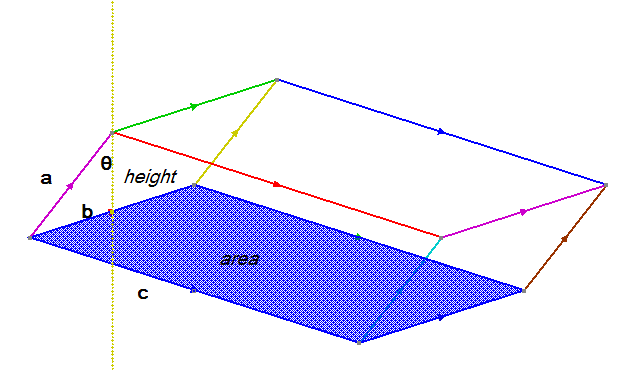
The base \(
\lvert \mathbf{b} \rvert \,,\quad \lvert \mathbf{c} \rvert
\) is separated by angle \( \theta \).
\[
\text{The area of the base is }
\lvert\,\mathbf{b}\times\mathbf{c}\,\rvert
\]
\[
\text{The height is }
\lvert \mathbf{a} \rvert \cos\theta
\]
\[
\therefore\;
V = A h
\]
\[
= \lvert\,\mathbf{b}\times\mathbf{c}\,\rvert
\;\cdot\;
\lvert \mathbf{a} \rvert \cos\theta
\]
\[
= \mathbf{a}\,\cdot\,(\mathbf{b}\times\mathbf{c})
\]
\[
\mathbf{a}\cdot(\mathbf{b}\times\mathbf{c})
=
\begin{pmatrix}
a_{1}\\[4pt]
a_{2}\\[4pt]
a_{3}
\end{pmatrix}
\cdot
\begin{pmatrix}
b_{2}c_{3}-b_{3}c_{2}\\[4pt]
b_{3}c_{1}-b_{1}c_{3}\\[4pt]
b_{1}c_{2}-b_{2}c_{1}
\end{pmatrix}
\]
\[
=
a_{1}(b_{2}c_{3}-b_{3}c_{2})
+
a_{2}(b_{3}c_{1}-b_{1}c_{3})
+
a_{3}(b_{1}c_{2}-b_{2}c_{1})
\]
\[
(\mathbf{a}\times\mathbf{b})\cdot\mathbf{c}
=
\begin{pmatrix}
b_{2}c_{3}-b_{3}c_{2}\\[4pt]
b_{3}c_{1}-b_{1}c_{3}\\[4pt]
b_{1}c_{2}-b_{2}c_{1}
\end{pmatrix}
\cdot
\begin{pmatrix}
a_{1}\\[4pt]
a_{2}\\[4pt]
a_{3}
\end{pmatrix}
\]
\[
=
a_{1}(b_{2}c_{3}-b_{3}c_{2})
+
a_{2}(b_{3}c_{1}-b_{1}c_{3})
+
a_{3}(b_{1}c_{2}-b_{2}c_{1})
\]
\[
\mathbf{a}\cdot(\mathbf{b}\times\mathbf{c})
=
(\mathbf{a}\times\mathbf{b})\cdot\mathbf{c}
\]
\[
\text{Since }\mathbf{a}\cdot\mathbf{b}\text{ is a scalar, }
(\mathbf{a}\cdot\mathbf{b})\times\mathbf{c}
\text{ is meaningless.}
\]
\[
\mathbf{a}\cdot\mathbf{b}\times\mathbf{c}
\text{ means }
\mathbf{a}\cdot(\mathbf{b}\times\mathbf{c}).
\]
Example
Find the volume of the parallelepiped with vectors:
a = i + 2j − 3k
b = 2i − 2j + k
c = i − 4k
\[
\mathbf{a}\cdot(\mathbf{b}\times\mathbf{c})
=
\begin{pmatrix}
1\\[4pt]
2\\[4pt]
-3
\end{pmatrix}
\cdot
\begin{pmatrix}
\mathbf{i} & \mathbf{j} & \mathbf{k} \\
2 & -2 & 1 \\
1 & 0 & -4
\end{pmatrix}
\]
\[
\mathbf{a}\cdot(\mathbf{b}\times\mathbf{c})
=
\begin{pmatrix}
1\\[4pt]
2\\[4pt]
-3
\end{pmatrix}
\cdot
\begin{pmatrix}
8 - 0\\[4pt]
1 - (-8)\\[4pt]
0 - (-2)
\end{pmatrix}
\]
\[
= 8 + 2\times 9 - 3\times 2
\]
\[
= 20 \text{ units of volume}
\]
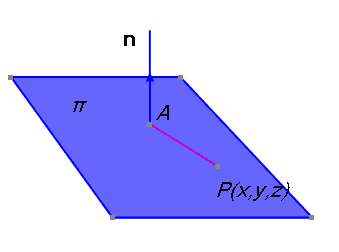
Let P(x,y,z) be a general point on plane π.
\[
\mathbf{n}
=
\begin{pmatrix}
a\\[4pt]
b\\[4pt]
c
\end{pmatrix}
\]
is a normal to π passing through point A.
\[
P \text{ lies in } \pi,\ \text{so}\ \overrightarrow{AP}\ \perp\ \mathbf{n}
\]
\[
\Rightarrow\ \mathbf{n}\cdot\overrightarrow{AP}=0
\]
\[
\text{Let }\mathbf{a}=\overrightarrow{OA}
\quad\text{and}\quad
\mathbf{p}=\overrightarrow{OP},
\ \text{so}\
\overrightarrow{AP}
=
\overrightarrow{OP}-\overrightarrow{OA}
\]
\[
\Rightarrow\ \mathbf{n}\cdot(\mathbf{p}-\mathbf{a})=0
\]
\[
\Rightarrow\ \mathbf{n}\cdot\mathbf{p}-\mathbf{n}\cdot\mathbf{a}=0
\]
\[
\Rightarrow\ \mathbf{n}\cdot\mathbf{p}
=
\mathbf{n}\cdot\mathbf{a}
\]
\[
\text{This gives a vector equation for plane }\pi.
\]
\[
\text{Since both }\mathbf{n}\text{ and }A\text{ are fixed, }
\mathbf{n}\cdot\mathbf{a}\text{ is a constant.}
\]
\[
\text{Let }\mathbf{n}\cdot\mathbf{a}=k
\]
\[
\text{Then }\mathbf{n}\cdot\mathbf{p}-\mathbf{n}\cdot\mathbf{a}=0
\]
\[
\Rightarrow\ \mathbf{n}\cdot\mathbf{p}-k=0
\]
\[
\Rightarrow\ \mathbf{n}\cdot\mathbf{p}=k
\]
\[
\Rightarrow
\begin{pmatrix}
a\\[4pt]
b\\[4pt]
c
\end{pmatrix}
\cdot
\begin{pmatrix}
x\\[4pt]
y\\[4pt]
z
\end{pmatrix}
= k
\]
\[
\Rightarrow\ ax + by + cz = k
\]
\[
\text{Which gives a co-ordinate equation for plane }\pi.
\]
\[
\text{If }\; ax + by + cz = k
\]
\[
\text{Then }\; \mathbf{n} = (a,b,c)\ \text{is a normal vector.}
\]
\[
\text{If } P \text{ and } Q \text{ lie on the plane,}
\]
\[
\mathbf{n}\cdot\mathbf{p}=k
\quad\text{and}\quad
\mathbf{n}\cdot\mathbf{q}=k
\]
\[
\Rightarrow\ \mathbf{n}\cdot(\mathbf{p}-\mathbf{q})=0
\]
\[
\Rightarrow\ \mathbf{n}\ \text{is orthogonal to all directions in the plane.}
\]
Steps:
- Identify the normal (use cross product if necessary).
- The dot product of the normal and each point on the plane is equal.
- Find the dot product of the normal and one known point.
- Use this to form the plane equation.
Example
Find the equation of the plane perpendicular to
n = 2i + 3j + 6k
at point G(1,2,0).
Does T(2,4,0) lie on the plane?
\[
\text{Let } P(x,y,z) \text{ be a general point on the plane}
\]
\[
\text{so }\ \overrightarrow{GP}\ \perp\ \mathbf{n}
\]
\[
\Rightarrow\ \mathbf{n}\cdot\overrightarrow{GP}=0
\]
\[
\text{Let }\mathbf{g}=\overrightarrow{OG}
\quad\text{and}\quad
\mathbf{p}=\overrightarrow{OP},
\ \text{so }\
\overrightarrow{GP}
=
\overrightarrow{OP}-\overrightarrow{OG}
\]
\[
\mathbf{n}\cdot\overrightarrow{GP}=0
\]
\[
\mathbf{n}\cdot(\mathbf{p}-\mathbf{g})=0
\]
\[
\mathbf{n}\cdot\mathbf{p}-\mathbf{n}\cdot\mathbf{g}=0
\]
\[
\text{Let }\mathbf{n}\cdot\mathbf{g}=k
\]
\[
\Rightarrow
\begin{pmatrix}
2\\[4pt]
3\\[4pt]
6
\end{pmatrix}
\cdot
\begin{pmatrix}
1\\[4pt]
2\\[4pt]
0
\end{pmatrix}
= k
\]
\[
\Rightarrow\ 2 + 6 = k
\]
\[
\Rightarrow\ k = 8
\]
\[
\text{Then }\mathbf{n}\cdot\mathbf{p}-\mathbf{n}\cdot\mathbf{g}=0
\]
\[
\Rightarrow\ \mathbf{n}\cdot\mathbf{p}-8=0
\]
\[
\Rightarrow\ \mathbf{n}\cdot\mathbf{p}=8
\]
\[
\Rightarrow
\begin{pmatrix}
2\\[4pt]
3\\[4pt]
6
\end{pmatrix}
\cdot
\begin{pmatrix}
x\\[4pt]
y\\[4pt]
z
\end{pmatrix}
= 8
\]
\[
\Rightarrow\ 2x + 3y + 6z = 8
\]
\[
\text{The plane has equation } 2x + 3y + 6z = 8.
\]
\[
\text{Substitute } T(2,4,0) \text{ into } 2x + 3y + 6z = 8
\]
\[
2\times 2 \;+\; 3\times 4 \;+\; 6\times 0
\;=\;
4 + 12
\;=\;
16
\]
\[
\text{since } 16 \ne 8,\; T \text{ does not lie on the plane.}
\]
Example
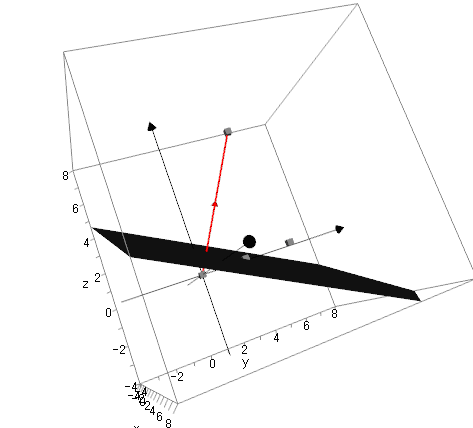
Given R(1,2,3) and S(−2,−1,−3),
find the equation of the plane passing through R
which is perpendicular to RS.
\[
\mathbf{n}\cdot\overrightarrow{RP}=0
\]
\[
\Rightarrow\ \mathbf{n}\cdot(\mathbf{p}-\mathbf{r})=0
\]
\[
\mathbf{n}\cdot\mathbf{p}-\mathbf{n}\cdot\mathbf{r}=0
\]
\[
\text{Let }\mathbf{r}=\overrightarrow{OR}
\quad\text{and}\quad
\mathbf{p}=\overrightarrow{OP},
\ \text{so }\
\overrightarrow{RP}
=
\overrightarrow{OP}-\overrightarrow{OR}
\]
\[
\mathbf{n}\cdot\overrightarrow{RP}=0
\]
\[
\mathbf{n}\cdot(\mathbf{p}-\mathbf{r})=0
\]
\[
\Rightarrow\ \mathbf{n}\cdot\mathbf{p}-\mathbf{n}\cdot\mathbf{r}=0
\]
\[
\text{Here, the line }\overrightarrow{RS}\text{ describes the normal, }\mathbf{n}
\]
\[
\Rightarrow\
\overrightarrow{RS}\cdot\mathbf{p}
-
\overrightarrow{RS}\cdot\mathbf{r}
=0
\]
\[
\Rightarrow\
\overrightarrow{RS}\cdot\mathbf{p}
=
\overrightarrow{RS}\cdot\mathbf{r}
\]
\[
\overrightarrow{RS}
=
\begin{pmatrix}
-2\\[4pt]
-1\\[4pt]
-3
\end{pmatrix}
-
\begin{pmatrix}
1\\[4pt]
2\\[4pt]
3
\end{pmatrix}
=
\begin{pmatrix}
-3\\[4pt]
-3\\[4pt]
-6
\end{pmatrix}
\]
\[
\Rightarrow\
\overrightarrow{RS}\cdot\mathbf{r}
=
\begin{pmatrix}
-3\\[4pt]
-3\\[4pt]
-6
\end{pmatrix}
\cdot
\begin{pmatrix}
1\\[4pt]
2\\[4pt]
3
\end{pmatrix}
\]
\[
= -3 - 6 - 18 = -27
\]
\[
\overrightarrow{RS}\cdot\mathbf{p} = -27
\]
\[
\Rightarrow
\begin{pmatrix}
-3\\[4pt]
-3\\[4pt]
-6
\end{pmatrix}
\cdot
\begin{pmatrix}
x\\[4pt]
y\\[4pt]
z
\end{pmatrix}
= -27
\]
\[
\Rightarrow\ -3x - 3y - 6z = -27
\]
\[
\Rightarrow\ x + y + 2z = 9
\]
\[
\text{is an equation of the plane.}
\]
Example
Find the equation of the plane passing through
A(1,3,1), B(2,0,−2) and C(4,5,6).
\[
\overrightarrow{AB}
=
\begin{pmatrix}
2\\[4pt]
0\\[4pt]
-2
\end{pmatrix}
-
\begin{pmatrix}
1\\[4pt]
3\\[4pt]
1
\end{pmatrix}
=
\begin{pmatrix}
1\\[4pt]
-3\\[4pt]
-3
\end{pmatrix}
\]
\[
\overrightarrow{AC}
=
\begin{pmatrix}
4\\[4pt]
5\\[4pt]
6
\end{pmatrix}
-
\begin{pmatrix}
1\\[4pt]
3\\[4pt]
1
\end{pmatrix}
=
\begin{pmatrix}
3\\[4pt]
2\\[4pt]
5
\end{pmatrix}
\]
\[ \text{Let } P(x,y,z) \text{ be a general point on the plane } \mathbf{n}\cdot\overrightarrow{AP}=0 \] \[ \text{Let }\mathbf{a}=\overrightarrow{OA} \quad\text{and}\quad \mathbf{p}=\overrightarrow{OP}, \ \text{so }\ \overrightarrow{AP} = \overrightarrow{OP}-\overrightarrow{OA} \] \[ \Rightarrow\ \mathbf{n}\cdot(\mathbf{p}-\mathbf{a})=0 \]
\[
\text{Here, }\mathbf{n}
=
\left|
\overrightarrow{AB}
\times
\overrightarrow{AC}
\right|
\]
\[
\mathbf{n}
=
\left|
\overrightarrow{AB}
\times
\overrightarrow{AC}
\right|
=
\left|
\begin{matrix}
\mathbf{i} & \mathbf{j} & \mathbf{k} \\
1 & -3 & -3 \\
3 & 2 & 5
\end{matrix}
\right|
\]
\[
= -9\mathbf{i}\;-\;14\mathbf{j}\;+\;11\mathbf{k}
\]
\[
\mathbf{p}-\mathbf{a}
=
\begin{pmatrix}
x\\[4pt]
y\\[4pt]
z
\end{pmatrix}
-
\begin{pmatrix}
1\\[4pt]
3\\[4pt]
1
\end{pmatrix}
=
\begin{pmatrix}
x-1\\[4pt]
y-3\\[4pt]
z-1
\end{pmatrix}
\]
\[
\Rightarrow\
\mathbf{n}\cdot\overrightarrow{AP}=0
\]
\[
\Rightarrow
\begin{pmatrix}
-9\\[4pt]
-14\\[4pt]
11
\end{pmatrix}
\cdot
\begin{pmatrix}
x-1\\[4pt]
y-3\\[4pt]
z-1
\end{pmatrix}
=0
\]
\[
\Rightarrow\
-9(x-1)\;-\;14(y-3)\;+\;11(z-1)=0
\]
\[
\Rightarrow\
-9x + 9\;-\;14y + 42\;+\;11z - 11 = 0
\]
\[
\Rightarrow\
-9x - 14y + 11z = -40
\]
A plane in space can be found if
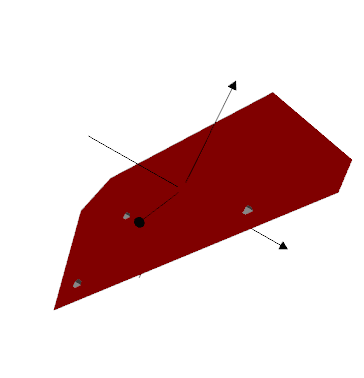
- 3 points on the plane are known
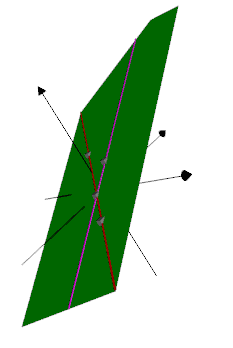
- 2 non‑parallel intersecting lines on the plane are known
- One point on the plane and a normal to the plane are known
 © Alexander Forrest