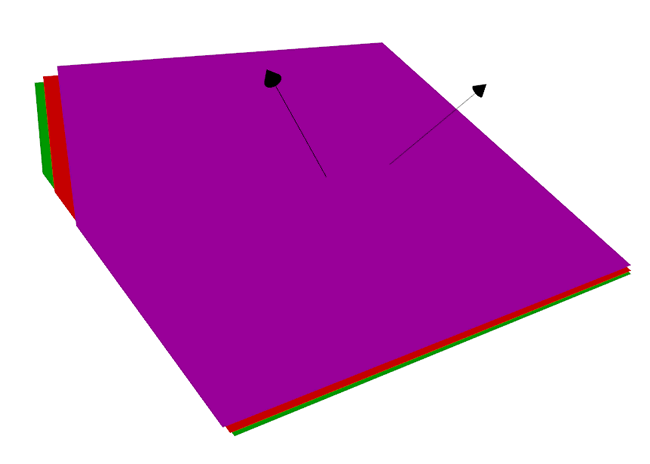
Vector Equations
The angle between two planes
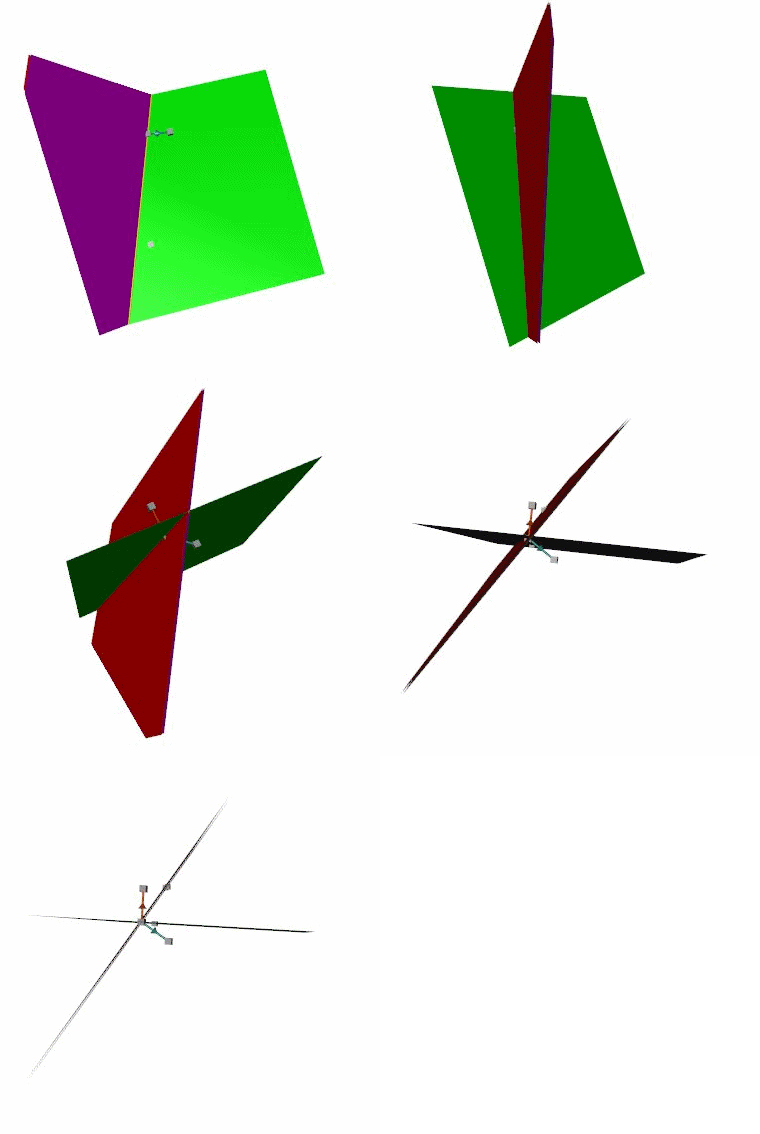
The angle between two planes is found using the scalar product.
It is equal to the acute angle determined by the normal vectors
of the planes.
Example
Calculate the angle between the planes
\(\pi_1: x + 2y - 2z = 5\) and \(\pi_2: 6x - 3y + 2z = 8\).
\[
\text{let }\mathbf{a}
=
\begin{pmatrix}
1\\[4pt]
2\\[4pt]
-2
\end{pmatrix}
\text{ represent the normal for }\pi_1
\]
\[
\text{and }\mathbf{b}
=
\begin{pmatrix}
6\\[4pt]
-3\\[4pt]
2
\end{pmatrix}
\text{ represent the normal for }\pi_2
\]
\[
\lVert \mathbf{a} \rVert
= \sqrt{\,1 + 4 + 4\,}
\]
\[
= 3
\]
\[
\lVert \mathbf{b} \rVert
= \sqrt{\,36 + 9 + 4\,}
\]
\[
= 7
\]
\[
\;\;\cos\theta
=
\frac{
a_1 b_1 + a_2 b_2 + a_3 b_3
}{
\lVert \mathbf{a} \rVert \,\lVert \mathbf{b} \rVert
}
\]
\[
\;\;\cos\theta
=
\frac{
1\times 6 \;-\; 2\times 3 \;-\; 2\times 2
}{
21
}
\]
\[
\;\;\cos\theta
=
\frac{-4}{\;21\;}
\]
\[
\;\;\theta = 100.98^\circ\ \text{i.e. obtuse}
\]
\[
\;\;\theta = 79.02^\circ
\]
The distance between parallel planes
Let P be a point on plane \(\pi_1: ax + by + cz = n\)
(i.e. a·x = n),
and Q a point on plane \(\pi_2: ax + by + cz = m\)
(i.e. a·x = m).
Since the planes are parallel, they share the common normal
a = \(ai + bj + ck\).
The distance between the planes is:
\[
PQ
=
\frac{\;\lvert m - n \rvert\;}
{\;\lVert \mathbf{a} \rVert\;}
\]
Example
Calculate the distance between the planes
\(\pi_1: x + 2y - 2z = 5\) and
\(\pi_2: 6x + 12y - 12z = 8\).
\[
x + 2y - 2z = 5
\]
\[
6x + 12y - 12z = 8
\]
\[
\text{so}
\]
\[
x + 2y - 2z = \frac{4}{3}
\]
\[
\text{so }\mathbf{a}
=
\begin{pmatrix}
1\\[4pt]
2\\[4pt]
-2
\end{pmatrix},
\quad
n = 5
\quad\text{and}\quad
m = \frac{4}{3}
\]
\[
PQ
=
\frac{\lvert m - n \rvert}{\lVert \mathbf{a} \rVert}
\]
\[
\;\;=
\frac{\left|\dfrac{4}{3} - 5\right|}
{\left|\sqrt{1 + 4 + 4}\right|}
\]
\[
\;\;=
\frac{\dfrac{11}{3}}{3}
\]
\[
\;\;=
\frac{11}{9}
\]
\[
= 1\dfrac{2}{9}\ \text{units}
\]
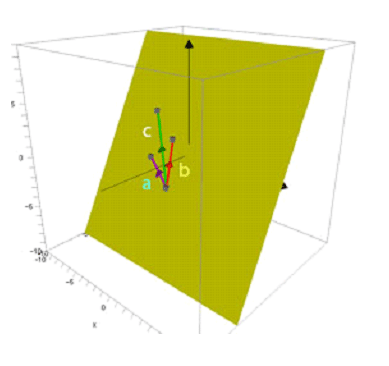
If a relationship exists between vectors a,
b and c such that
c = λa + μb, where λ and μ are constants,
then vectors a, b and c are coplanar.
If three vectors are coplanar,
c = λa + μb.
Vector equation of a plane
From the coplanar section above,
c = λa + μb.
When position vectors are used:
\[
\mathbf{c} = \lambda \mathbf{a} + \mu \mathbf{b}
\]
\[
\overrightarrow{AR}
= \lambda \overrightarrow{AB} + \mu \overrightarrow{AC}
\]
\[
\mathbf{r} - \mathbf{a}
= \lambda(\mathbf{b} - \mathbf{a}) + \mu(\mathbf{c} - \mathbf{a})
\]
\[
\mathbf{r}
= \lambda(\mathbf{b} - \mathbf{a}) + \mu(\mathbf{c} - \mathbf{a}) + \mathbf{a}
\]
\[
\mathbf{r}
= \lambda\mathbf{b} - \lambda\mathbf{a}
+ \mu\mathbf{c} - \mu\mathbf{a}
+ \mathbf{a}
\]
\[
\mathbf{r}
= \mathbf{a} - \lambda\mathbf{a} - \mu\mathbf{a}
+ \mu\mathbf{c} + \lambda\mathbf{b}
\]
\[
\mathbf{r}
= (1 - \lambda - \mu)\mathbf{a}
+ \lambda\mathbf{b}
+ \mu\mathbf{c}
\]
r = (1 − λ − μ)a + λb + μc is the
vector equation of the plane.
Since λ and μ are variable, there are many possible equations
for the plane.
Example
Find a vector equation of the plane through the points
A(−1,−2,−3), B(−2,0,1) and C(−4,−1,−1).
\[
\mathbf{r}
= (1 - \lambda - \mu)\mathbf{a}
+ \lambda\mathbf{b}
+ \mu\mathbf{c}
\]
\[
= (1 - \lambda - \mu)
\begin{pmatrix}
-1\\[2pt]
-2\\[2pt]
-3
\end{pmatrix}
+ \lambda
\begin{pmatrix}
-2\\[2pt]
0\\[2pt]
1
\end{pmatrix}
+ \mu
\begin{pmatrix}
-4\\[2pt]
-1\\[2pt]
-1
\end{pmatrix}
\]
\[
=
\begin{pmatrix}
-(1-\lambda-\mu) - 2\lambda - 4\mu\\[4pt]
-2(1-\lambda-\mu) - \mu\\[4pt]
-3(1-\lambda-\mu) + \lambda - \mu
\end{pmatrix}
\]
\[
=
\begin{pmatrix}
-1 + \lambda + \mu - 2\lambda - 4\mu\\[4pt]
-2 + 2\lambda + 2\mu - \mu\\[4pt]
-3 + 3\lambda + 3\mu + \lambda - \mu
\end{pmatrix}
\]
\[
=
\begin{pmatrix}
-1 - \lambda - 3\mu\\[4pt]
-2 + 2\lambda + \mu\\[4pt]
-3 + 4\lambda + 2\mu
\end{pmatrix}
\]
\[
=
(-1 - \lambda - 3\mu)\,\mathbf{i}
+ (-2 + 2\lambda + \mu)\,\mathbf{j}
+ (-3 + 4\lambda + 2\mu)\,\mathbf{k}
\]
If λ = 2 and μ = 3:
\[
\mathbf{r}
=
(-1 - \lambda - 3\mu)\,\mathbf{i}
+
(-2 + 2\lambda + \mu)\,\mathbf{j}
+
(-3 + 4\lambda + 2\mu)\,\mathbf{k}
\]
\[
\mathbf{r}
=
(-1 - 2 - 9)\,\mathbf{i}
+
(-2 + 4 + 3)\,\mathbf{j}
+
(-3 + 8 + 6)\,\mathbf{k}
\]
\[
\mathbf{r}
=
-12\,\mathbf{i}
+ 5\,\mathbf{j}
+ 11\,\mathbf{k}
\]
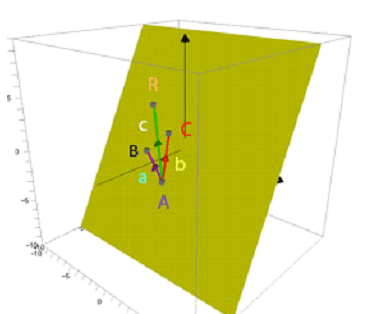
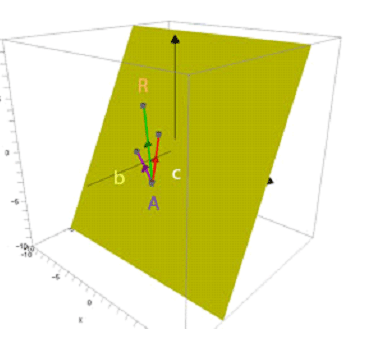
When A is a known point on the plane, R is any point on the plane,
and b and c are vectors parallel to the plane,
the vector equation of the plane is
r = a + λb + μc.
A line can be described when a point on it and its direction vector
(a vector parallel to the line) are known.
In the diagram below, the line L passes through points
A(\(x_1,y_1,z_1\)) and P(x,y,z).
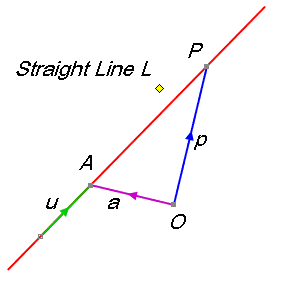
u is the direction vector \(ai + bj + ck\).
Being on the line, it has the same direction as any parallel line.
O is the origin.
a and p represent the position vectors of A and P.
\[
P \text{ is on line } L
\]
\[
\Rightarrow\ \overrightarrow{AP} = \lambda \mathbf{u}
\quad\text{for some scalar }\lambda
\]
\[
\Rightarrow\ \mathbf{p} - \mathbf{a} = \lambda \mathbf{u}
\]
\[
\Rightarrow\ \mathbf{p} = \mathbf{a} + \lambda \mathbf{u}
\]
\[
\mathbf{p} = \mathbf{a} + \lambda \mathbf{u}
\]
\[
\text{is the vector equation of the line}
\]
\[
\text{convention often replaces }\mathbf{p}\text{ with }\mathbf{r}
\]
\[
\Rightarrow\ \mathbf{r} = \mathbf{a} + \lambda \mathbf{u}
\]
\[
\text{If two points are known, say }A\text{ and }B
\]
\[
\text{then }\mathbf{u} = \overrightarrow{AB} = \mathbf{b} - \mathbf{a}
\]
\[
\Rightarrow\ \mathbf{r} = \mathbf{a} + \lambda(\mathbf{b} - \mathbf{a})
\]
\[
\Rightarrow\ \mathbf{r} = \mathbf{a} + \lambda\mathbf{b} - \lambda\mathbf{a}
\]
\[
\Rightarrow\ \mathbf{r} = (1 - \lambda)\mathbf{a} + \lambda\mathbf{b}
\]
\[
\text{In component form, }\mathbf{r} = \mathbf{a} + \lambda\mathbf{u}\text{ becomes}
\]
\[
\begin{pmatrix}
x\\[4pt]
y\\[4pt]
z
\end{pmatrix}
=
\begin{pmatrix}
x_1\\[4pt]
y_1\\[4pt]
z_1
\end{pmatrix}
+
\lambda
\begin{pmatrix}
a\\[4pt]
b\\[4pt]
c
\end{pmatrix}
\]
\[
\text{Thus}
\]
\[
\begin{pmatrix}
x\\[4pt]
y\\[4pt]
z
\end{pmatrix}
=
\begin{pmatrix}
x_1 + \lambda a\\[4pt]
y_1 + \lambda b\\[4pt]
z_1 + \lambda c
\end{pmatrix}
\]
\[
\text{giving the parametric equations}
\]
\[
x = x_1 + \lambda a,
\qquad
y = y_1 + \lambda b,
\qquad
z = z_1 + \lambda c
\]
\[
\text{so}
\]
\[
\frac{x - x_1}{a}
= \lambda
\qquad
\frac{y - y_1}{b}
= \lambda
\qquad
\frac{z - z_1}{c}
= \lambda
\]
\[
\text{Giving the symmetric form}
\]
\[
\frac{x - x_1}{a}
=
\frac{y - y_1}{b}
=
\frac{z - z_1}{c}
=
\lambda
\]
\[
\text{This is also known as:}
\]
\[
\text{standard form}
\]
\[
\text{canonical form}
\]
\[
\text{co‑ordinate equation}
\]
Example
Find the vector equation of the straight line through (3,2,1)
which is parallel to the vector \(2i + 3j + 4k\).
\[
\mathbf{r} = \mathbf{a} + \lambda\mathbf{u}
\]
\[
\Rightarrow\
\mathbf{r}
= 3\mathbf{i} + 2\mathbf{j} + \mathbf{k}
\;+\;
\lambda(2\mathbf{i} + 3\mathbf{j} + 4\mathbf{k})
\]
\[
\Rightarrow\
\mathbf{r}
=
\begin{pmatrix}
3\\[4pt]
2\\[4pt]
1
\end{pmatrix}
+
\lambda
\begin{pmatrix}
2\\[4pt]
3\\[4pt]
4
\end{pmatrix}
\]
\[
\text{are the vector equations of the line}
\]
Example
Find the vector form of the equation of the straight line
which has the following parametric equations.
\[
x = 4 - 2\lambda,
\qquad
y = 7 + \lambda,
\qquad
z = 3 - 4\lambda
\]
\[
\begin{pmatrix}
x\\[4pt]
y\\[4pt]
z
\end{pmatrix}
=
\begin{pmatrix}
4\\[4pt]
7\\[4pt]
3
\end{pmatrix}
+
\lambda
\begin{pmatrix}
-2\\[4pt]
1\\[4pt]
-4
\end{pmatrix}
\]
\[
\Rightarrow\
\mathbf{r}
=
4\mathbf{i} + 7\mathbf{j} + 3\mathbf{k}
\;+\;
\lambda(-2\mathbf{i} + \mathbf{j} - 4\mathbf{k})
\]
Example
Find the Cartesian form of the line which has position vector
\(3i + 2j + k\) and is parallel to the vector \(i - j + k\).
\[
\mathbf{r}
= 3\mathbf{i} + 2\mathbf{j} + \mathbf{k}
\;+\;
\lambda(\mathbf{i} - \mathbf{j} + \mathbf{k})
\]
\[
\Rightarrow
\begin{pmatrix}
x\\[4pt]
y\\[4pt]
z
\end{pmatrix}
=
\begin{pmatrix}
3\\[4pt]
2\\[4pt]
1
\end{pmatrix}
+
\lambda
\begin{pmatrix}
1\\[4pt]
-1\\[4pt]
1
\end{pmatrix}
\]
\[
\therefore\
x = 3 + \lambda,
\qquad
y = 2 - \lambda,
\qquad
z = 1 + \lambda
\]
\[
\frac{x - 3}{1}
=
\frac{y - 2}{-1}
=
\frac{z - 1}{1}
=
\lambda
\]
\[
\Rightarrow\
x - 3
=
2 - y
=
z - 1
=
\lambda
\]
Example
Find the vector equation of the line passing through
A(1,2,3) and B(4,5,6).
\[
\mathbf{r} = \mathbf{a} + \lambda\mathbf{u}
\]
\[
\mathbf{a} = \mathbf{i} + 2\mathbf{j} + 3\mathbf{k}
\]
\[
\mathbf{b} = 4\mathbf{i} + 5\mathbf{j} + 6\mathbf{k}
\]
\[
\mathbf{u} = \overrightarrow{AB} = \mathbf{b} - \mathbf{a}
\]
\[
\Rightarrow\
\mathbf{u} = 3\mathbf{i} + 3\mathbf{j} + 3\mathbf{k}
\]
\[
\Rightarrow\
\mathbf{r}
=
\mathbf{i} + 2\mathbf{j} + 3\mathbf{k}
\;+\;
\lambda(3\mathbf{i} + 3\mathbf{j} + 3\mathbf{k})
\]
\[
\text{alternatively}
\]
\[
\mathbf{r}
=
(1-\lambda)\mathbf{a}
+
\lambda\mathbf{b}
\]
\[
\Rightarrow\
\mathbf{r}
=
(1-\lambda)(\mathbf{i} + 2\mathbf{j} + 3\mathbf{k})
+
\lambda(4\mathbf{i} + 5\mathbf{j} + 6\mathbf{k})
\]
\[
\Rightarrow\
\mathbf{r}
=
(\mathbf{i} + 2\mathbf{j} + 3\mathbf{k})
-
\lambda(\mathbf{i} + 2\mathbf{j} + 3\mathbf{k})
+
\lambda(4\mathbf{i} + 5\mathbf{j} + 6\mathbf{k})
\]
\[
\Rightarrow\
\mathbf{r}
=
(\mathbf{i} + 2\mathbf{j} + 3\mathbf{k})
+
\lambda(3\mathbf{i} + 3\mathbf{j} + 3\mathbf{k})
\]
Example
\[
\text{The vector equation of a line is}
\]
\[
\mathbf{r}
= 3\mathbf{i} + 2\mathbf{j} + 6\mathbf{k}
\;+\;
\lambda(2\mathbf{i} - \mathbf{j} + 3\mathbf{k})
\]
\[
\text{State the point with } z\text{-coordinate }3 \text{ which also lies on this line.}
\]
\[
\mathbf{r}
=
\begin{pmatrix}
3\\[4pt]
2\\[4pt]
6
\end{pmatrix}
+
\lambda
\begin{pmatrix}
2\\[4pt]
-1\\[4pt]
3
\end{pmatrix}
\]
\[
\Rightarrow\quad
x = 3 + 2\lambda,
\qquad
y = 2 - \lambda,
\qquad
z = 6 + 3\lambda
\]
\[
\text{When } z = 3
\]
\[
\qquad 3 = 6 + 3\lambda
\]
\[
\Rightarrow\quad
\lambda = \frac{3 - 6}{3} = -1
\]
\[
\Rightarrow\quad
x = 3 - 2 = 1,
\qquad
y = 2 + 1 = 3,
\qquad
z = 6 - 3 = 3
\]
\[
\Rightarrow\quad
\text{point } (1,\,3,\,3) \text{ lies on the line}
\]
Example
\[
\text{A line } L \text{ has equations}
\]
\[
\frac{x + 2}{3}
=
\frac{y - 1}{2}
=
\frac{3 - z}{4}
\]
\[
\text{Is the vector }
\mathbf{s} = 6\mathbf{i} + 4\mathbf{j} - 8\mathbf{k}
\text{ parallel to } L?
\]
\[
\frac{x+2}{3}
=
\frac{y-1}{2}
=
\frac{3-z}{4}
=
\lambda
\]
\[
\Rightarrow\quad
x = -2 + 3\lambda,
\qquad
y = 1 + 2\lambda,
\qquad
z = 3 - 4\lambda
\]
\[
\Rightarrow\quad
\mathbf{r}
=
\begin{pmatrix}
-2\\[4pt]
1\\[4pt]
3
\end{pmatrix}
+
\lambda
\begin{pmatrix}
3\\[4pt]
2\\[4pt]
-4
\end{pmatrix}
\]
\[
\mathbf{r} = \mathbf{a} + \lambda\mathbf{u}
\]
\[
(-2,\,1,\,3) \text{ is a point on } L,
\qquad
\lambda(3\mathbf{i}+2\mathbf{j}-4\mathbf{k}) \text{ is a direction vector.}
\]
\[
\mathbf{s}=6\mathbf{i}+4\mathbf{j}-8\mathbf{k}
\]
\[
\text{Direction ratios of } \mathbf{s}:\quad 6:4:-8 = 3:2:-4
\]
\[
\text{Direction ratios of } \mathbf{u}:\quad 3:2:-4
\]
\[
\therefore\ \mathbf{s} \parallel \mathbf{u}
\]
\(\mathbf{s} \) is parallel to L
The angle between a line and a plane
The angle θ between a line and a plane is the complement of the
angle between the line and the normal to the plane.
If the line has direction vector u and the normal
to the plane is a, then:
\[
\sin\theta^\circ
=
\left|\cos(90^\circ - \theta^\circ)\right|
=
\frac{\left|\mathbf{a}\cdot\mathbf{u}\right|}
{\left|\mathbf{a}\right|\left|\mathbf{u}\right|}
\]
Example
\[
\text{Given the equations}
\]
\[
\frac{x-4}{3}
=
\frac{y-3}{2}
=
\frac{z-5}{6}
\]
\[
\text{and the plane } 6x + 3y - 2z = 14
\]
\[
\text{1) Find the point of intersection}
\]
\[
\text{2) Find the angle the line makes with the plane.}
\]
1)
\[
\frac{x-4}{3}
=
\frac{y-3}{2}
=
\frac{z-5}{6}
=
\lambda
\]
\[
\Rightarrow\quad
x = 4 + 3\lambda,
\qquad
y = 3 + 2\lambda,
\qquad
z = 5 + 6\lambda
\]
\[
\therefore\
(4 + 3\lambda,\; 3 + 2\lambda,\; 5 + 6\lambda)
\text{ lies on the plane.}
\]
\[
6(4 + 3\lambda)
\;+\;
3(3 + 2\lambda)
\;-\;
2(5 + 6\lambda)
= 14
\]
\[
24 + 18\lambda
\;+\;
9 + 6\lambda
\;-\;
10 - 12\lambda
= 14
\]
\[
23 + 12\lambda = 14
\]
\[
\lambda
=
\frac{14 - 23}{12}
=
\frac{-9}{12}
=
-\frac{3}{4}
\]
\[
\begin{aligned}
x &= 4 + 3\!\left(-\frac{3}{4}\right)
&&= \frac{16 - 9}{4}
&&= \frac{7}{4}
\\[6pt]
y &= 3 + 2\!\left(-\frac{3}{4}\right)
&&= \frac{12 - 6}{4}
&&= \frac{3}{2}
\\[6pt]
z &= 5 + 6\!\left(-\frac{3}{4}\right)
&&= \frac{20 - 18}{4}
&&= \frac{1}{2}
\end{aligned}
\]
\[
\text{The point of intersection is }
\left(
\frac{7}{4},
\;\frac{3}{2},
\;\frac{1}{2}
\right)
\]
2)
\[
\sin\theta^\circ
=
\left|\cos(90^\circ - \theta^\circ)\right|
=
\frac{\left|\mathbf{a}\cdot\mathbf{u}\right|}
{\left|\mathbf{a}\right|\left|\mathbf{u}\right|}
\]
\[
\mathbf{a}
=
6\mathbf{i}
+
3\mathbf{j}
-
2\mathbf{k}
\]
\[
\mathbf{u}
=
3\mathbf{i}
+
2\mathbf{j}
+
6\mathbf{k}
\]
\[
\sin\theta^\circ
=
\frac{
\left|
\,(6\mathbf{i}+3\mathbf{j}-2\mathbf{k})\cdot(3\mathbf{i}+2\mathbf{j}+6\mathbf{k})\,
\right|
}{
\left|\sqrt{36+9+4}\right|\;
\left|\sqrt{9+4+36}\right|
}
\]
\[
\Rightarrow\quad
\sin\theta^\circ
=
\frac{12}{49}
\qquad
(0^\circ \le \theta \le 90^\circ)
\]
\[
\Rightarrow\quad
\theta = 14.175^\circ
\]
\[
\text{The angle of intersection is } 14.2^\circ
\]
The intersection of two lines
Example
\[
\text{Show that the lines with equations}
\]
\[
\mathbf{r}
=
\begin{pmatrix}
3\\[4pt]
4\\[4pt]
1
\end{pmatrix}
+
\lambda_1
\begin{pmatrix}
4\\[4pt]
1\\[4pt]
0
\end{pmatrix}
\]
\[
\text{and}
\]
\[
\frac{x+1}{12}
=
\frac{y-7}{6}
=
\frac{z-5}{3}
=
\lambda_2
\]
\[
\text{intersect and find the point of intersection}
\]
\[
\text{and the equation of the plane containing the lines.}
\]
\[
\mathbf{r}
=
\begin{pmatrix}
3\\[4pt]
4\\[4pt]
1
\end{pmatrix}
+
\lambda_1
\begin{pmatrix}
4\\[4pt]
1\\[4pt]
0
\end{pmatrix}
\]
\[
\Rightarrow\quad
x = 3 + 4\lambda_1,
\qquad
y = 4 + \lambda_1,
\qquad
z = 1
\]
\[
\text{and}
\]
\[
\frac{x+1}{12}
=
\frac{y-7}{6}
=
\frac{z-5}{3}
=
\lambda_2
\]
\[
\Rightarrow\quad
x = -1 + 12\lambda_2,
\qquad
y = 7 + 6\lambda_2,
\qquad
z = 5 + 3\lambda_2
\]
Equating co-ordinates
\[
3 + 4\lambda_1
=
-1 + 12\lambda_2
\qquad\qquad
4 + \lambda_1
=
7 + 6\lambda_2
\qquad\qquad
1
=
5 + 3\lambda_2
\]
\[
4\lambda_1
=
-4 + 12\lambda_2
\qquad\qquad
\lambda_1
=
3 + 6\lambda_2
\qquad\qquad
0
=
4 + 3\lambda_2
\]
Now working backwards from z
\[
0 = 4 + 3\lambda_2
\]
\[
-\frac{4}{3} = \lambda_2
\]
So
\[
\lambda_1 = 3 + 6\lambda_2
\]
\[
= 3 + 6\left(-\frac{4}{3}\right) = -5
\]
\[
\text{substituting}
\]
\[
x = 3 + 4\lambda_1,
\qquad
y = 4 + \lambda_1,
\qquad
z = 1
\]
\[
=\, 3 - 20,
\qquad
=\, 4 - 5
\]
\[
=\, -17,
\qquad
=\, -1
\]
\[
\text{Intersection point is } (-17,\,-1,\,1)
\]
\[
\text{Let } A(-17,-1,1),\quad B(3,4,1),\quad C(-1,7,5)\text{ be the points from the lines above.}
\]
\[
\overrightarrow{AB}
=
\begin{pmatrix}
3\\[4pt]
4\\[4pt]
1
\end{pmatrix}
-
\begin{pmatrix}
-17\\[4pt]
-1\\[4pt]
1
\end{pmatrix}
=
\begin{pmatrix}
20\\[4pt]
5\\[4pt]
0
\end{pmatrix}
\]
\[
\overrightarrow{AC}
=
\begin{pmatrix}
-1\\[4pt]
7\\[4pt]
5
\end{pmatrix}
-
\begin{pmatrix}
-17\\[4pt]
-1\\[4pt]
1
\end{pmatrix}
=
\begin{pmatrix}
16\\[4pt]
8\\[4pt]
4
\end{pmatrix}
\]
\[
\mathbf{n}\,\cdot\,\overrightarrow{AP} = 0
\]
\[
\text{Let }\mathbf{a}=\overrightarrow{OA}
\quad\text{and}\quad
\mathbf{p}=\overrightarrow{OP},
\quad\text{so}\quad
\overrightarrow{AP}
=
\overrightarrow{OP}
-
\overrightarrow{OA}.
\]
\[
\Rightarrow\quad
\mathbf{n}\cdot(\mathbf{p}-\mathbf{a}) = 0
\]
\[
\text{Here, }\mathbf{n}
=
\left|\,
\overrightarrow{AB}
\times
\overrightarrow{AC}
\,\right|
\]
\[
\mathbf{n}
=
\left|\,
\overrightarrow{AB}
\times
\overrightarrow{AC}
\,\right|
=
\left|
\begin{matrix}
\mathbf{i} & \mathbf{j} & \mathbf{k} \\
20 & 5 & 0 \\
16 & 8 & 4
\end{matrix}
\right|
\]
\[
\qquad
=\,20\mathbf{i}
- 80\mathbf{j}
+ 80\mathbf{k}
\]
\[
\qquad
=\,\mathbf{i}
- 4\mathbf{j}
+ 4\mathbf{k}
\]
\[
\mathbf{p}-\mathbf{a}
=
\begin{pmatrix}
x\\[4pt]
y\\[4pt]
z
\end{pmatrix}
-
\begin{pmatrix}
-17\\[4pt]
-1\\[4pt]
1
\end{pmatrix}
=
\begin{pmatrix}
x+17\\[4pt]
y+1\\[4pt]
z-1
\end{pmatrix}
\]
\[
\Rightarrow\quad
\mathbf{n}\cdot\overrightarrow{AP}=0
\]
\[
\Rightarrow\quad
\begin{pmatrix}
1\\[4pt]
-4\\[4pt]
4
\end{pmatrix}
\cdot
\begin{pmatrix}
x+17\\[4pt]
y+1\\[4pt]
z-1
\end{pmatrix}
=0
\]
\[
\Rightarrow\quad
x+17
-4(y+1)
+4(z-1)
=0
\]
\[
\Rightarrow\quad
x+17 -4y -4 +4z -4 = 0
\]
\[
\Rightarrow\quad
x - 4y + 4z + 9 = 0
\]
The intersection of two planes
To find the equations of the line of intersection of two planes,
a direction vector and a point on the line are required.
Since the line of intersection lies in both planes, the direction
vector is parallel to the vector product of the normals of each plane.
Example
Find the equation for the line of intersection of the planes:
−3x + 2y + z = −5
7x + 3y − 2z = −2
\[
-3x + 2y + z = -5
\qquad\qquad
7x + 3y - 2z = -2
\]
\[
\text{Let } z = 0
\]
\[
\text{Then}\quad -3x + 2y = -5 \quad\text{(1)}
\]
\[
\text{and}\quad \underline{7x + 3y = -2}\quad\text{(2)}
\]
\[
(2)\times 2:\qquad 14x + 6y = -4
\]
\[
(1)\times (-3):\qquad \underline{9x - 6y = 15}
\]
\[
\text{add:}\qquad 23x = 11
\]
\[
\Rightarrow\quad x = \frac{11}{23}
\]
\[
\text{subst in (1)}
\]
\[
-\frac{33}{23} + 2y = -5
\]
\[
\Rightarrow\quad
y
=
\frac{-5 + \frac{33}{23}}{2}
=
-\frac{41}{23}
\]
\[
\text{The point }
\left(
\frac{11}{23},
\;-\frac{41}{23},
\;0
\right)
\text{ is on the line of intersection.}
\]
\[
\text{Normal vectors are }\;
\mathbf{u} = -3\mathbf{i} + 2\mathbf{j} + \mathbf{k}
\]
\[
\text{and}\qquad
\mathbf{v} = 7\mathbf{i} + 3\mathbf{j} - 2\mathbf{k}
\]
\[
\mathbf{u} \times \mathbf{v}
=
\left|
\begin{matrix}
\mathbf{i} & \mathbf{j} & \mathbf{k} \\
-3 & 2 & 1 \\
7 & 3 & -2
\end{matrix}
\right|
\]
\[
=\, -7\mathbf{i} + \mathbf{j} - 23\mathbf{k}
\]
\[
\mathbf{r}
=
\begin{pmatrix}
\frac{11}{23}\\[4pt]
-\frac{41}{23}\\[4pt]
0
\end{pmatrix}
+
\lambda_1
\begin{pmatrix}
-7\\[4pt]
1\\[4pt]
-23
\end{pmatrix}
\]
\[
=\;
\begin{pmatrix}
\frac{11}{23}\\[4pt]
-\frac{41}{23}\\[4pt]
0
\end{pmatrix}
+
\lambda_1
\begin{pmatrix}
\frac{7}{23}\\[4pt]
-\frac{1}{23}\\[4pt]
1
\end{pmatrix}
\]
\[
\Rightarrow\quad
x
=
\frac{11}{23}
+
\frac{7}{23}\lambda_1,
\qquad
y
=
-\frac{41}{23}
-
\frac{1}{23}\lambda_1,
\qquad
z
=
\lambda_1
\]
The distance from a point to a plane
To find the distance of a point P to a plane:
- Find the equation of the projection PP′ using the normal to the plane and the point P.
- Find the coordinates of P′, the intersection with the plane.
- Apply the distance formula to PP′.
Alternatively:
\[
\text{The distance } D \text{ between a point }
P_0(x_0, y_0, z_0)
\]
\[
\text{and the plane } ax + by + cz + d = 0
\]
\[
\text{is}
\]
\[
D
=
\frac{
\left|
ax_0 + by_0 + cz_0 + d
\right|
}{
\sqrt{a^2 + b^2 + c^2}
}
\]
Example
Find the distance between the point (3,1,−2) and the plane
\(x + 2y + 2z = -4\).
\[
\mathbf{r}
=
\mathbf{u}
+
\lambda_1
\begin{pmatrix}
1\\[4pt]
2\\[4pt]
2
\end{pmatrix}
\]
\[
\mathbf{r}
=
\begin{pmatrix}
3\\[4pt]
1\\[4pt]
-2
\end{pmatrix}
+
\lambda_1
\begin{pmatrix}
1\\[4pt]
2\\[4pt]
2
\end{pmatrix}
\]
\[
\Rightarrow\quad
x = 3 + \lambda_1,
\qquad
y = 1 + 2\lambda_1,
\qquad
z = -2 + 2\lambda_1
\]
\[
\text{Plane equation is } x + 2y + 2z + 4 = 0
\]
\[
\Rightarrow\;
3 + \lambda_1
\;+\;
2(1 + 2\lambda_1)
\;+\;
2(-2 + 2\lambda_1)
\;+\;
4
= 0
\]
\[
\Rightarrow\;
3 + \lambda_1
+ 2 + 4\lambda_1
- 4 + 4\lambda_1
+ 4
= 0
\]
\[
\Rightarrow\;
5 + 9\lambda_1 = 0
\]
\[
\Rightarrow\;
\lambda_1 = -\frac{5}{9}
\]
\[
\Rightarrow\quad
x = 3 - \frac{5}{9},
\qquad
y = 1 - \frac{10}{9},
\qquad
z = -2 - \frac{10}{9}
\]
\[
P' \left( \frac{22}{9},\; -\frac{1}{9},\; -\frac{28}{9} \right)
\]
\[
PP'
=
\begin{pmatrix}
-\frac{5}{9}\\[4pt]
-\frac{10}{9}\\[4pt]
-\frac{10}{9}
\end{pmatrix}
=
\frac{-5}{9}
\begin{pmatrix}
1\\[4pt]
2\\[4pt]
2
\end{pmatrix}
\]
\[
\Rightarrow\;
\lvert PP' \rvert
=
\left|
\frac{-5}{9}
\right|
\sqrt{1 + 4 + 4}
\]
\[
=
\left|
\frac{-5}{9}
\right|
\cdot 3
\]
\[
=
\left|
\frac{-5}{3}
\right|
=
\frac{5}{3}\text{ units}
\]
Alternatively:
\[
x + 2y + 2z = -4
\quad\text{at }(3,1,-2)
\]
\[
\Rightarrow\;
x + 2y + 2z + 4 = 0
\]
\[
D
=
\frac{
\left|
ax_0 + by_0 + cz_0 + d
\right|
}{
\sqrt{a^2 + b^2 + c^2}
}
\]
\[
=\;
\frac{
\left|\,3 + 2 - 4 + 4\,\right|
}{
\sqrt{1 + 4 + 4}
}
\]
\[
=\;
\frac{5}{3}
\]
\[
\text{The distance is }\frac{5}{3}\text{ units.}
\]
The distance from a point to a line
To find the distance of a point P to a line L:
- The line has direction vector u and parameter λ.
-
Find the coordinates of PP′ by using the scalar product
with u and the point P.
- Apply the distance formula to PP′.
Example
\[
\text{Find the distance between the line}
\]
\[
\frac{x+3}{-6}
=
\frac{y-2}{9}
=
\frac{z+8}{6}
\]
\[
\text{and the point }
P(-1,\;7,\;4)
\]
\[
P' =
\begin{pmatrix}
-3\\[4pt]
2\\[4pt]
-8
\end{pmatrix}
+
\lambda_1
\begin{pmatrix}
-6\\[4pt]
9\\[4pt]
6
\end{pmatrix}
\]
\[
\Rightarrow\quad
x = -3 - 6\lambda_1,
\qquad
y = 2 + 9\lambda_1,
\qquad
z = -8 + 6\lambda_1
\]
\[
P'(-3 - 6\lambda_1,\; 2 + 9\lambda_1,\; -8 + 6\lambda_1)
\]
\[
\overrightarrow{PP'}
=
\begin{pmatrix}
-3 - 6\lambda_1\\[4pt]
2 + 9\lambda_1\\[4pt]
-8 + 6\lambda_1
\end{pmatrix}
-
\begin{pmatrix}
-1\\[4pt]
7\\[4pt]
4
\end{pmatrix}
\]
\[
=
\begin{pmatrix}
-2 - 6\lambda_1\\[4pt]
-5 + 9\lambda_1\\[4pt]
-12 + 6\lambda_1
\end{pmatrix}
\]
\[
\overrightarrow{PP'} \cdot \mathbf{u} = 0
\]
\[
\Rightarrow\;
\begin{pmatrix}
-2 - 6\lambda_1\\[4pt]
-5 + 9\lambda_1\\[4pt]
-12 + 6\lambda_1
\end{pmatrix}
\cdot
\begin{pmatrix}
-6\\[4pt]
9\\[4pt]
6
\end{pmatrix}
= 0
\]
\[
\Rightarrow\;
-6(-2 - 6\lambda_1)
\;+\;
9(-5 + 9\lambda_1)
\;+\;
6(-12 + 6\lambda_1)
= 0
\]
\[
\Rightarrow\;
12 + 36\lambda
\;-\; 45 + 81\lambda
\;-\; 72 + 36\lambda
= 0
\]
\[
\Rightarrow\;
-105 + 153\lambda = 0
\]
\[
\Rightarrow\;
\lambda
=
\frac{105}{153}
=
\frac{35}{51}
\]
\[
\overrightarrow{PP'}
=
\begin{pmatrix}
-2 - 6\lambda\\[4pt]
-5 + 9\lambda\\[4pt]
-12 + 6\lambda
\end{pmatrix}
=
\begin{pmatrix}
-2 - 6\left(\frac{35}{51}\right)\\[4pt]
-5 + 9\left(\frac{35}{51}\right)\\[4pt]
-12 + 6\left(\frac{35}{51}\right)
\end{pmatrix}
\]
\[
=
\begin{pmatrix}
-\frac{104}{17}\\[4pt]
\frac{20}{17}\\[4pt]
-\frac{134}{17}
\end{pmatrix}
=
\frac{1}{17}
\begin{pmatrix}
-104\\[4pt]
20\\[4pt]
-134
\end{pmatrix}
\]
\[
\Rightarrow\;
PP'
=
\frac{1}{17}\sqrt{29172}
=
10.04
\]
\[
\text{The distance is } 10.04 \text{ units.}
\]
The intersection of three planes
To solve the intersection, use the equations of the planes
\(ax + by + cz + d = 0\) to form an augmented matrix,
which is solved for x, y and z.
The intersection between three planes could be:
A single point
A unique solution is found.
Example
\[
x + y + z = 2
\]
\[
4x + 2y + z = 4
\]
\[
x - y + z = 4
\]
\[
\left[
\begin{array}{ccc|c}
1 & 1 & 1 & 2\\
4 & 2 & 1 & 4\\
1 & -1 & 1 & 4
\end{array}
\right]
\;\longrightarrow\;
\left[
\begin{array}{ccc|c}
1 & 1 & 1 & 2\\
0 & 1 & 0 & -1\\
0 & 0 & 1 & 2
\end{array}
\right]
\]
\[
\longrightarrow\;
\left[
\begin{array}{ccc|c}
1 & 0 & 0 & 1\\
0 & 1 & 0 & -1\\
0 & 0 & 1 & 2
\end{array}
\right]
\]
\[
\text{Point } (1,\,-1,\,2)
\]
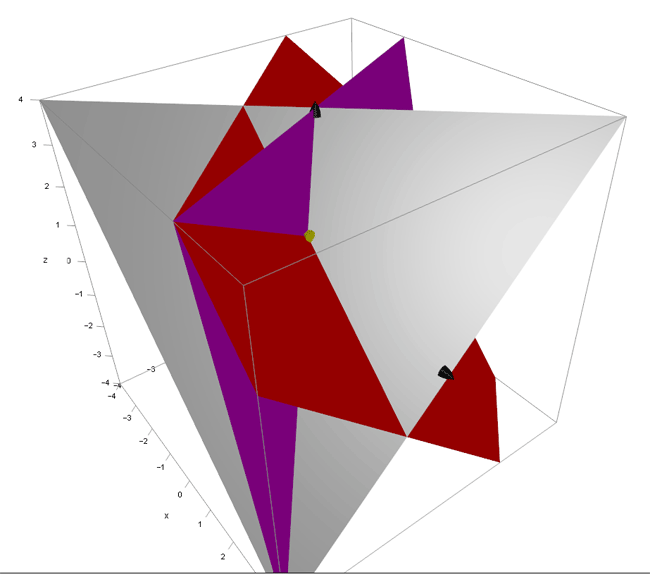
A line of intersection
An infinite number of solutions exist.
Example
\[
x + 2y + 2z = 11
\]
\[
x - y + 3z = 8
\]
\[
4x - y + 11z = 35
\]
\[
\left[
\begin{array}{ccc|c}
1 & 2 & 2 & 11\\
1 & -1 & 3 & 8\\
4 & -1 & 11 & 35
\end{array}
\right]
\;\longrightarrow\;
\left[
\begin{array}{ccc|c}
1 & 2 & 2 & 11\\
0 & -3 & 1 & -3\\
0 & 0 & 0 & 0
\end{array}
\right]
\]
\[
x + 2y + 2z = 11
\]
\[
\Rightarrow\quad
x = 11 - 2y - 2z
\]
\[
-3y + z = -3
\]
\[
y = \frac{z + 3}{3}
\]
\[
z = z
\]
Parametric equations.
\[ x = 11 - 2\left(\frac{z+3}{3}\right) - 2z \] \[ x = 13 - \frac{8z}{3} \] \[ x = \frac{39 - 8z}{3} \]
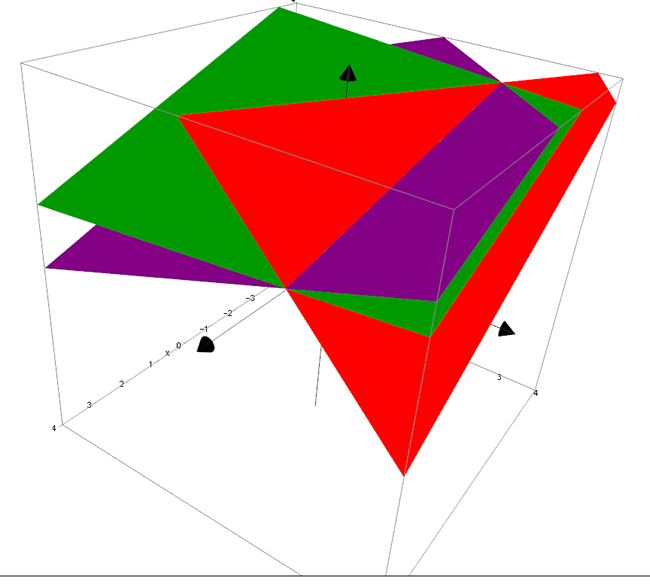
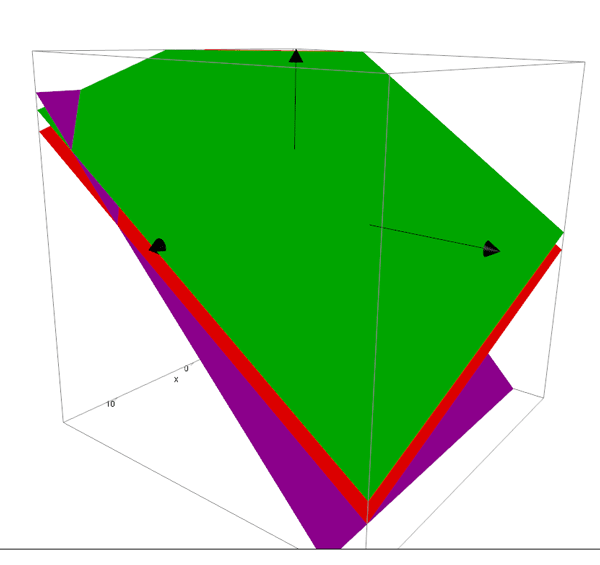
Two lines of intersection
An infinite number of solutions.
Example
\[
2x + 4y + 6z = 22
\]
\[
3y + 3z = -9
\]
\[
x + 2y + 3z = 16
\]
\[
\text{which reduces to}
\]
\[
\left[
\begin{array}{ccc|c}
1 & 2 & 3 & 11\\
0 & 1 & 1 & -3\\
0 & 0 & 0 & 5
\end{array}
\right]
\]
\[
\text{The system is inconsistent}
\]
Using the second row:
\[
\text{let } z = t
\]
\[
\text{so}
\]
\[
y + t = -3
\]
\[
y = -3 - t
\]
Substitute into first row:
\[
x + 2y + 3z = 11
\]
\[
x + 2(-3 - t) + 3t = 11
\]
\[
x - 6 - 2t + 3t = 11
\]
\[
x + t = 17
\]
\[
x = 17 - t
\]
\[
\text{so}
\]
\[
t = z = 17 - x = -y - 3
\]
Substitute into third equation:
\[
x + 2y + 3z = 16
\]
\[
x + 2(-3 - t) + 3t = 16
\]
\[
x - 6 - 2t + 3t = 16
\]
\[
x + t = 22
\]
\[
t = 22 - x
\]
\[
\text{so}
\]
\[
t = z = 22 - x = -y - 3
\]
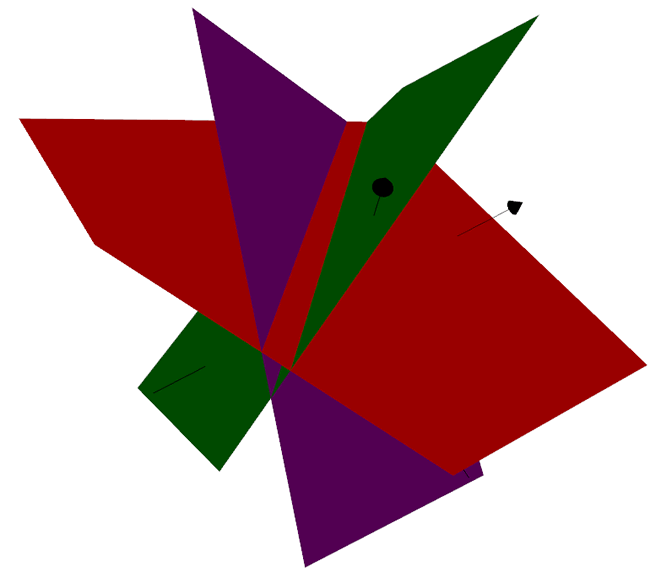
Three lines of intersection
Similar to above. Examine each pair of planes in turn.
Example
\[
3x - y + 2z = 1
\]
\[
x - 2y - z = -3
\]
\[
2x + y + 3z = 5
\]
\[
\text{Which reduces to}
\]
\[
\left[
\begin{array}{ccc|c}
1 & -\tfrac{1}{3} & \tfrac{2}{3} & \tfrac{1}{3}\\[6pt]
0 & 1 & 1 & 2\\[6pt]
0 & 0 & 0 & 1
\end{array}
\right]
\]
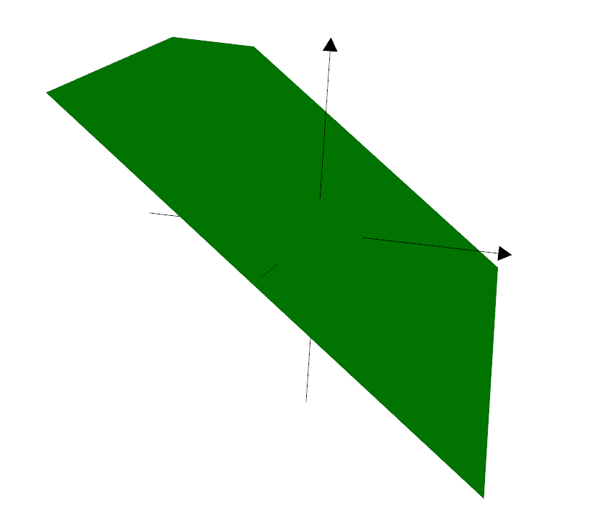
A plane of intersection
Two redundant equations.
Example
\[
3x - y + 4z = 3
\]
\[
6x - 2y + 8z = 6
\]
\[
15x - 5y + 20z = 15
\]
\[
\text{Which reduces to}
\]
\[
\left[
\begin{array}{ccc|c}
1 & -\tfrac{1}{3} & \tfrac{4}{3} & 1\\[6pt]
0 & 0 & 0 & 0\\[6pt]
0 & 0 & 0 & 0
\end{array}
\right]
\]
No consistency:
No intersection
Example
\[
3x - y + 4z = 3
\]
\[
6x - 2y + 8z = 8
\]
\[
15x - 5y + 20z = 12
\]
\[
\text{Which reduces to}
\]
\[
\left[
\begin{array}{ccc|c}
1 & -\tfrac{1}{3} & \tfrac{4}{3} & 1\\[6pt]
0 & 0 & 0 & 2\\[6pt]
0 & 0 & 0 & -3
\end{array}
\right]
\]
No consistency. All planes are parallel.