The Wave Function – Part 1
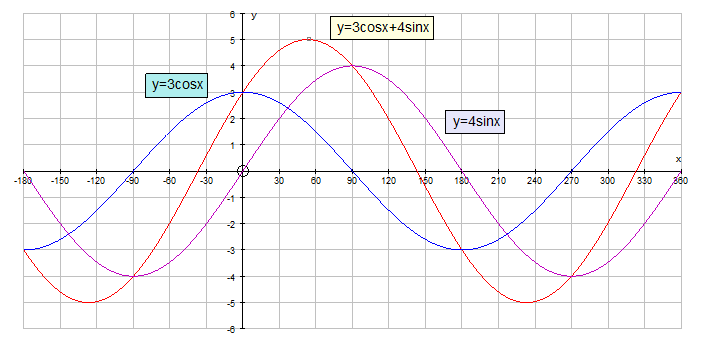
Waves can be added. When this happens, a new wave is formed which can be described by the equation:
\[ \begin{aligned} a\cos x + b\sin x &= k\cos(x - \alpha) \end{aligned} \] \[ \text{where} \] \[ \begin{aligned} k &= \sqrt{a^{2} + b^{2}} \\[0.8em] \tan\alpha &= \frac{b}{a} \end{aligned} \] \[ k = \text{amplitude}, \qquad \alpha = \text{phase angle} \]
Proof
\[ \text{Let } a\cos x + b\sin x = k\cos(x - \alpha) \] \[ \text{Then } a\cos x + b\sin x = k(\cos x \cos\alpha + \sin x \sin\alpha) \] \[ \Rightarrow\; a\cos x + b\sin x = k\cos x \cos\alpha + k\sin x \sin\alpha \] \[ \text{Equating like terms:} \] \[ a\cos x = k\cos x \cos\alpha \qquad b\sin x = k\sin x \sin\alpha \] \[ \Rightarrow\; a = k\cos\alpha \qquad b = k\sin\alpha \]
\[ a\cos x + b\sin x = k\cos(x - \alpha) \] \[ \text{where } k = \sqrt{a^{2} + b^{2}} \qquad\text{and}\qquad \tan\alpha = \frac{b}{a} \] \[ \begin{aligned} a\cos x + b\sin x &= k\cos(x - \alpha) \\[0.8em] &= k(\cos x \cos\alpha + \sin x \sin\alpha) \end{aligned} \] \[ \Rightarrow\; a\cos x + b\sin x = k\cos x \cos\alpha + k\sin x \sin\alpha \] \[ \text{Equating like terms:} \] \[ a = k\cos\alpha \qquad b = k\sin\alpha \] \[ k = \text{amplitude}, \qquad \alpha = \text{phase angle} \]
\[ \text{Now} \] \[ \frac{b}{a} = \frac{k\sin\alpha}{k\cos\alpha} \] \[ = \frac{\sin\alpha}{\cos\alpha} \] \[ = \tan\alpha \] \[ \tan\alpha = \frac{b}{a} \] \[ \text{where }\alpha\text{ lies in the quadrant determined by }\sin\alpha\text{ and }\cos\alpha. \]
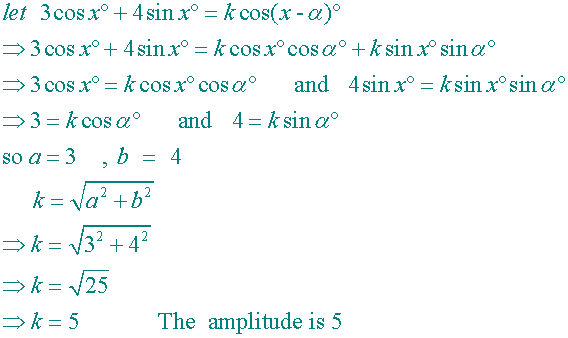
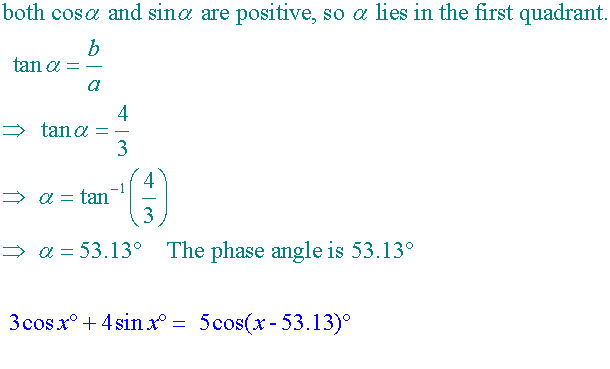
\[ \text{Write } 3\cos x^\circ + 4\sin x^\circ \text{ in the form } k\cos(x - \alpha)^\circ, \quad 0 \le \alpha \le 360. \]
Alternative Proof
\( y = a\cos x + b\sin x \)
\( = \sqrt{a^2 + b^2} \left( \frac{a}{\sqrt{a^2+b^2}}\cos x + \frac{b}{\sqrt{a^2+b^2}}\sin x \right) \)
\( = k(\cos\alpha\cos x + \sin\alpha\sin x) \)
\( = k\cos(x - \alpha) \)
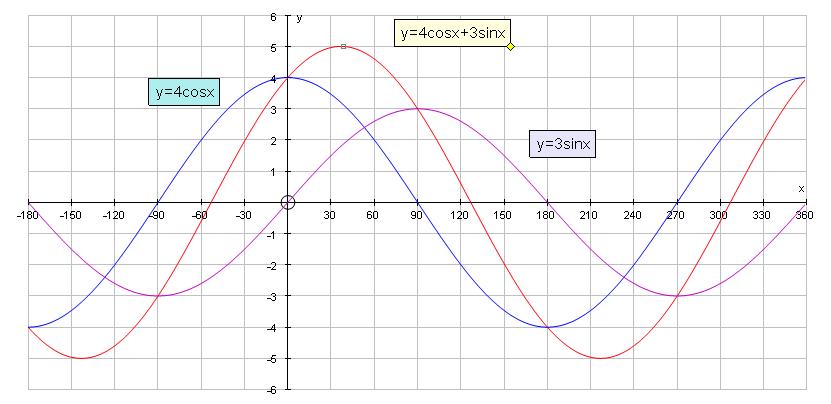
\( y = 4\cos x + 3\sin x \)
\( k = \sqrt{4^2 + 3^2} = 5 \)
\( \tan\alpha = \frac{3}{4} \)
\( y = 5\cos(x - \alpha) \)
Does it matter which value is used for \(a\) and \(b\)?
\[ \text{Write } 4\cos x^\circ + 3\sin x^\circ \text{ in the form } k\cos(x - \alpha)^\circ, \quad 0 \le \alpha \le 360. \]
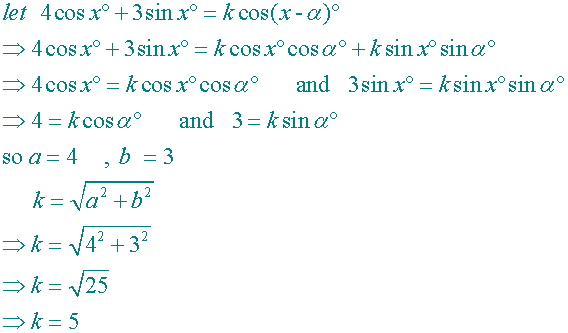
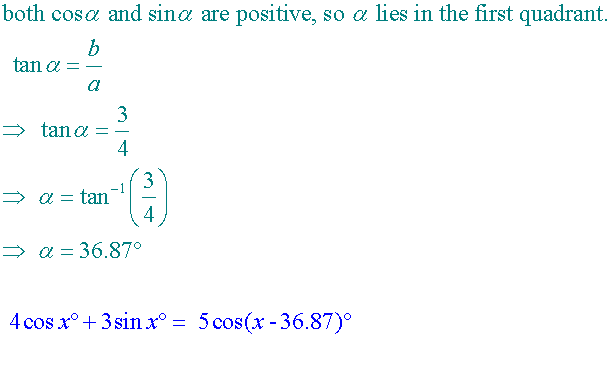
a is always with cos α
b is always with sin α
The Difference of Two Waves
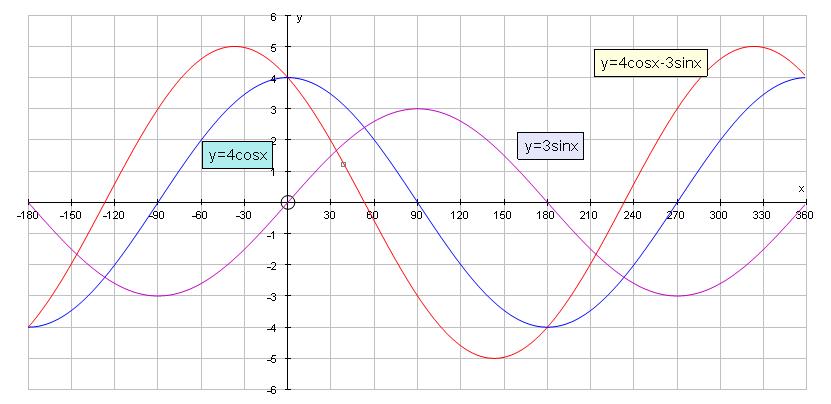
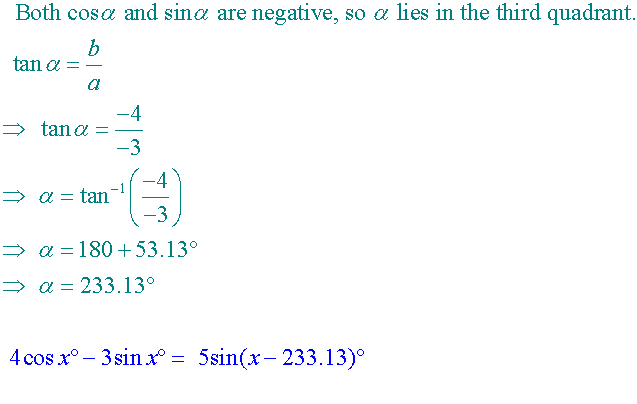
\[ \text{Write } 4\cos x^\circ - 3\sin x^\circ \text{ in the form } k\cos(x - \alpha)^\circ, \quad 0 \le \alpha \le 360. \]
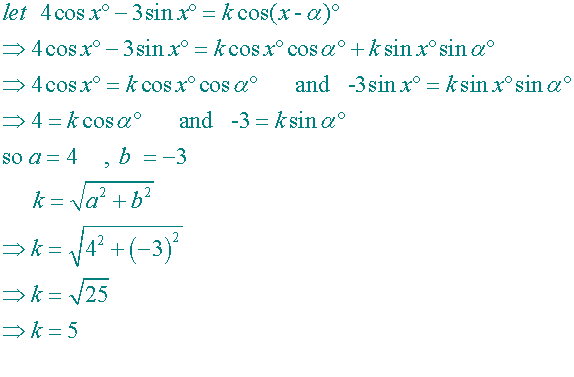
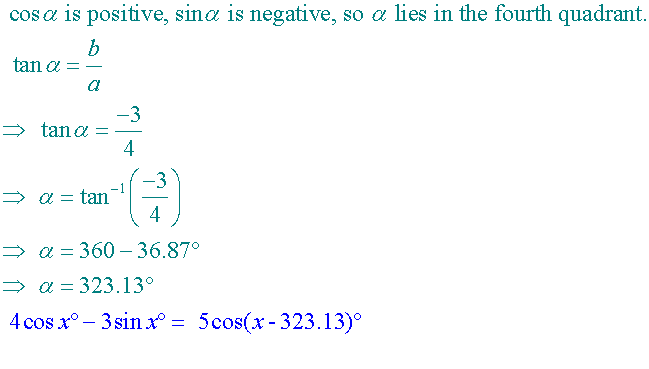
Expressing Waves in the form \( k\cos(x +\alpha) \)
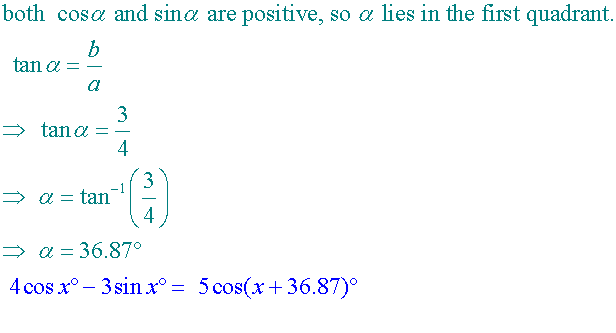
\[ \text{Write } 4\cos x^\circ - 3\sin x^\circ \text{ in the form } k\cos(x + \alpha)^\circ, \quad 0 \le \alpha \le 360. \]
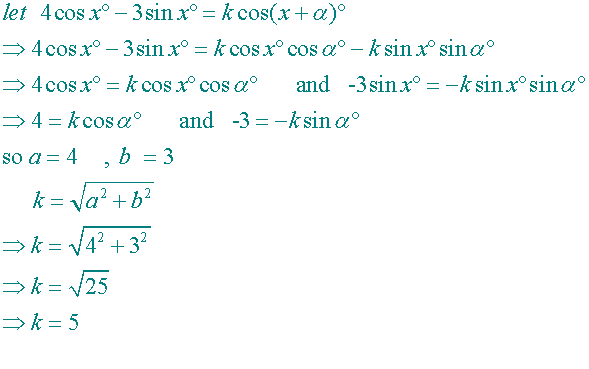
Expressing Waves in the Form \( k\sin(x + \alpha) \)
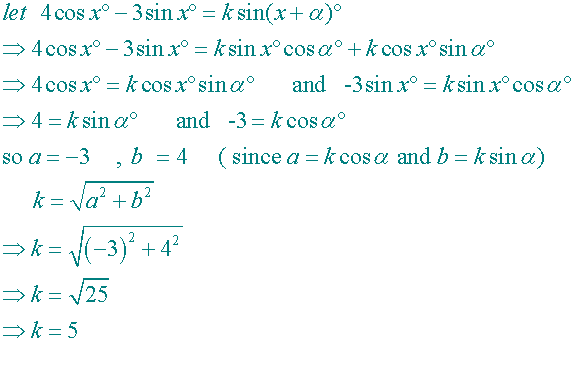
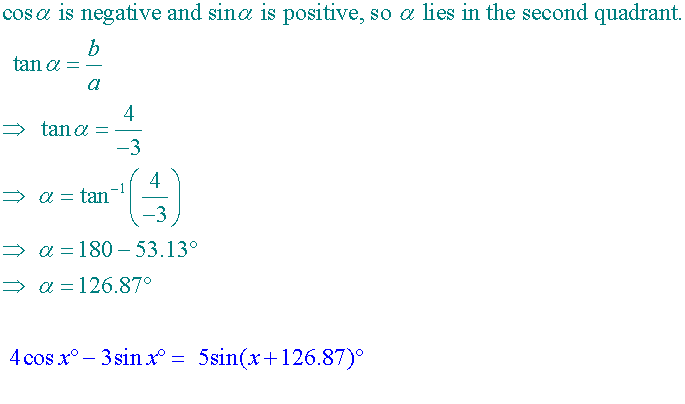
\[ \text{Write } 4\cos x^\circ - 3\sin x^\circ \text{ in the form } k\sin(x + \alpha)^\circ, \quad 0 \le \alpha \le 360. \]
Expressing Waves in the Form \( k\sin(x - \alpha) \)
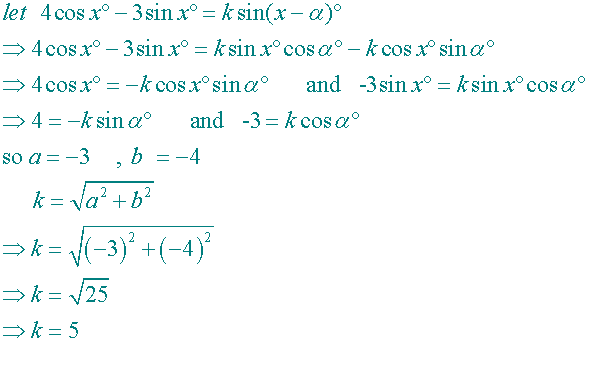
\[ \text{Write } 4\cos x^\circ - 3\sin x^\circ \text{ in the form } k\sin(x - \alpha)^\circ, \quad 0 \le \alpha \le 360. \]
Multiple Angles
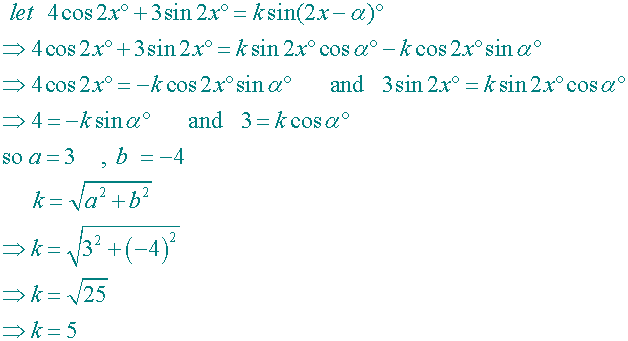
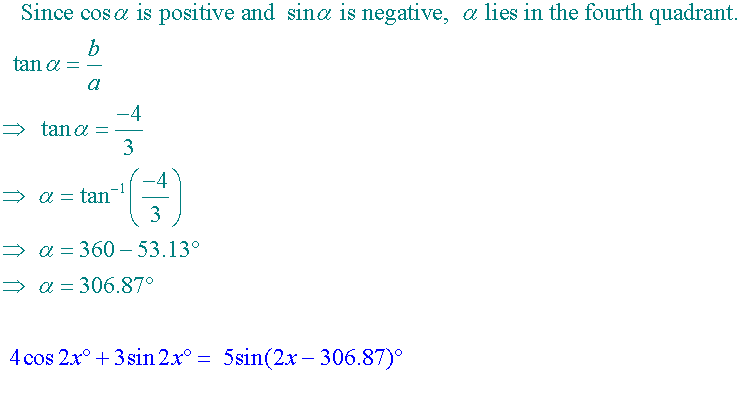
Just exactly the same process, but remember the multiple angle!
\[ \text{Write } 4\cos(2x)^\circ + 3\sin(2x)^\circ \text{ in the form } k\sin(2x - \alpha)^\circ, \quad 0 \le \alpha \le 360. \]