The Wave Function – Part 2
Maximum and Minimum Values
If a wave is written in the form \[ y = k\cos(Ax \pm \alpha) \text{ or } y = k\sin(Ax \pm \alpha) \] then the amplitude is \(k\). Therefore:
\[
\text{Maximum value} = k,\qquad
\text{Minimum value} = -k.
\]
Example
\[
\text{Calculate the maximum and minimum values of the equation}
\]
\[
y = 4\cos(2x)^\circ + 3\sin(2x)^\circ + 11,
\qquad 0 \le x \le 360^\circ.
\]
\[
4\cos(2x)^\circ + 3\sin(2x)^\circ
= k\sin(2x + \alpha)
\]
\[
k = \sqrt{4^2 + 3^2} = 5
\]
\[
\therefore\quad
-5 \le 4\cos(2x)^\circ + 3\sin(2x)^\circ \le 5
\]
\[
\text{The amplitude of the sine wave is } 5,
\]
\[
\qquad
4\cos(2x)^\circ + 3\sin(2x)^\circ
= 5\sin(2x + \alpha)
\]
\[
\text{So}
\qquad
4\cos(2x)^\circ + 3\sin(2x)^\circ + 11
= 5\sin(2x + \alpha) + 11
\]
\[
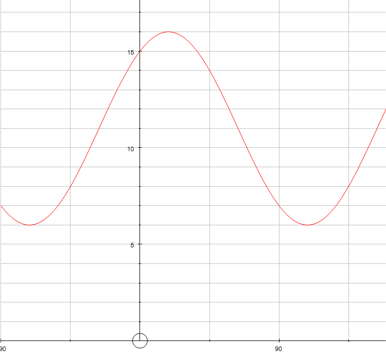
\text{so the maximum value is } 5 + 11 = 16,
\]
\[
\text{and the minimum value is } -5 + 11 = 6.
\]
Example
\[
\text{Find the maximum value of }
12 + \sqrt{3}\sin x + \cos x
\]
\[
\text{and determine the corresponding value of } x
\]
\[
\text{in the range } 0 \le x \le 360^\circ.
\]
\[
\text {Let } \sqrt{3}\sin x + \cos x = k\sin(x+\alpha)
\]
\[
\sqrt{3}\sin x + \cos x
= k\bigl(\sin x \cos\alpha + \cos x \sin\alpha\bigr)
\]
\[
\Rightarrow\;
\sqrt{3}\sin x = k\sin x \cos\alpha,
\qquad
\cos x = k\cos x \sin\alpha
\]
\[
\Rightarrow\;
\sqrt{3} = k\cos\alpha,
\qquad
1 = k\sin\alpha
\]
\[
\text{So } a=\sqrt{3},\; b=1
\]
\[
k = \sqrt{a^2 + b^2}
\]
\[
k = \sqrt{(\sqrt{3})^2 + 1^2}
= \sqrt{3 + 1}
= \sqrt{4}
= 2
\]
\[
\text{Since both } \cos\alpha \text{ and } \sin\alpha \text{ are positive,}
\quad
\alpha \text{ lies in the first quadrant.}
\]
\[
\tan\alpha = \frac{b}{a}
\]
\[
\Rightarrow\;
\tan\alpha = \frac{1}{\sqrt{3}}
\]
\[
\Rightarrow\;
\alpha = \tan^{-1}\!\left(\frac{1}{\sqrt{3}}\right)
= 30^\circ
\]
\[
\sqrt{3}\sin x + \cos x
= 2\sin(x + 30^\circ)
\]
Now substitute this into the equation:
\[
12 + \sqrt{3}\sin\theta + \cos\theta
= 12 + 2\sin(\theta + 30^\circ)
\]
\[
\text{Max value of } \sin(\theta + 30^\circ) = 1
\]
\[
\Rightarrow\;
\text{Max value of } 2\sin(\theta + 30^\circ) = 2
\]
\[
\Rightarrow\;
\text{Max value of } 12 + \sqrt{3}\sin\theta + \cos\theta
= 12 + 2 = 14
\]
\[
\text{This occurs when }
\sin(\theta + 30^\circ) = 1
\]
\[
\theta + 30^\circ = 90^\circ
\]
\[
\Rightarrow\;
\theta = 60^\circ
\]
\[
\boxed{y_{\max} = 14 \text{ at } x = 60^\circ}
\]
Sketching Wave Functions
When sketching a wave function, remember the key points:
- Maximum value (from amplitude)
- Minimum value (from amplitude)
- Where it cuts the y-axis: evaluate at \(x = 0\)
- Where it cuts the x-axis: solve \(y = 0\)
Example
\[
\text{Sketch the graph of the equation }
\sqrt{27}\,\sin x + 3\cos x
\text{ in the form } k\cos(x - \alpha),
\]
\[
\text{where } 0 \le \alpha \le 2\pi.
\]
\[
\text{Let }
\sqrt{27}\,\sin x + 3\cos x
= k\cos(x - \alpha)
\]
\[
\sqrt{27}\,\sin x + 3\cos x
= k\bigl(\cos x\cos\alpha + \sin x\sin\alpha\bigr)
\]
\[
\Rightarrow\;
\sqrt{27}\,\sin x = k\sin\alpha\,\sin x,
\qquad
3\cos x = k\cos\alpha\,\cos x
\]
\[
\Rightarrow\;
\sqrt{27} = k\sin\alpha,
\qquad
3 = k\cos\alpha
\]
\[
\text{So }
a = 3,\quad b = \sqrt{27}
\quad\text{(since } a = k\cos\alpha,\; b = k\sin\alpha\text{)}
\]
\[
k = \sqrt{a^2 + b^2}
\]
\[
k = \sqrt{3^2 + (\sqrt{27})^2}
= \sqrt{9 + 27}
= \sqrt{36}
= 6
\]
\[
\text{Since both } \cos\alpha \text{ and } \sin\alpha \text{ are positive, }
\alpha \text{ lies in the first quadrant.}
\]
\[
\tan\alpha = \frac{b}{a}
\]
\[
\Rightarrow\;
\tan\alpha = \frac{\sqrt{27}}{3}
\]
\[
\Rightarrow\;
\alpha = \tan^{-1}\!\left(\frac{\sqrt{27}}{3}\right)
\quad\text{(remember to use radians)}
\]
\[
\Rightarrow\;
\alpha = 1.0471975\ \text{rads}
\]
\[
\Rightarrow\;
\alpha = \frac{\pi}{3}\ \text{rads}
\]
\[
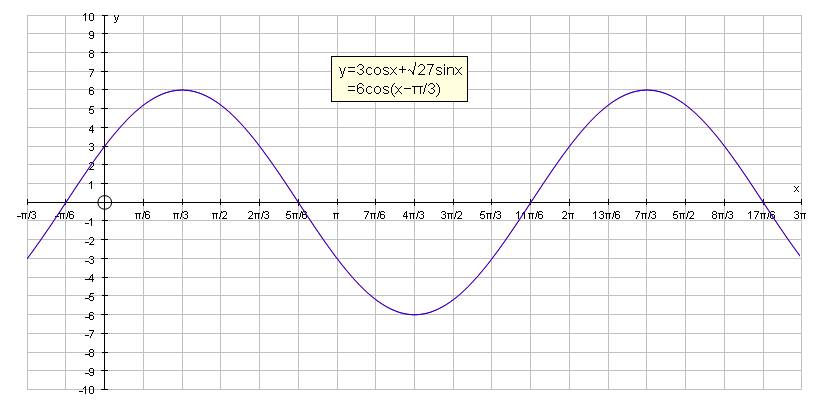
\sqrt{27}\,\sin x + 3\cos x
= 6\cos\!\left(x - \frac{\pi}{3}\right)
\]
\[
\cos\!\left(x - \frac{\pi}{3}\right)
\text{ has a maximum value of } 1
\text{ and a minimum value of } -1.
\]
\[
\text{So the maximum value of }
6\cos\!\left(x - \frac{\pi}{3}\right)
\text{ is } 6
\]
\[
\text{and the minimum value is } -6.
\]
\[
\text{The maximum value occurs when }
\cos\!\left(x - \frac{\pi}{3}\right) = 1.
\]
\[
\Rightarrow\;
x - \frac{\pi}{3}
= \cos^{-1}(1)
\quad\text{(remember to use radians)}
\]
\[
\Rightarrow\;
x - \frac{\pi}{3}
= 0,\; 2\pi
\]
\[
\Rightarrow\;
x = 0 + \frac{\pi}{3}
\quad\text{and}\quad
x = 2\pi + \frac{\pi}{3}
\]
\[
\Rightarrow\;
x = \frac{\pi}{3},
\qquad
x = \frac{7\pi}{3}.
\]
\[
\text{The minimum value occurs when }
\cos\!\left(x - \frac{\pi}{3}\right) = -1
\]
\[
\Rightarrow\;
x - \frac{\pi}{3}
= \cos^{-1}(-1)
\quad\text{(remember to use radians)}
\]
\[
\Rightarrow\;
x - \frac{\pi}{3} = \pi
\]
\[
\Rightarrow\;
x = \pi + \frac{\pi}{3}
\]
\[
\Rightarrow\;
x = \frac{4\pi}{3}
\]
\[
\text{Maximum value of } 6\cos\!\left(x - \frac{\pi}{3}\right) \text{ is } 6
\]
\[
\text{which occurs at }
x = \frac{\pi}{3},\quad
x = \frac{7\pi}{3}.
\]
\[
\text{Minimum value of } 6\cos\!\left(x - \frac{\pi}{3}\right) \text{ is } -6
\]
\[
\text{which occurs at }
x = \frac{4\pi}{3}.
\]
Equations
Use the wave function to solve equations.
Example
\[
\text{Solve }
2\cos x^\circ + 3\sin x^\circ = -1
\qquad
0 \le x \le 360^\circ.
\]
\[
\text{Let }
2\cos x^\circ + 3\sin x^\circ
= k\cos(x^\circ - \alpha^\circ)
\]
\[
2\cos x^\circ + 3\sin x^\circ
= k\bigl(\cos x^\circ \cos\alpha^\circ
+ \sin x^\circ \sin\alpha^\circ\bigr)
\]
\[
\Rightarrow\;
2\cos x^\circ = k\cos\alpha^\circ \cos x^\circ,
\qquad
3\sin x^\circ = k\sin\alpha^\circ \sin x^\circ
\]
\[
\Rightarrow\;
2 = k\cos\alpha^\circ,
\qquad
3 = k\sin\alpha^\circ
\]
\[
\text{So } a = 2,\quad b = 3
\quad\text{(since } a = k\cos\alpha,\; b = k\sin\alpha\text{)}
\]
\[
k = \sqrt{a^2 + b^2}
\]
\[
k = \sqrt{2^2 + 3^2}
= \sqrt{4 + 9}
= \sqrt{13}
\]
\[
\text{Since both } \cos\alpha \text{ and } \sin\alpha \text{ are positive, }
\alpha \text{ lies in the first quadrant.}
\]
\[
\tan\alpha = \frac{b}{a}
\]
\[
\Rightarrow\;
\tan\alpha = \frac{3}{2}
\]
\[
\Rightarrow\;
\alpha = \tan^{-1}\!\left(\frac{3}{2}\right)
\]
\[
\Rightarrow\;
\alpha = 56.31^\circ \; (2\text{ d.p.})
\]
\[
2\cos x^\circ + 3\sin x^\circ
= \sqrt{13}\,\cos\!\left(x - 56.31^\circ\right)
\]
\[
2\cos x^\circ + 3\sin x^\circ = -1
\]
\[
\Rightarrow\;
\sqrt{13}\,\cos\!\left(x - 56.31^\circ\right) = -1
\]
\[
\Rightarrow\;
\cos\!\left(x - 56.31^\circ\right)
= \frac{-1}{\sqrt{13}}
\]
\[
\Rightarrow\;
x - 56.31^\circ
= \cos^{-1}\!\left(\frac{-1}{\sqrt{13}}\right)
\]
\[
\Rightarrow\;
x - 56.31^\circ
= 106.10^\circ
\quad\text{and}\quad
253.90^\circ
\]
\[
\Rightarrow\;
x = 106.10^\circ + 56.31^\circ
\quad\text{and}\quad
x = 253.90^\circ + 56.31^\circ
\]
\[
\Rightarrow\;
x = 162.41^\circ,
\qquad
x = 310.21^\circ.
\]
Example
\[
\text{Solve }
2\cos 2x^\circ + 3\sin2 x^\circ = -1
\qquad
0 \le x \le 360^\circ.
\]
\[
\text{Let }
2\cos 2x^\circ + 3\sin 2x^\circ
= k\cos(2x^\circ - \alpha^\circ)
\]
\[
2\cos 2x^\circ + 3\sin 2x^\circ
= k\bigl(\cos 2x^\circ \cos\alpha^\circ
+ \sin 2x^\circ \sin\alpha^\circ\bigr)
\]
\[
\Rightarrow\;
2\cos 2x^\circ = k\cos\alpha^\circ \cos 2x^\circ,
\qquad
3\sin 2x^\circ = k\sin\alpha^\circ \sin 2x^\circ
\]
\[
\Rightarrow\;
2 = k\cos\alpha^\circ,
\qquad
3 = k\sin\alpha^\circ
\]
\[
\text{So } a = 2,\quad b = 3
\quad\text{(since } a = k\cos\alpha,\; b = k\sin\alpha\text{)}
\]
\[
k = \sqrt{a^2 + b^2}
\]
\[
k = \sqrt{2^2 + 3^2}
= \sqrt{4 + 9}
= \sqrt{13}
\]
\[
\text{Since both } \cos\alpha \text{ and } \sin\alpha \text{ are positive, }
\alpha \text{ lies in the first quadrant.}
\]
\[
\tan\alpha = \frac{b}{a}
\]
\[
\Rightarrow\;
\tan\alpha = \frac{3}{2}
\]
\[
\Rightarrow\;
\alpha = \tan^{-1}\!\left(\frac{3}{2}\right)
\]
\[
\Rightarrow\;
\alpha = 56.31^\circ \; (2\text{ d.p.})
\]
\[
2\cos 2x^\circ + 3\sin 2x^\circ
= \sqrt{13}\,\cos\!\left(2x^\circ - 56.31^\circ\right)
\]
This has found the wave function, now solve the equation
\[
2\cos 2x^\circ + 3\sin 2x^\circ = -1
\]
\[
\Rightarrow\;
\sqrt{13}\,\cos\!\left(2x^\circ - 56.31^\circ\right) = -1
\]
\[
\Rightarrow\;
\cos\!\left(2x^\circ - 56.31^\circ\right)
= \frac{-1}{\sqrt{13}}
\]
\[
\Rightarrow\;
2x^\circ - 56.31^\circ
= \cos^{-1}\!\left(\frac{-1}{\sqrt{13}}\right)
\]
\[
\Rightarrow\;
2x^\circ - 56.31^\circ
= 106.10^\circ
\quad\text{and}\quad
253.90^\circ
\]
\[
\text{This gives the first cycle, but remember that}
\]
\[
\text{there are two cycles in this period.}
\]
\[
\text{Find the other values by adding } 360^\circ.
\]
\[
(2x - 56.31^\circ)
= 106.10^\circ + 360^\circ
= 466.10^\circ,
\]
\[
(2x - 56.31^\circ)
= 253.90^\circ + 360^\circ
= 613.90^\circ.
\]
\[
2x = 106.10^\circ + 56.31^\circ
\]
\[
2x = 162.41^\circ
\]
\[
x = 81.2^\circ \;(1\text{ d.p.})
\]
\[
2x = 253.90^\circ + 56.31^\circ
\]
\[
2x = 310.21^\circ
\]
\[
x = 155.1^\circ \;(1\text{ d.p.})
\]
\[
2x = 466.10^\circ + 56.31^\circ
\]
\[
2x = 522.41^\circ
\]
\[
x = 261.2^\circ \;(1\text{ d.p.})
\]
\[
2x = 613.90^\circ + 56.31^\circ
\]
\[
2x = 670.21^\circ
\]
\[
x = 335.1^\circ \;(1\text{ d.p.})
\]