The Straight Line – Part 2
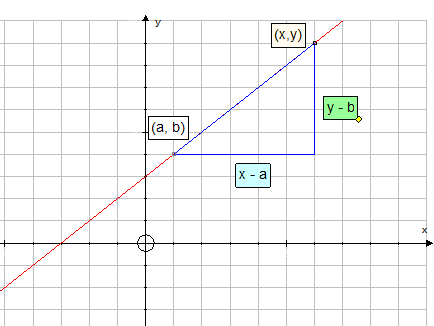
Point–Gradient Formula
\[
y - b = m(x - a)
\]
where \( (a, b) \) is a point on the line.
Proof
\[
\text{Let } P(x, y) \text{ be any point on the line except } A(a, b).
\]
\[
\text{The gradient of a line is }
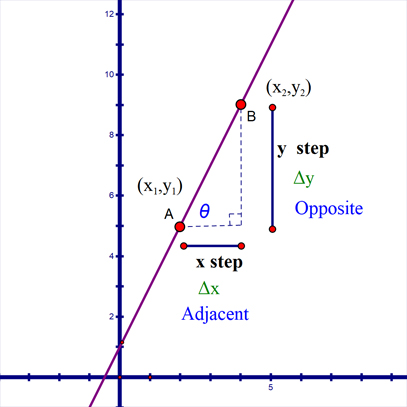
m = \frac{\text{y step}}{\text{x step}}
= \frac{y_2 - y_1}{x_2 - x_1},
\qquad x_2 \ne x_1.
\]
\[
\text{So the gradient of } AP \text{ is }
m = \frac{y - b}{x - a}.
\]
\[
\Rightarrow\; m(x - a) = y - b.
\]
\[
\text{When } x = a,
\]
\[
0 = y - b
\]
\[
\Rightarrow\; y = b
\quad\text{Hence the point } (a, b) \text{ is also on the line.}
\]
\[
\Rightarrow\; y - b = m(x - a).
\]
Example
Find the equation of the line of gradient 3
which passes through the point (1,5).
\[
y - b = m(x - a)
\]
\[
\Rightarrow\; y - 5 = 3(x - 1)
\]
\[
\Rightarrow\; y - 5 = 3x - 3
\]
\[
\Rightarrow\; y = 3x + 2
\]
Gradient and Tangent
\[
\text{Gradient} = \tan \theta
\]
where \( \theta \) is measured anticlockwise from the x‑axis.
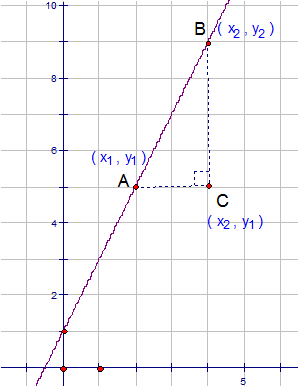
\[
m = \frac{V}{H}
= \frac{\text{y step}}{\text{x step}}
= \frac{y_2 - y_1}{x_2 - x_1}
\]
\[
= \frac{\text{opposite}}{\text{adjacent}}
= \tan\theta
\]
Proof
\[
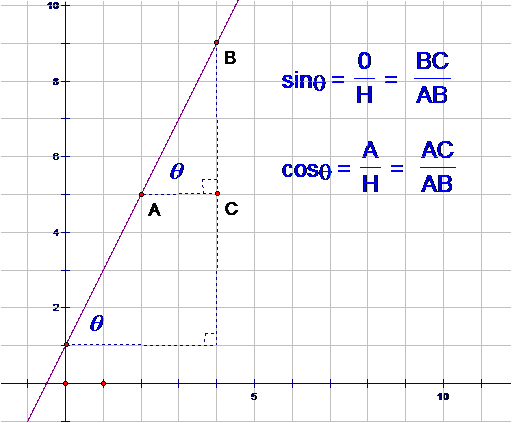
\text{In } \triangle ABC
\]
\[
\sin\theta
= \frac{\text{Opposite}}{\text{Hypotenuse}}
= \frac{BC}{AB}
\]
\[
\cos\theta
= \frac{\text{Adjacent}}{\text{Hypotenuse}}
= \frac{AC}{AB}
\]
\[
\tan\theta
= \frac{\text{Opposite}}{\text{Adjacent}}
= \frac{\sin\theta \times \text{Hypotenuse}}
{\cos\theta \times \text{Hypotenuse}}
\]
\[
\Rightarrow\;
\tan\theta = \frac{\sin\theta}{\cos\theta}
\]
\[
\Rightarrow\;
\tan\theta = \frac{BC}{AC}
\]
\[
\text{But }
m_{ab}
= \frac{y\text{ step}}{x\text{ step}}
= \frac{BC}{AC}
\]
\[
\Rightarrow\;
m_{ab} = \tan\theta
\]
Example
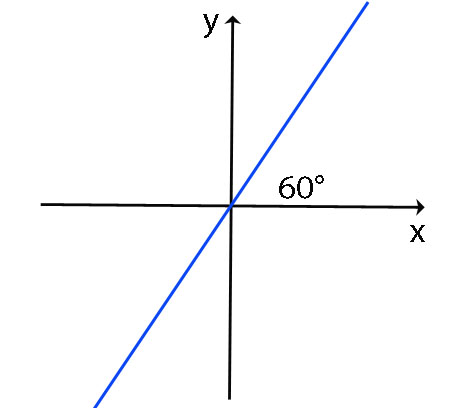
What is the gradient of the line shown?
\[
m = \tan\theta
\]
\[
= \tan 60^\circ
\]
\[
= 1.732 \; (3\text{ d.p.})
\]
Or using exact values:
\[
m = \frac{\sqrt{3}}{1} = \sqrt{3}
\]
Example
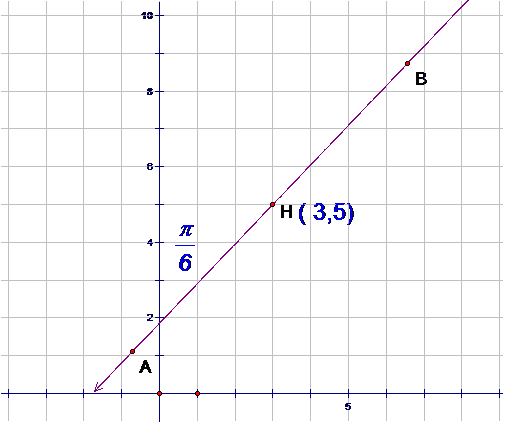
The line AB makes an angle of π /6 radians with the y‑axis.
as shown in the diagram.
a) Find the exact value of the gradient of AB.
b) Given that the point H (3,5) lies on AB, find the equation of the line AB
Remember, angle is measured anticlockwise!
\[
\text{a) The angle between the } x\text{-axis and line AB is }
\frac{\pi}{2} - \frac{\pi}{6}
\]
\[
= \frac{3\pi - \pi}{6}
= \frac{2\pi}{6}
= \frac{\pi}{3}
\]\[
m_{ab} = \frac{\pi}{3}
\]
\[
\text{b) } y - b = m(x - a)
\quad\text{has point } (3,5) \text{ and gradient } \frac{\pi}{3}
\]
\[
\Rightarrow\; y - 5 = \frac{\pi}{3}(x - 3)
\]
\[
\Rightarrow\; y - 5 = \frac{\pi}{3}x - \pi
\]
\[
\Rightarrow\; y - 5 = \pi\left(\frac{1}{3}x - 1\right)
\]
\[
\Rightarrow\; y = \pi\left(\frac{1}{3}x - 1\right) + 5
\]
Differentiation and gradient
Distance Formula
This formula is used to find the length of the line between two points.
\[
\text{From Pythagoras' Theorem}
\]
\[
AB^2 = AC^2 + BC^2
\]
\[
\Rightarrow\;
AB^2
= (x_2 - x_1)^2
+ (y_2 - y_1)^2
\]
\[
\Rightarrow\;
AB = \sqrt{(x_2 - x_1)^2 + (y_2 - y_1)^2}
\]
\[
\text{This is known as the distance formula.}
\]
Example
Do the points A(4,6), B(5,-1)and C(10,4)
form an isosceles triangle?
An isosceles triangle has two equal sides. Use the distance formula to find their lengths.
\[
AB = \sqrt{(x_2 - x_1)^2 + (y_2 - y_1)^2}
\]
\[
\Rightarrow\;
AB = \sqrt{(5 - 4)^2 + \big((-1) - 6\big)^2}
\]
\[
\Rightarrow\;
AB = \sqrt{1^2 + (-7)^2}
\]
\[
\Rightarrow\;
AB = \sqrt{1 + 49}
\]
\[
\Rightarrow\;
AB = \sqrt{50}
\]
\[
AC = \sqrt{(x_2 - x_1)^2 + (y_2 - y_1)^2}
\]
\[
\Rightarrow\;
AC = \sqrt{(10 - 4)^2 + (4 - 6)^2}
\]
\[
\Rightarrow\;
AC = \sqrt{6^2 + (-2)^2}
\]
\[
\Rightarrow\;
AC = \sqrt{36 + 4}
\]
\[
\Rightarrow\;
AC = \sqrt{40}
\]
\[
BC = \sqrt{(x_2 - x_1)^2 + (y_2 - y_1)^2}
\]
\[
\Rightarrow\;
BC = \sqrt{(10 - 5)^2 + \big(4 - (-1)\big)^2}
\]
\[
\Rightarrow\;
BC = \sqrt{5^2 + 5^2}
\]
\[
\Rightarrow\;
BC = \sqrt{25 + 25}
\]
\[
\Rightarrow\;
BC = \sqrt{50}
\]
\[
AB = BC \quad\text{so } \triangle ABC \text{ is isosceles.}
\]
Midpoint Formula
\[
\text{The midpoint of } AB \text{ is}
\]
\[
M\!\left(
\frac{x_1 + x_2}{2},
\frac{y_1 + y_2}{2}
\right)
\]
\[
\text{This is known as the midpoint formula.}
\]
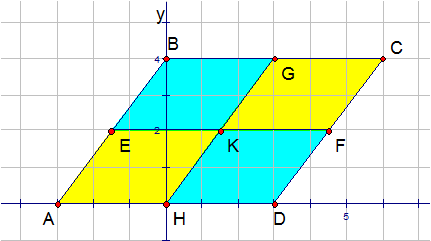
Example
Find the coordinates of:
- G, the midpoint of BC
- F, the midpoint of CD
- The midpoint of AC
- The midpoint of BD
What do you notice about your answers for the last two questions?
\[
\text{The midpoint of } BC \text{ is}
\]
\[
M\!\left(
\frac{x_1 + x_2}{2},
\frac{y_1 + y_2}{2}
\right)
\]
\[
\Rightarrow\;
G\!\left(
\frac{0 + 6}{2},
\frac{4 + 4}{2}
\right)
=
G\!\left(
\frac{6}{2},
\frac{8}{2}
\right)
=
G(3,4)
\]
\[
\text{The midpoint of } CD \text{ is}
\]
\[
M\!\left(
\frac{x_1 + x_2}{2},
\frac{y_1 + y_2}{2}
\right)
\]
\[
\text{so}
\]
\[
F\!\left(
\frac{6 + 3}{2},
\frac{4 + 0}{2}
\right)
=
F\!\left(
\frac{9}{2},
\frac{4}{2}
\right)
\]
\[
= F\!\left(4\tfrac{1}{2},\, 2\right)
\]
\[
\text{The midpoint of } AC \text{ is}
\]
\[
M\!\left(
\frac{x_1 + x_2}{2},
\frac{y_1 + y_2}{2}
\right)
\]
\[
=
\left(
\frac{(-3) + 6}{2},
\frac{0 + 4}{2}
\right)
\]
\[
=
\left(
\frac{3}{2},
\frac{4}{2}
\right)
\]
\[
=
\left(
1\tfrac{1}{2},\; 2
\right)
\]
\[
\text{The midpoint of } BD \text{ is}
\]
\[
M\!\left(
\frac{x_1 + x_2}{2},
\frac{y_1 + y_2}{2}
\right)
\]
\[
=
\left(
\frac{0 + 3}{2},
\frac{4 + 0}{2}
\right)
\]
\[
=
\left(
\frac{3}{2},
\frac{4}{2}
\right)
\]
\[
=
\left(
1\tfrac{1}{2},\; 2
\right)
\]
The diagonals intersect at their midpoint.
Perpendicular Lines
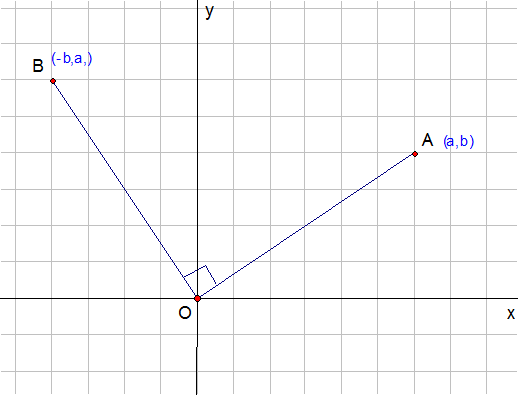
OA is perpendicular to OB.
\[
m_{OA} = \frac{b}{a}
\qquad\qquad
m_{OB} = \frac{a}{-b}
\]
\[
m_{OA} \times m_{OB}
= \frac{b}{a} \times \frac{a}{-b}
= \frac{b}{-b}
= -1
\]
\[
\text{If } m_1 \times m_2 = -1 \text{ for two gradients } m_1, m_2,
\]
\[
\text{then the two lines are perpendicular.}
\]
\[
\text{If } m_1 = m_2,\; \text{the lines are parallel.}
\]
Example
Are the lines \(y = 3x + 7\) and \(3y + x = 54\) perpendicular?
\[
\text{Call } y = 3x + 7 \text{ equation (1)}
\]
\[
\text{so } m_1 = 3
\]
\[
\text{Call } 3y + x = 54 \text{ equation (2)}
\]
\[
\Rightarrow\; y = \frac{54 - x}{3}
\]
\[
\Rightarrow\; y = -\frac{x}{3} + 18
\]
\[
\text{so } m_2 = -\frac{1}{3}
\]
\[
m_1 \times m_2
= 3 \times \left(-\frac{1}{3}\right)
= -1
\]
\[
\text{So the two lines are perpendicular.}
\]
Example
The points A(-2,-4), B(1,2) , C(-5,0) D(1,t)
are plotted on a chart.
\[
\text{If } AB \perp CD,\; \text{find the value of } t.
\]
Start by finding the gradient of AB. Then use this to find the gradient of CD.
\[
m_{AB}
= \frac{2 - (-4)}{\,1 - (-2)\,}
= \frac{6}{3}
= 2
\]
\[
AB \perp CD
\]
\[
m_{AB} \times m_{CD} = -1
\]
\[
\text{so } m_{CD} = -\frac{1}{2}
\]
\[
\text{Find the equation of line } CD
\]
\[
y = mx + c
\]
\[
y = -\frac{1}{2}x + c
\]
\[
\text{Use known point } C(-5,0) \text{ to find } c
\]
\[
0 = -\frac{1}{2} \times (-5) + c
\]
\[
\Rightarrow\; c = \frac{5}{2}
\]
\[
y = -\frac{1}{2}x + \frac{5}{2}
\]
\[
y = \frac{1}{2}(-x + 5)
\]
\[
\text{To find } t,\; \text{substitute } x = 1 \text{ since } D(1,t)
\]
\[
y = \frac{1}{2}(-1 + 5)
\]
\[
\Rightarrow\; y = \frac{1}{2} \times 4
\]
\[
\Rightarrow\; y = 2
\]
\[
\text{so } t = 2
\]
Collinearity
Points that lie on the same straight line and share a common point are collinear.
Example
Are the points A(-5,3), B(-1,0)and C(7,-8)collinear?
\[
m_{AB}
= \frac{0 - 3}{\,(-1) - (-5)\,}
= \frac{-3}{4}
\]
\[
m_{BC}
= \frac{-8 - 0}{\,7 - (-1)\,}
= \frac{-8}{8}
= -1
\]
\[
m_{AB} \ne m_{BC}
\quad\text{so the points are not collinear.}
\]
Example
Are the points A(-2,1), B(-1,0) and C(7,-8) collinear?
\[
m_{AB}
= \frac{0 - 1}{\,(-1) - (-2)\,}
= \frac{-1}{1}
= -1
\]
\[
m_{BC}
= \frac{-8 - 0}{\,7 - (-1)\,}
= \frac{-8}{8}
= -1
\]
\[
m_{AB} = m_{BC}
\quad\text{so yes, the points are collinear,}
\]
\[
\text{since they have the same gradient and share the common point } B(-1,0).
\]
Showing equal gradients only proves the lines are parallel.
To be collinear, they must share a common point.
General Equation of a Straight Line
\[
Ax \;+\; By \;+\; C \;=\; 0
\]
Example
\[
y = 2x + 5 \text{ written in the form } Ax + By + C = 0 \text{ is}
\]
\[
-2x + y - 5 = 0
\]
\[
\text{with coefficients } A = -2,\; B = 1,\; C = -5
\]