Linear Recurrence Relations
A sequence of the form:
is called a linear recurrence relation. This ties in directly with the straight‑line equation \(y = mx + c\).
\[ \begin{alignedat}{2} \textbf{Recurrence relation:} \;&u_{n+1} = 0.5u_n + 18,\quad u_0 = 100 \\[1em] \text{Step 1: } \;&u_1 = 0.5 \times 100 + 18 = 68 \\[0.6em] \text{Step 2: } \;&u_2 = 0.5 \times 68 + 18 = 52 \\[0.6em] \text{Step 3: } \;&u_3 = 0.5 \times 52 + 18 = 44 \\[0.6em] \text{Step 4: } \;&u_4 = 0.5 \times 44 + 18 = 40 \\[0.6em] \text{Step 5: } \;&u_5 = 0.5 \times 40 + 18 = 38 \\[1em] \textbf{Conclusion: } \;&u_5 = 38,\quad n=6\text{ is the smallest value with }u_n \ge 37. \end{alignedat} \]
Divergence / Convergence
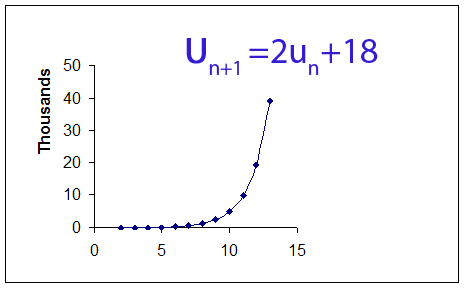
Some sequences grow exponentially:
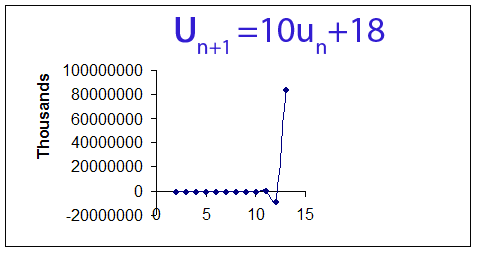
Others bounce around, then take off:
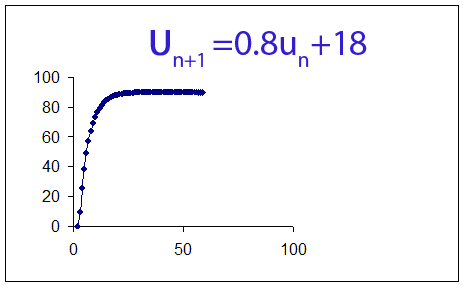
Whereas others converge to a limit:
For Linear Recurrence Relations
For a recurrence relation of the form:
If the sequence converges to a limit \(L\), then:
\[ \begin{alignedat}{2} \textbf{Proof} \\[0.8em] \text{If a limit exists, then } &\lim_{n\to\infty} u_n = L \\[0.6em] \text{Therefore } &\lim_{n\to\infty} u_{n+1} = L \\[0.6em] \text{But } &u_{n+1} = a\,u_n + b \\[0.6em] \text{So } &L = aL + b \\[0.6em] \Rightarrow\;&L - aL = b \\[0.6em] \Rightarrow\;&L(1 - a) = b \\[0.6em] \Rightarrow\;&L = \frac{b}{\,1 - a\,} \end{alignedat} \]
\[ \qquad\text{Find the limit of }\qquad u_{n+1} = 0.5\,u_n + 18 \text{ if it exists.}\]
\[ \begin{alignedat}{2} u_{n+1} &= 0.5\,u_n + 18 \\[1.2em] L &= aL + b \qquad\text{where } a = 0.5,\; b = 18 \\[0.8em] -1 \lt a \lt 1 \qquad\text{therefore a limit exists} \\[1.2em] L &= 0.5L + 18 \\[0.6em] \Rightarrow\; L - 0.5L &= 18 \\[0.6em] \Rightarrow\; 0.5L &= 18 \\[0.6em] \Rightarrow\; L &= \frac{18}{0.5} \\[0.6em] \Rightarrow\; L &= 36 \\[1.2em] \text{Check: } u_{n+1} &= 0.5 \times 36 + 18 = 18 + 18 = 36 \\[0.8em] \text{Therefore the limit is } &36. \end{alignedat} \]
A sequence is defined by:
Find the limit, if it exists.
A man plants trees around his property. The trees grow 75 cm per year, but he cuts off 20% of their height each year.
a) What height will the trees approach in the long term?
b) What percentage should be cut off to keep the height below 2.5 m?
a) Trees cut off 20% per year. 100% - 20% = 80% left
\[ \begin{alignedat}{2} u_{n+1} &= 0.8\,u_n + 0.75 \\[1em] L &= aL + b \qquad\text{where } a = 0.8,\; b = 0.75 \\[0.8em] -1 \lt a \lt 1 \qquad\text{therefore a limit exists} \\[1.2em] L &= 0.8L + 0.75 \\[0.6em] \Rightarrow\; L - 0.8L &= 0.75 \\[0.6em] \Rightarrow\; 0.2L &= 0.75 \\[0.6em] \Rightarrow\; L &= \frac{0.75}{0.2} \\[0.6em] \Rightarrow\; L &= 3.75 \end{alignedat} \]
The trees will grow to a height of 3.75 m
b) To limit the height to 2.5 m :
\[ \begin{alignedat}{2} L &= \frac{b}{\,1 - a\,} \\[1em] 2.5 &= \frac{0.75}{\,1 - a\,} \\[0.8em] 2.5(1 - a) &= 0.75 \\[0.6em] 2.5 - 2.5a &= 0.75 \\[0.6em] 2.5 - 0.75 &= 2.5a \\[0.6em] 1.75 &= 2.5a \\[0.6em] \frac{1.75}{2.5} &= a \\[0.6em] a &= 0.7 \end{alignedat} \]
So 100% - 70% = 30% must be cut off the height each year.
Solving Recurrence Relations
A bank account had:
- £328 in August 2003
- £504.40 in August 2004
- £689.62 in August 2005
No withdrawals were made. Find the interest rate and annual capital added.
\[ \begin{alignedat}{2} u_{n+1} &= a\,u_n + b \\[1.2em] \text{Let } u_1 &= £328, \qquad u_2 = £504.40, \qquad u_3 = £689.62 \\[1.2em] u_2 &= a\,u_1 + b \qquad\qquad u_3 = a\,u_2 + b \\[1.2em] 504.40 &= 328a + b \qquad\qquad 689.62 = 504.40a + b \end{alignedat} \]
\[ \begin{alignedat}{2} \text{Solve simultaneously} \\[1.2em] 504.40 &= 328a + b \qquad\qquad\text{(1)} \\[0.8em] 689.62 &= 504.40a + b \qquad\text{(2)} \\[1.2em] (2) - (1): \\[0.4em] 185.22 &= 176.4a \\[0.8em] \Rightarrow\; a &= \frac{185.22}{176.4} \\[0.8em] \Rightarrow\; a &= 1.05 \end{alignedat} \]
\[ \begin{alignedat}{2} \text{sub in eqn (1)} \\[1em] 504.4 &= 328 \times 1.05 + b \\[0.6em] 504.4 &= 344.4 + b \\[0.6em] b &= 160 \\[1.2em] \text{Check (2)} \\[0.6em] 504.4 \times 1.05 + 160 &= 529.62 + 160 = 689.62 \\[1.2em] u_{n+1} &= 1.05\,u_n + 160 \\[1em] \text{Interest is 5%, capital added is £160} \end{alignedat} \]
Two power companies share 100,000 customers.
- PowerUs loses 20% to LightU each year
- LightU loses 30% to PowerUs each year
Find the long‑term number of customers each company will have.
Let \(P_n = \) number of PowerUs customers
let \(LU _n = \) number of LightU customers
\[ \begin{alignedat}{2} P_n + LU_n &= 100{,}000 \\[1.2em] P_{n+1} &= 0.8\,P_n + 0.3\,LU_n \\[1.2em] LU_{n+1} &= 0.7\,LU_n + 0.2\,P_n \end{alignedat} \]
\[ \begin{alignedat}{2} P_n + LU_n &= 100{,}000 \\[1.2em] LU_n &= 100{,}000 - P_n \\[1.2em] \text{So } P_{n+1} &= 0.8\,P_n + 0.3\,(100{,}000 - P_n) \\[1.2em] P_{n+1} &= 0.8P_n + 30{,}000 - 0.3P_n \\[1.2em] P_{n+1} &= 0.5P_n + 30{,}000 \\[1.2em] \text{This is of the form } u_{n+1} &= a\,u_n + b \end{alignedat} \]
\[ \begin{alignedat}{2} a &= 0.5 \qquad\text{so } -1 \lt a \lt 1 \qquad\therefore\text{ a limit exists} \\[1.2em] \text{ limit for PowerUs} \\ L &= \frac{b}{1 - a} \\[1.2em] L &= \frac{30{,}000}{1 - 0.5} \\[1.2em] L &= 60{,}000 \\[1.2em] \text{PowerUs expect } 60{,}000 \text{ customers} \\[0.6em] \text{LightU expect } 40{,}000 \text{ customers} \end{alignedat} \]
Special Sequences
\[ \begin{alignedat}{2} u_{n+1} &= u_n + b \qquad\text{describes an arithmetic sequence.} \\[1.2em] u_{n+1} &= a\,u_n \qquad\text{describes a geometric sequence.} \\[1.2em] u_{n+2} &= u_{n+1} + u_n \qquad\text{describes a Fibonacci sequence.} \end{alignedat} \]