Radioactivity
In 1899 Ernest Rutherford showed the existence of alpha and beta radiation. Paul Villard discovered gamma radiation a year later.
Alpha Radiation
α particles are the nuclei of the helium atom.
When an element undergoes alpha decay , a helium atom is removed – so the original element loses two protons and two neutrons and is transformed into a lighter element.

Example
The radioisotope Platinum 190 decays into Osmium 186 and a Helium particle.
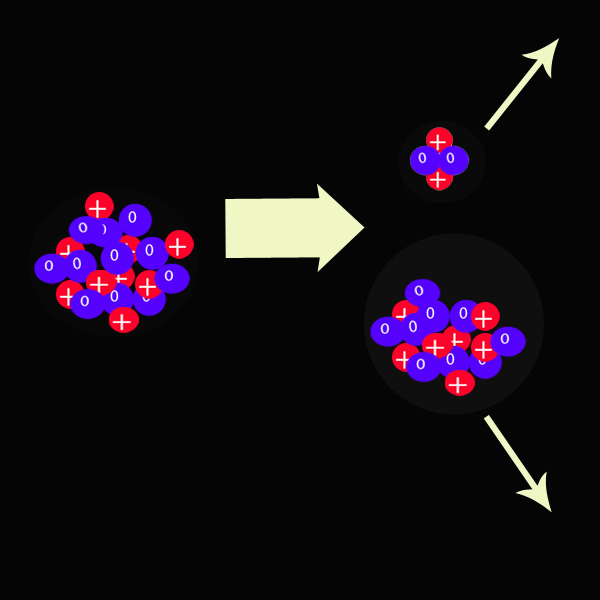

Alpha particles can be stopped by a thin sheet of paper.
Beta Radiation
β particles are electrons that have been emitted from the atom. Free neutrons are radioactive with a half-life of around 11 minutes. A neutron converts into a proton and electron.
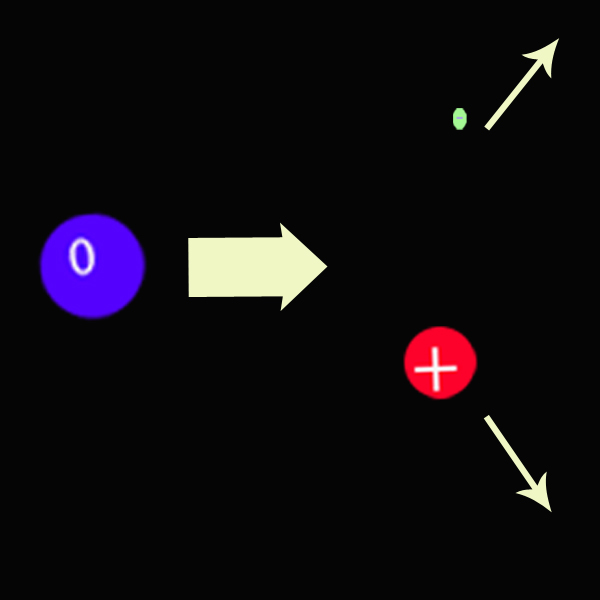
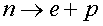
As a result, the original element gains a proton, so will be increase its atomic number by 1 , but keep its atomic mass since the mass of the neutron is the same as the proton and the mass of the electron is negligble.

Example
Strontium undergoes beta decay and turns into Yttrium.
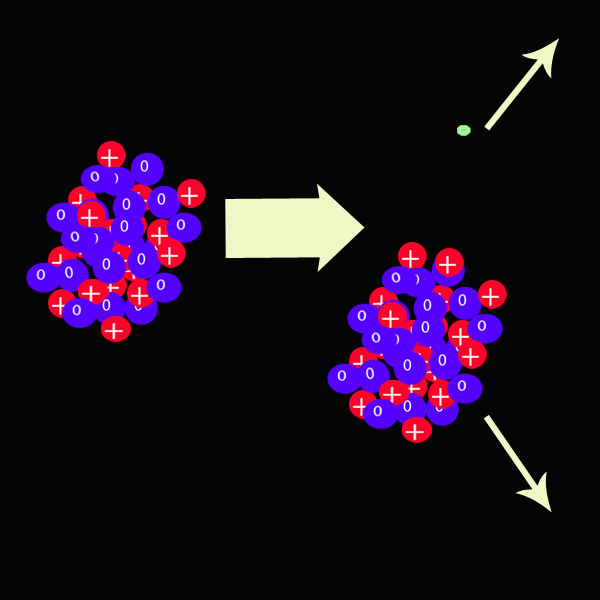
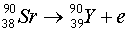
Beta particles can be stopped by a few cm of aluminium.
Gamma Radiation
γ decay is the result of energy state changes within the nucleus, often following α or β decay where the newly formed nucleus is not in its lowest energy state.
The excess energy is emitted as radiation – light waves with very high frequency and very short wavelength ( approx. 1 x 10 -12 mm )
Radioactive Decay and Half-life
The Royal Society of Chemistry Interactive Periodic Table
Libre Text books Nuclear Radioactivity
 © Alexander Forrest