Linear Motion with Bearings
Example
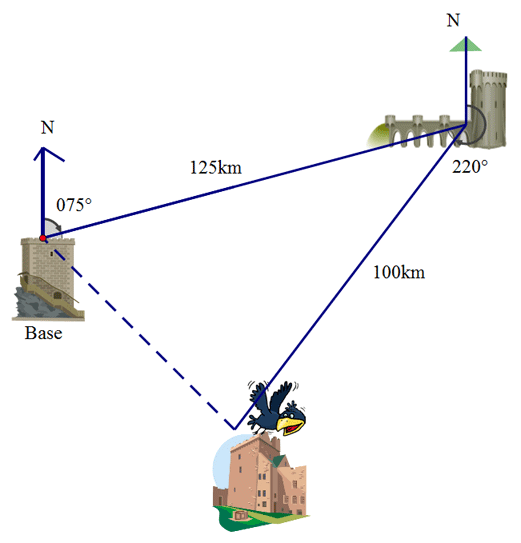
A crow leaves its base to deliver a message to a castle located 125 km away on a bearing of 075°.
It then flies 100 km to another castle on a bearing of 220°.
Questions:
- What is the crow’s displacement from its base?
- What bearing must the crow fly to return to base?
Solution
Refresher: Trigonometry with bearings
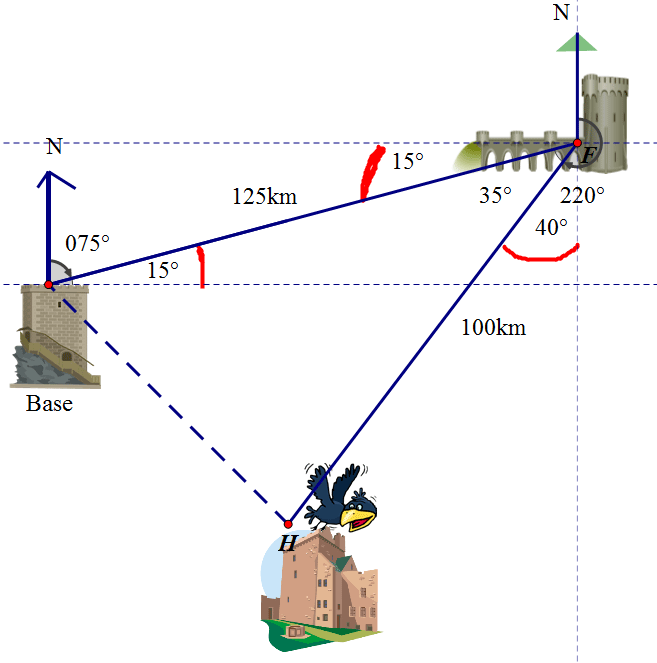
Using the cosine rule
\[
a^{2} = b^{2} + c^{2} - 2bc\cos A
\]
\[
a^{2} = 100^{2} + 125^{2} - 2 \times 100 \times 125 \times \cos 35^\circ
\]
\[
a^{2} = 10000 + 15625 - 20478.8011
\]
\[
a^{2} = 5146.19889
\]
\[
a = \sqrt{5146.19889}
\]
\[
a = 71.7370
\]
\[
a = 71.7\ \text{km (1 d.p.)}
\]
The crow is displaced 71.7 km from its base.
Finding the bearing back to base
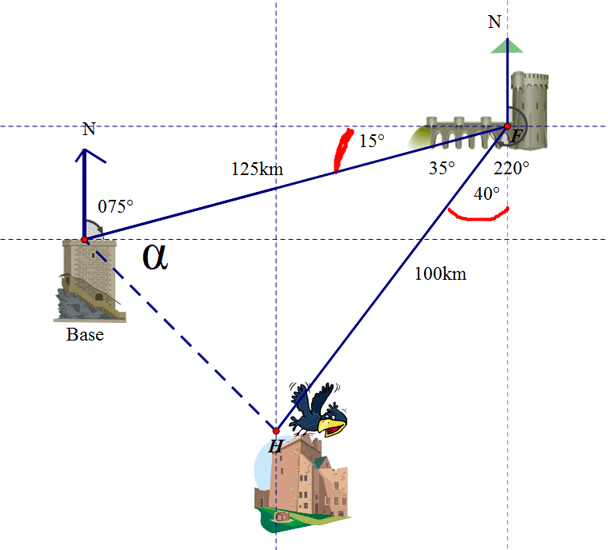
To find the bearing of the crow from its base, the angle \(\alpha \) between the two castles and the base can be calculated :
\[
\cos A = \frac{c^{2} + b^{2} - a^{2}}{2bc}
\]
\[
\cos \alpha
= \frac{125^{2} + 71.7^{2} - 100^{2}}{2 \times 125 \times 71.7}
\]
\[
\cos \alpha
= \frac{15625 + 5140.89 - 10000}{17925}
\]
\[
\alpha
= \cos^{-1}\!\left(\frac{10765.89}{17925}\right)
\]
\[
\alpha = 53.086^\circ
\]
\[
\alpha = 53.1^\circ\ \text{(1 d.p.)}
\]
\[
\frac{a}{\sin a}
= \frac{b}{\sin b}
= \frac{c}{\sin c}
\]
\[
\frac{100}{\sin \alpha}
= \frac{71.7}{\sin 35^\circ}
\]
\[
\sin \alpha
= \frac{100 \sin 35^\circ}{71.7}
\]
\[
\sin \alpha = 0.7999671
\]
\[
\alpha = 53.1269^\circ
\]
\[
\alpha = 53.1^\circ\ \text{(1 d.p.)}
\]
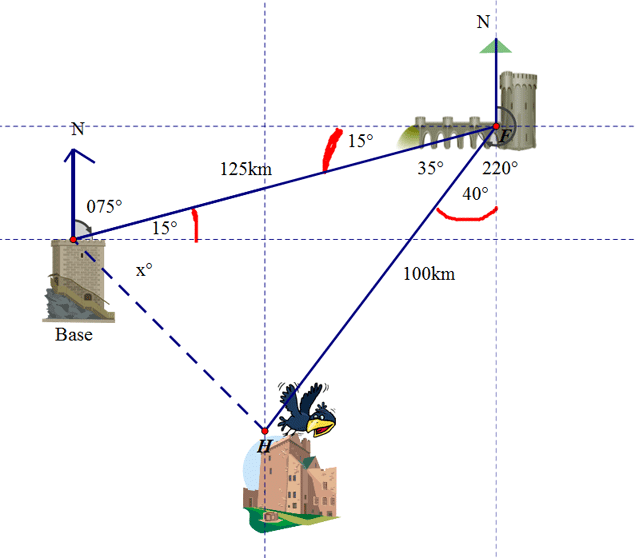
Final bearing
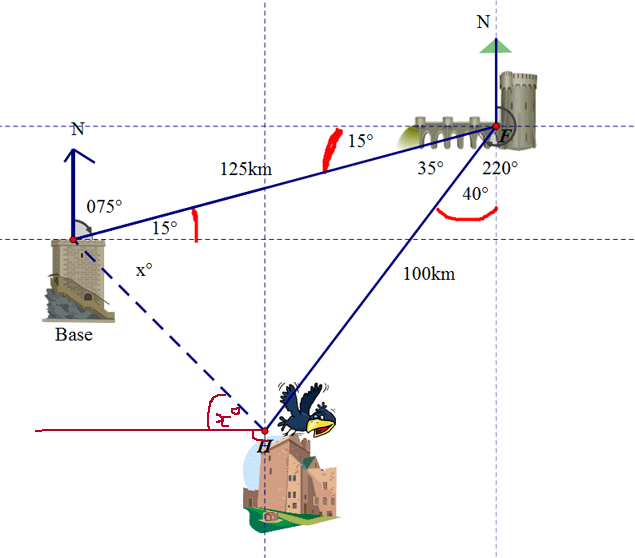
\[
\alpha = 53.1^\circ
\]
\[
\alpha = 15^\circ + x^\circ
\]
\[
53.1 = 15^\circ + x^\circ
\]
\[
53.1 - 15^\circ = x^\circ
\]
\[
x^\circ = 38.1^\circ
\]
\[
\text{bearing of crow from base }
38.1^\circ + 90^\circ = 128.1^\circ
\]
\[
\text{The supplement of this is }
180^\circ - 128.1^\circ = 51.9^\circ
\]
\[
\text{bearing for crow to fly}
\]
\[
360^\circ - 51.9^\circ = 308.1^\circ
\]
alternatively adding \(x^\circ \) to West
\[ \text{bearing of crow from base } 38.1^\circ + 270^\circ = 308.1^\circ \]The crow must fly on a bearing of 308° (to the nearest degree) to return to base.