Conversions
Fractions, decimals, percentages, and ratios all represent parts of a whole in different forms.
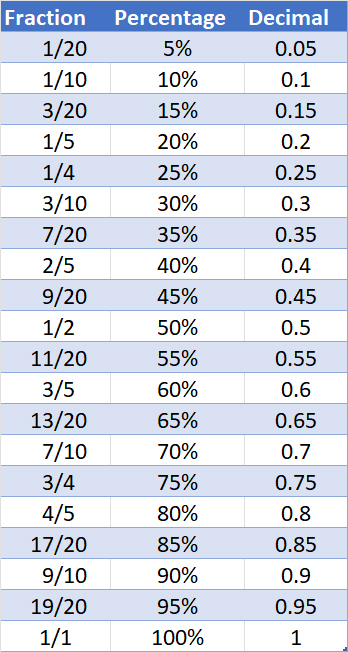
A fraction expresses a division of one quantity by another, while decimals provide a base-10 representation of that division.
Percentages convert fractions into parts per hundred, making it easier to compare proportions.
Ratios compare two quantities directly, often expressed as fractions or with a colon.
Understanding these connections helps in interpreting and converting between these formats, enhancing numerical literacy and problem-solving skills.
Fractions Percentages Decimals RatioFraction to Percentage
Just divide the top number (numerator) by the bottom number (denominator), then multiply by 100 and add a % sign.
Examples
Alternatively, convert the fraction so that the denominator is 100, then write the new numerator with a % sign.
Fraction to Decimal
Just divide the top number (numerator) by the bottom number (denominator).
Examples
Percentage Conversions
Percentage to Decimal
Just divide the number by 100 and remove the % sign.
Examples
Percentage to Fraction
Write the number over 100,then simplify as much as possible.
Examples
Decimal Conversions
Decimal to Percentage
Just multiply the number by 100 and add a % sign.
Examples
Decimal to Fraction
Write the number without the decimal point.
If one digit after the decimal → put over 10
If two digits → put over 100
If three digits → put over 1000
If four digits → put over 10000
Then simplify!
Examples