Differentiating Inverse Functions
When a function $y = f(x)$ has an inverse $x = f^{-1}(y)$, their derivatives are related by
\[
\frac{dy}{dx} \cdot \frac{dx}{dy} = 1
\]
\[
\Rightarrow \frac{dx}{dy} = \frac{1}{\dfrac{dy}{dx}}
\]
\[
\text{so} \quad \frac{d}{dx}\bigl(f^{-1}(x)\bigr)
= \frac{1}{f'\bigl(f^{-1}(x)\bigr)}.
\]
- Find the inverse of the function.
- Differentiate the original function.
- Use the relationship
\[
\frac{d}{dx}\bigl(f^{-1}(x)\bigr)
= \frac{1}{f'\bigl(f^{-1}(x)\bigr)}.
\]
Given $f(x) = x^6$, find $f'(x)$ and state the derivative of $f^{-1}(x)$.
First differentiate $f(x)$:
\[
f(x) = x^6
\quad\Rightarrow\quad
f'(x) = 6x^5.
\]
Now find the inverse:
\[
y = x^6
\quad\Rightarrow\quad
x = y^{1/6}
\quad\Rightarrow\quad
f^{-1}(x) = x^{1/6}.
\]
Using the inverse derivative formula:
\[
\frac{d}{dx}\bigl(f^{-1}(x)\bigr)
= \frac{1}{f'\bigl(f^{-1}(x)\bigr)}
= \frac{1}{6\bigl(x^{1/6}\bigr)^5}
= \frac{1}{6x^{5/6}}.
\]
Given $f(x) = 3x^{-2}$, find $f'(x)$ and state the derivative of $f^{-1}(x)$.
Differentiate $f(x)$:
\[
f(x) = 3x^{-2}
\quad\Rightarrow\quad
f'(x) = 3(-2)x^{-3} = -6x^{-3}.
\]
Find the inverse:
\[
y = 3x^{-2}
\quad\Rightarrow\quad
y = \frac{3}{x^2}
\quad\Rightarrow\quad
x^2 = \frac{3}{y}
\quad\Rightarrow\quad
x = \sqrt{\frac{3}{y}}.
\]
So
\[
f^{-1}(x) = \sqrt{\frac{3}{x}}.
\]
Now use the inverse derivative formula:
\[
\frac{d}{dx}\bigl(f^{-1}(x)\bigr)
= \frac{1}{f'\bigl(f^{-1}(x)\bigr)}
= \frac{1}{-6\left(\sqrt{\dfrac{3}{x}}\right)^{-3}}
\]
\[
= \frac{1}{-6\left( \frac{3}{x} \right)^{-3/2}}
\]
\[
= \frac{1}{-6}\,\left( \frac{3}{x} \right)^{3/2}
\]
\[
= \frac{\sqrt{27}}{-6\,x^{3/2}}
\]
\[
= \frac{3\sqrt{3}}{-6\,x^{3/2}}
\]
\[
= \frac{\sqrt{3}}{-2\,x^{3/2}}
\]
\[
= \frac{\sqrt{3}}{-2\,x^{3/2}}
\cdot
\frac{\sqrt{3}}{\sqrt{3}}
= \frac{3}{-2\sqrt{3}\,x^{3/2}}
= \frac{3}{-2\sqrt{3}\,x\sqrt{x}}
\]
\[
= \frac{3}{-2x\sqrt{3}\sqrt{x}}
= \frac{3}{-2x\sqrt{3x}}
\]
Express $f(x) = x^2 + 2x + 4$, $x \ge 4$, in the form $p(x + q)^2 + r$.
Find $f'(x)$ and state the derivative of $f^{-1}(x)$.
Complete the square:
\[
x^2 + 2x + 4
= (x^2 + 2x + 1) + 3
= (x + 1)^2 + 3.
\]
So
\[
f(x) = (x + 1)^2 + 3, \quad x \ge 4.
\]
Differentiate:
\[
f'(x) = 2(x + 1).
\]
Find the inverse:
\[
y = (x + 1)^2 + 3
\quad\Rightarrow\quad
(x + 1)^2 = y - 3
\quad\Rightarrow\quad
x + 1 = \sqrt{y - 3}
\]
\[
\Rightarrow\quad
x = \sqrt{y - 3} - 1
\quad\Rightarrow\quad
f^{-1}(x) = \sqrt{x - 3} - 1.
\]
Then
\[
\frac{d}{dx}\bigl(f^{-1}(x)\bigr)
= \frac{1}{f'\bigl(f^{-1}(x)\bigr)}
= \frac{1}{2\bigl(f^{-1}(x) + 1\bigr)}
= \frac{1}{2\sqrt{x - 3}}.
\]
If $y = f(x)$ has an inverse $x = f^{-1}(y)$ and $f'(x) \ne 0$, then
\[
\frac{d}{dx}\bigl(f^{-1}(x)\bigr)
= \frac{1}{f'\bigl(f^{-1}(x)\bigr)}.
\]
Differentiating Inverse Trig Functions
Given $f(x) = \sin x$ for the interval $-\dfrac{\pi}{2} \le x \le \dfrac{\pi}{2}$,
find the derivative of $f^{-1}(x)$.
Let $y = \sin x$. Then $x = \sin^{-1} y$.
\[
\frac{dy}{dx} = \cos x
\quad\Rightarrow\quad
\frac{dx}{dy} = \frac{1}{\cos x}.
\]
\(
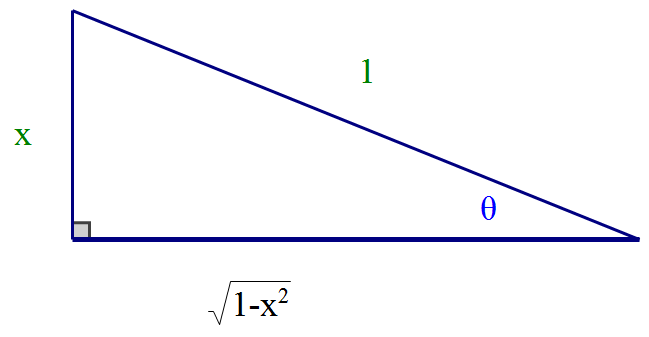
\text{Let }\sin^{-1}(x) = \theta
\text {, then }x = \sin\theta
\)
This substitution allows us to work with the familiar trigonometric relationship instead of the inverse.
On the interval $-\dfrac{\pi}{2} \le x \le \dfrac{\pi}{2}$, we can form a right‑angled triangle
with opposite side $x$ and hypotenuse $1$.
\[
\frac{d}{dx}\,f^{-1}(x)
= \frac{1}{\,f'\!\left(f^{-1}(x)\right)}
\]
\[
= \frac{1}{\cos\!\left(\sin^{-1}(x)\right)}
\]
\[
= \frac{1}{\cos\theta}
\]
\[
= \frac{1}{\left(\frac{\sqrt{1 - x^{2}}}{1}\right)}
\]
\[
= \frac{1}{\sqrt{1 - x^{2}}}
\]
\[
\frac{d}{dx}\bigl(\sin^{-1} x\bigr)
= \frac{1}{\sqrt{1 - x^2}}.
\]
Given $f(x) = \cos x$ for the interval $0 \le x \le \pi$,
find the derivative of $f^{-1}(x)$.
Let $y = \cos x$. Then $x = \cos^{-1} y$.
\[
\frac{dy}{dx} = -\sin x
\quad\Rightarrow\quad
\frac{dx}{dy} = \frac{1}{-\,\sin x}.
\]
\[
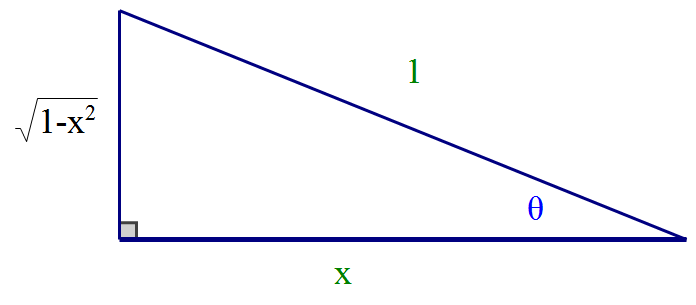
\text{Let }\cos^{-1}(x) = \theta
\text { then }x = \cos\theta
\]
On this interval we can form a right‑angled triangle with adjacent side $x$ and hypotenuse $1$.
\[
\frac{d}{dx}\,f^{-1}(x)
= \frac{1}{\,f'\!\left(f^{-1}(x)\right)}
\]
\[
= \frac{1}{-\sin\!\left(\cos^{-1}(x)\right)}
\]
\[
= \frac{1}{-\sin\theta}
\]
\[
= \frac{-1}{\left(\frac{\sqrt{1 - x^{2}}}{1}\right)}
\]
\[
= \frac{-1}{\sqrt{1 - x^{2}}}
\]
\[
\frac{d}{dx}\bigl(\cos^{-1} x\bigr)
= -\frac{1}{\sqrt{1 - x^2}}.
\]
Given $f(x) = \tan x$ for the interval $-\dfrac{\pi}{2} \lt x \lt \dfrac{\pi}{2}$,
find the derivative of $f^{-1}(x)$.
Let $y = \tan x$. Then $x = \tan^{-1} y$.
\[
\frac{dy}{dx} = \sec^2 x
\quad\Rightarrow\quad
\frac{dx}{dy} = \frac{1}{\sec^2 x}.
\]
\[
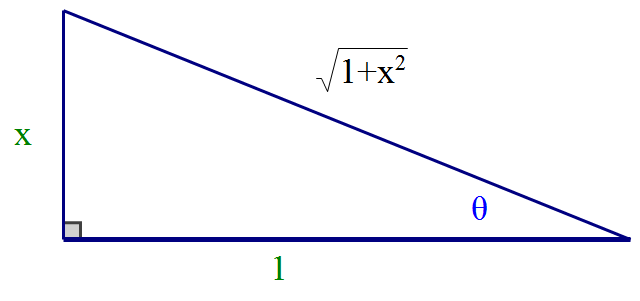
\text{Let }\tan^{-1}(x) = \theta
\text { then }x = \tan\theta
\]
On this interval we can form a right‑angled triangle with opposite side $x$ and adjacent side $1$.
\[
\frac{d}{dx}\,f^{-1}(x)
= \frac{1}{\,f'\!\left(f^{-1}(x)\right)}
\]
\[
= \frac{1}{\sec^{2}\!\left(\tan^{-1}(x)\right)}
\]
\[
= \frac{1}{\sec^{2}\theta}
\]
\[
= \cos^{2}\theta
\]
\[
= \left(\frac{1}{\sqrt{x^{2}+1}}\right)^{2}
\]
\[
= \frac{1}{x^{2}+1}
\]
\[
\frac{d}{dx}\bigl(\tan^{-1} x\bigr)
= \frac{1}{1 + x^2}.
\]
\[
\frac{d}{dx}\bigl(\sin^{-1} x\bigr)
= \frac{1}{\sqrt{1 - x^2}}
\]
\[
\frac{d}{dx}\bigl(\cos^{-1} x\bigr)
= -\frac{1}{\sqrt{1 - x^2}}
\]
\[
\frac{d}{dx}\bigl(\tan^{-1} x\bigr)
= \frac{1}{1 + x^2}.
\]
Don’t forget the chain rule!
\[
\text{Find }\frac{d}{dx}\!\left(\tan^{-1}(x^{2})\right)
\]
\[
y = \tan^{-1}(x^{2})
\]
\[
\frac{dy}{dx}
= \frac{1}{\,1 + (x^{2})^{2}\,}\;\cdot\;2x
\]
\[
= \frac{2x}{\,1 + x^{4}\,}
\]
Integrating Inverse Trig Functions
The derivative results can be reversed to give standard integrals involving inverse trig functions.
\[
\int \frac{1}{\sqrt{1 - x^2}}\,dx = \sin^{-1} x + C
\]
\[\int \frac{dx}{\sqrt{a^{2} - x^{2}}}
= \sin^{-1}\!\left(\frac{x}{a}\right) + C.\]
\[
\int -\frac{1}{\sqrt{1 - x^2}}\,dx = \cos^{-1} x + C
\]
\[\int -\frac{dx}{\sqrt{a^{2} - x^{2}}}
= \sin^{-1}\!\left(\frac{x}{a}\right) + C.\]
\[
\int \frac{1}{1 + x^2}\,dx = \tan^{-1} x + C.
\]
\[
\int \frac{dx}{a^{2} + x^{2}}
= \frac{1}{a}\,\tan^{-1}\!\left(\frac{x}{a}\right) + C
\]
Find the integral
\[
\int \frac{1}{\sqrt{4 - x^2}}\,dx.
\]
The key is recognising that the square root in the denominator
has the structure
\[\sqrt{a^{2} - x^{2}},\]
Using the standard result:
\[
\int \frac{dx}{\sqrt{4 - x^{2}}}
= \int \frac{dx}{\sqrt{2^{2} - x^{2}}}
\]
\[
= \sin^{-1}\!\left(\frac{x}{2}\right) + C
\]
Find the integral
\[
\int \frac{1}{45 + 5x^2}\,dx.
\]
Using the standard result:
\[
\int \frac{dx}{45 + 5x^{2}}
= \int \frac{dx}{5\left(9 + x^{2}\right)}
\]
\[
= \frac{1}{5}\int \frac{dx}{3^{2} + x^{2}}
\]
\[
= \frac{1}{5}\cdot \frac{1}{3}\,
\tan^{-1}\!\left(\frac{x}{3}\right) + C
\]
\[
= \frac{1}{15}\,\tan^{-1}\!\left(\frac{x}{3}\right) + C
\]
Find the integral
\[
\int \frac{1}{\sqrt{1 - (2x)^2}}\,dx.
\]
Use a substitution $u = 2x$:
\[
u = 2x \quad\Rightarrow\quad du = 2\,dx \quad\Rightarrow\quad dx = \frac{1}{2}\,du.
\]
\[
\int \frac{1}{\sqrt{1 - (2x)^2}}\,dx
= \int \frac{1}{\sqrt{1 - u^2}} \cdot \frac{1}{2}\,du
= \frac{1}{2}\sin^{-1} u + C
= \frac{1}{2}\sin^{-1}(2x) + C.
\]