Applications of Differentiation
Finding Greatest / Least Values
Example
A rectangular beam is to be cut out of a cylinder.
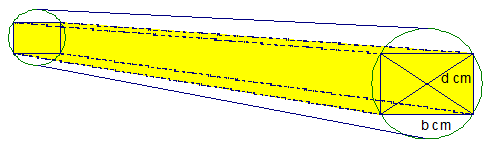
The diameter of the cylinder is 40 cm.
The breadth of the beam is b cm.
The depth of the beam is d cm.
The strength of the beam is given by the formula
\( S = 1.7b(400 - b^2) \)
What dimensions of the beam are required for the beam to
have maximum strength ?
To find the maximum strength, set the derivative to zero.
\[
S = 1.7\,b(400 - b^{2})
\]
Expand:
\[
S = 680b - 1.7b^{3}
\]
Differentiate:
\[
\frac{dS}{db} = 680 - 5.1b^{2}
\]
A maximum occurs when:
\[
\frac{dS}{db} = 0
\]
\[
0 = 680 - 5.1b^{2}
\]
\[
5.1b^{2} = 680
\]
\[
b^{2} = \frac{680}{5.1}
\]
\[
b^{2} = 133\tfrac{1}{3} = \frac{400}{3}
\]
\[
b = \sqrt{\frac{400}{3}}
\]
\[
b = \frac{20}{\sqrt{3}}
\]
Check that this is a maximum
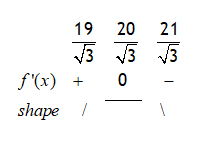
Maximum occurs when \( b = \frac{20}{\sqrt{3}} \) cm.
Find \(d\):
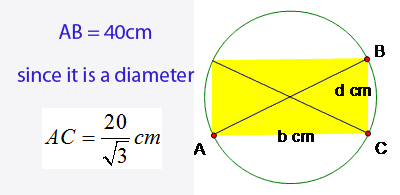
\[
\text{By Pythagoras' theorem}
\]
\[
AB^{2} = AC^{2} + BC^{2}
\]
Substitute the known values:
\[
40^{2}
=
\left(\frac{20}{\sqrt{3}}\right)^{2}
+
BC^{2}
\]
\[
BC^{2}
=
40^{2}
-
\left(\frac{20}{\sqrt{3}}\right)^{2}
\]
\[
BC^{2}
=
1600
-
\frac{400}{3}
\]
\[
BC^{2}
=
40\left(40 - \frac{10}{3}\right)
\]
\[
BC^{2}
=
40 \cdot \frac{110}{3}
\]
\[
BC^{2}
=
\frac{400 \cdot 11}{3}
\]
\[
BC
=
\sqrt{\frac{400 \cdot 11}{3}}
\]
\[
BC
=
20\sqrt{\frac{11}{3}}
\;\text{cm}
\]
\[
d \approx 38.30\text{ cm (2 d.p.)}
\qquad
b \approx 11.55\text{ cm (2 d.p.)}
\]
|
Newton |
Leibniz |
|
\( f(x) \) |
\( y = f(x) \) |
| 1st Derivative |
\( f'(x) \) |
\( \frac{dy}{dx} \) |
| 2nd Derivative |
\( f''(x) \) |
\( \frac{d^{2}y}{dx^{2}} \) |
| 3rd Derivative |
\( f'''(x) \) |
\( \frac{d^{3}y}{dx^{3}} \) |
| nth Derivative |
\( f^{(n)}(x) \) |
\( \frac{d^{n}y}{dx^{n}} \) |
Example
\[
\begin{aligned}
y &= 3x^4 - 5x^2 + 7x - 9 \\
\\
y' &= 12x^3 - 10x + 7 \\
\\
y'' &= 36x^2 - 10 \\
\\
y''' &= 72x
\end{aligned}
\]
Rectilinear Motion (Straight Line Motion)
If an object moves in a straight line along the x‑axis,
then after \(t\) seconds it has moved a distance \(s\) units from the origin.
Displacement is a function of time, so \(s = f(t)\).
\[
\text{velocity = rate of change of displacement with time}
\]
\[
v = \frac{ds}{dt}
\]
\[
\text{acceleration = rate of change of velocity with time}
\]
\[
a = \frac{dv}{dt}
= \frac{d^{2}s}{dt^{2}}
\]
Newton’s Equations of Motion:
\[
v = u + at
\]
\[
s = ut + \frac12 at^{2}
\]
\[
v^{2} = u^{2} + 2as
\]
\[
v = \text{final velocity}, \qquad
u = \text{initial velocity}
\]
\[
s = \text{distance travelled}
\]
\[
a = \text{acceleration}, \qquad
t = \text{time taken}
\]
Example
A ball is thrown vertically upwards.
The height after \(t\) seconds is
\(
h = 6t - t^2.
\)
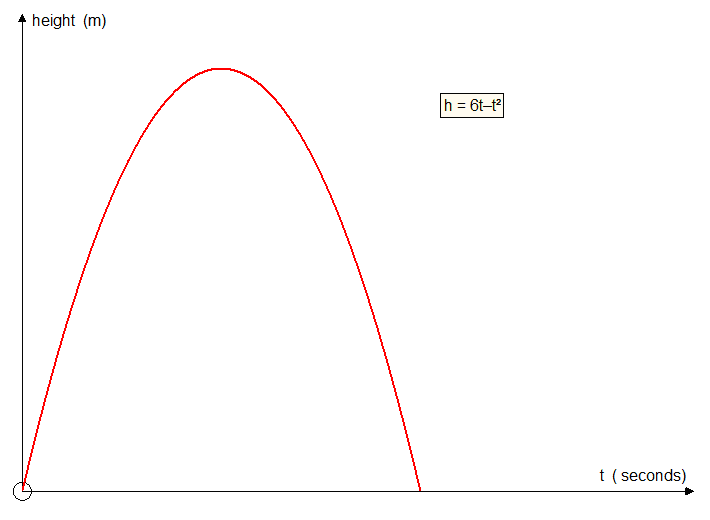
a) How long does the ball take to reach its maximum height ?
b) What is the maximum height ?
c) What is the velocity of the ball 5 seconds after being thrown ?
d) What is the velocity of the ball when it hits the ground ?
e) Is the ball accelerating or decelerating at this point ?
a)
\[
h = 6t - t^{2}
\]
Differentiate to find the velocity:
\[
\frac{dh}{dt} = 6 - 2t
\]
Maximum height occurs when the velocity is zero:
\[
\frac{dh}{dt} = 0
\]
\[
0 = 6 - 2t
\]
\[
2t = 6
\]
\[
t = 3
\]
The object reaches its maximum height after \(3\) seconds.
b)
\[
h = 6t - t^{2}
\]
Substitute \(t = 3\):
\[
h = 6 \times 3 - 3^{2}
\]
\[
h = 18 - 9
\]
\[
h = 9\text{ m}
\]
The maximum height reached is \(9\text{ m}\).
c)
\[
v = 6 - 2t
\]
At \(t = 5\):
\[
v = 6 - 2(5)
\]
\[
v = 6 - 10
\]
\[
v = -4\ \text{m/s}
\]
The velocity of the ball after \(5\) seconds is \(-4\ \text{m/s}\).
d)
\[
\text{The ball hits the ground when } h = 0.
\]
\[
0 = 6t - t^{2}
\]
Factor:
\[
0 = t(6 - t)
\]
So the solutions are:
\[
t = 0 \qquad \text{or} \qquad t = 6\text{ s}
\]
To find the velocity at impact:
\[
v = 6 - 2t
\]
At \(t = 6\):
\[
v = 6 - 12
\]
\[
v = -6\ \text{m/s}
\]
The velocity of the ball when it hits the ground is \(-6\ \text{m/s}\).
e)
\[
\text{The ball hits the ground when } h = 0.
\]
Velocity and acceleration from the model:
\[
v = 6 - 2t
\]
\[
a = -2
\]
The acceleration is constant because the second derivative of height is a constant value:
\[
a = \frac{d^{2}h}{dt^{2}} = -2
\]
This means the ball experiences a constant deceleration of:
\[
-2\ \text{m/s}^{2}
\]
throughout its entire motion.
\[
\text{Since } a = \frac{dv}{dt},
\qquad
v = \int a\,dt
\]
\[
\text{and since } v = \frac{ds}{dt},
\qquad
s = \int v\,dt
\]
Example
A car starts from rest and its acceleration after \(t\) seconds is:
\[
a(t) = \frac{1}{10}(20 - t)\ \text{m/s}^2
\]
What is its speed after 20 seconds?
\[
v = \int a\,dt
\]
\[
= \int \frac{1}{10}(20 - t)\,dt
\]
\[
= \frac{1}{10}\int (20 - t)\,dt
\]
\[
= \frac{1}{10}\left(20t - \frac{t^{2}}{2}\right) + C
\]
\[
= 2t - \frac{t^{2}}{20} + C
\]
\[
\text{When } t = 0,\ v = 0 \text{ so } C = 0
\]
So the velocity function becomes:
\[
v = 2t - \frac{t^{2}}{20}
\]
\[
\text{At } t = 20
\]
\[
v = 2 \cdot 20 - \frac{20^{2}}{20}
\]
\[
= 40 - 20
\]
\[
= 20\ \text{m s}^{-1}
\]
After 20 seconds the car is travelling at \(
= 20\ \text{m s}^{-1}
\)
The car ceases to accelerate and continues
at this uniform velocity.
What is the total distance
covered 30 seconds after it started ?
\[
s = \int v\,dt
\]
\[
= \int \left(2t - \frac{t^{2}}{20}\right) dt
\]
\[
= \left[t^{2} - \frac{t^{3}}{60}\right]_{0}^{20}
\]
\[
= \left(20 \cdot 20 - \frac{20^{3}}{60}\right) - 0
\]
\[
= 400 - \frac{8000}{60}
\]
\[
= 266\tfrac{2}{3}\ \text{m for the first 20 seconds}
\]
\[
+ \ 200\ \text{m for the next 10 seconds at } 20\ \text{m/s}
\]
\[
= 466\tfrac{2}{3}\ \text{m}
\]
More examples
Approximating Roots of an Equation: Newton’s Method
\[
x_{n+1} = x_n - \frac{f(x_n)}{f'(x_n)}
\]
Example
Find the roots of the function
\[
y = 12x^{3} + 4x^{2} - 15x - 4
\]
First compute the derivative:
\[
f'(x) = 36x^{2} + 8x - 15
\]
Newton–Raphson iteration formula:
\[
x_{n+1} = x_n - \frac{f(x_n)}{f'(x_n)}
\]
\[
x_{n+1}
= x_n - \frac{f(x_n)}{f'(x_n)}
\]
For this function:
\[
x_{n+1}
= x_n
- \frac{12x^{3} + 4x^{2} - 15x - 4}
{36x^{2} + 8x - 15}
\]
Try the starting value \(x_n = 1.5\).
\[
x_{n+1}
= 1.5
- \frac{12(1.5)^{3} + 4(1.5)^{2} - 15(1.5) - 4}
{36(1.5)^{2} + 8(1.5) - 15}
\approx 1.205128205
\]
This new value is then substituted back into the right-hand side of the
iteration formula. Continue iterating until the value converges to the root.
| Xn |
f(x) |
f'(x) |
f(x)/f'(x) |
Xn+1 |
| 1.5 | 23 | 78 | 0.294872 | 1.205128 |
| 1.205128 | 4.735397 | 46.92505 | 0.100914 | 1.104214 |
| 1.104214 | 0.470216 | 37.72811 | 0.012463 | 1.091751 |
| 1.091751 | 0.006773 | 36.64313 | 0.000185 | 1.091566 |
| 1.091566 | 1.48E-06 | 36.62712 | 4.04E-08 | 1.091566 |
| 1.091566 | 7.11E-14 | 36.62712 | 1.94E-15 | 1.091566 |