Completed Square Form
The roots and y‑intercept of a quadratic can usually be found from its equation. Writing the quadratic in completed square form allows the turning point to be read off immediately.
Example
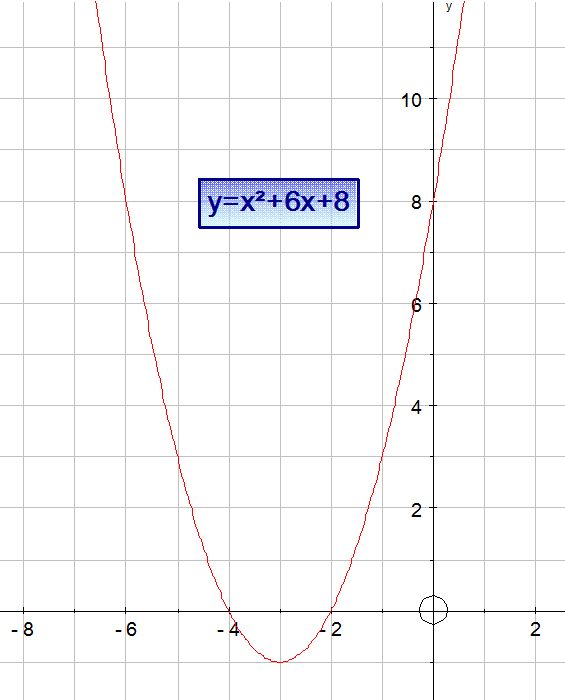
Sketch the graph of the quadratic:
\[
y = x^2 + 6x + 8
\]
Step 1 — Complete the square
\[
x^2 + 6x + 8
\]
Half of 6 is 3:
\[
x^2 + 6x = (x+3)^2 - 9
\]
Substitute:
\[
x^2 + 6x + 8 = (x+3)^2 - 9 + 8
\]
\[
= (x+3)^2 - 1
\]
Step 2 — Turning point
From the completed square form:
\[
y = (x+3)^2 - 1
\]
Turning point:
\[
(-3,\,-1)
\]
Step 3 — Roots
Set \(y = 0\):
\[
(x+3)^2 - 1 = 0
\]
\[
(x+3)^2 = 1
\]
\[
x+3 = \pm 1
\]
\[
x = -2,\quad x = -4
\]
Step 4 — y‑intercept
Set \(x = 0\):
\[
y = 0^2 + 6(0) + 8 = 8
\]
Final Sketch
Putting all the information together: