Maths Mutt HOME

Volumes of Solids of Revolution

If a curve is rotated about an axis which it does not cut, the area between the curve and the axis generates a solid of revolution.
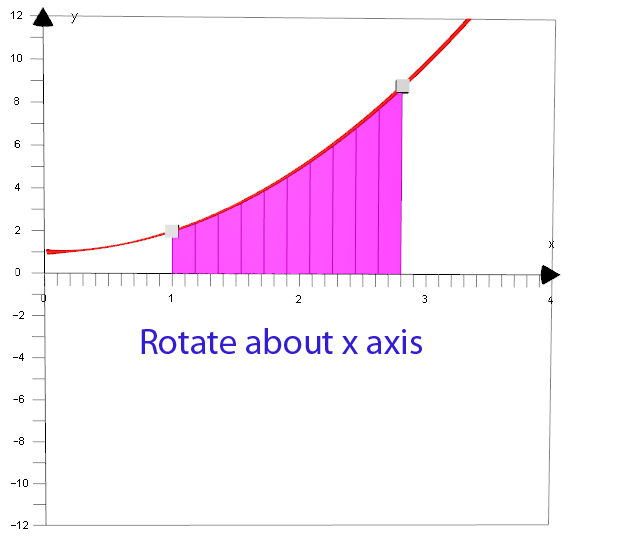
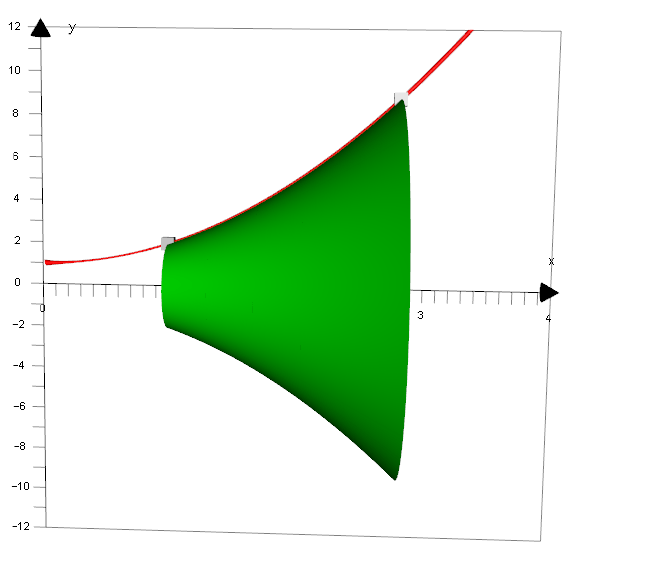
Diagram showing a curve rotated around an axis to form a solid of revolution

Illustration of rectangles forming cylindrical slices when rotated

The volume generated is the limit of the sum of the volumes of cylinders formed by rotating thin rectangles.

If a rectangle of width $dx$ and height $y$ is rotated, it forms a cylinder of radius $y$ and height $dx$.
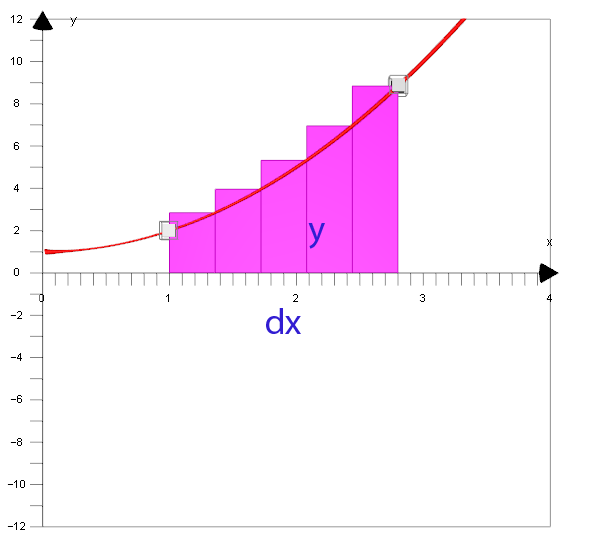
Diagram showing a thin rectangle rotated to form a cylindrical slice

The volume of this cylinder is:

\[ V = \pi r^{2}h = \pi y^{2}\,dx \]

The total volume of the solid of revolution is therefore:

\[ \lim_{\delta x \to 0} \sum_{x=a}^{b} \pi y^{2}\,dx = \int_{a}^{b} \pi y^{2}\,dx \]
\[ V = \int_a^b \pi y^2\,dx. \]

If rotated about the y axis

\[V = \int_c^d \pi\,x^2\,dy\]
Example

Find the volume and name the shape generated by rotating the positive branch of the circle

\[ x^2 + y^2 = a^2 \]

through $360^\circ$ about the $x$‑axis.
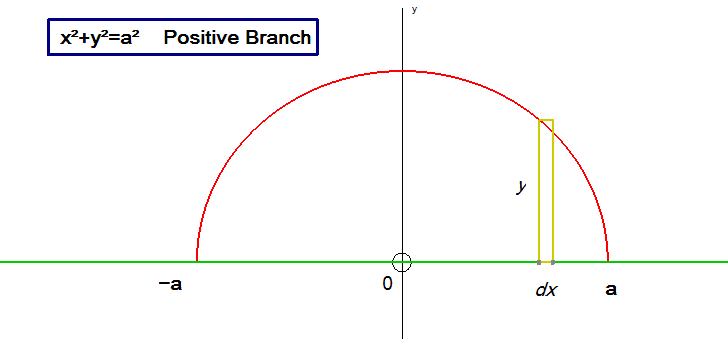

Diagram showing the positive semicircle rotated around the x-axis

Volume

\[ y = \sqrt{a^2 - x^2} \] \[ V = \int_{-a}^{a} \pi y^2\,dx = \int_{-a}^{a} \pi(a^2 - x^2)\,dx \] \[ = \pi\left[a^2x - \frac{x^3}{3}\right]_{-a}^{a} \] \[ = \pi\left(2a^3 - \frac{2a^3}{3}\right) = \frac{4\pi a^3}{3}. \]

The solid formed is a sphere of radius \(a\), since the volume is of the form \(\dfrac{4\pi r^{3}}{3}\).

Example

The portion of the curve

\[ y = 2x^2 \]

between $y = 1$ and $y = 3$ is rotated through $360^\circ$ about the $y$‑axis. Find the volume of the resulting solid.
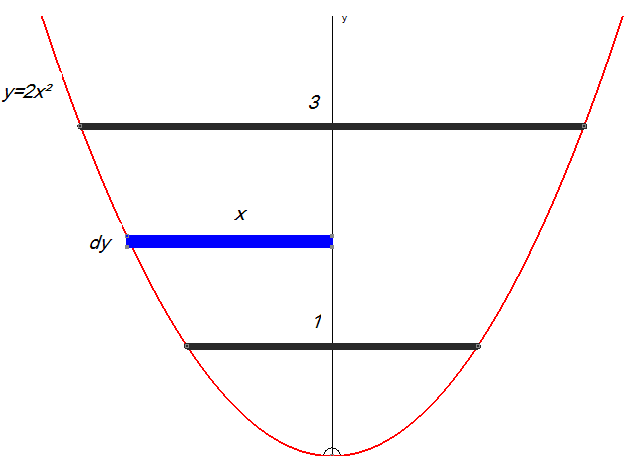

Diagram showing the curve y = 2x^2 rotated around the y-axis


\[V = \int_c^d \pi\,x^2\,dy = \int_{1}^{3} \pi x^{2}\,dy \] \[ \text{Given } y = 2x^2 \quad \Rightarrow x^{2} = \frac{y}{2} \] \[ \int_{1}^{3} \pi x^{2}\,dy = \int_{1}^{3} \pi \left(\frac{y}{2}\right)\,dy = \frac{\pi}{2}\int_{1}^{3} y\,dy \] \[ = \frac{\pi}{2}\left[\frac{y^{2}}{2}\right]_{1}^{3} = \frac{\pi}{4}\left(3^{2} - 1^{2}\right) = \frac{\pi}{4}(9 - 1) = \frac{\pi}{4}\cdot 8 = 2\pi. \]
MathsMutt logo linking to main site © Alexander Forrest