Vectors and Forces
Refresher
In the following diagram, vector a has direction θ in the (x,y) plane and is shown with unit vectors i and j.
If a represents the position vector of the point
A(\(a_x, a_y\)), then:
\(\mathbf{a} = a_x \mathbf{i} + a_y \mathbf{j}\)
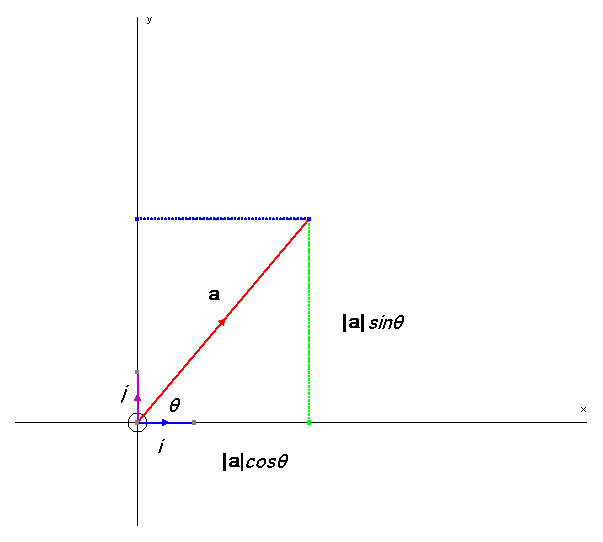
Comparing coefficients of point A:
Further:
For calculations with vertical and horizontal components, avoid confusion by always using the angle between the vector and the horizontal.
If P is a particle, the position vector of P at time t is given by:
The velocity vector of P is:
Otherwise written:
The acceleration of P at time t is:
Also written as:
A particle moves in the x-y plane relative to a fixed point O.
The particle is initially located at the point -2i + 3j, where i and j
are unit vectors in the directions of the x- and y-axis respectively.
t seconds after the start of its motion, the velocity of the particle is given by v = 2sin ti +3cos5tj
Find expressions for the acceleration and position of the particle t seconds after the start of its motion.
Acceleration:
Displacement:
A particle starts at \(-2\mathbf{i} + 3\mathbf{j}\) with velocity \(3\mathbf{i} + 4\mathbf{j}\) m/s and acceleration \(2\mathbf{i} + 4\mathbf{j}\) m/s².
Find its velocity, speed, and position after 5 seconds.
When t = 5:
\( \mathbf{v} = 13\mathbf{i} + 24\mathbf{j} \) m/s
When t = 5:
\( \mathbf{r} = 38\mathbf{i} + 73\mathbf{j} \) m
Effects of Wind
A ship travelling westward at 8 km/h is subjected to a wind blowing from the north at 60 km/h.
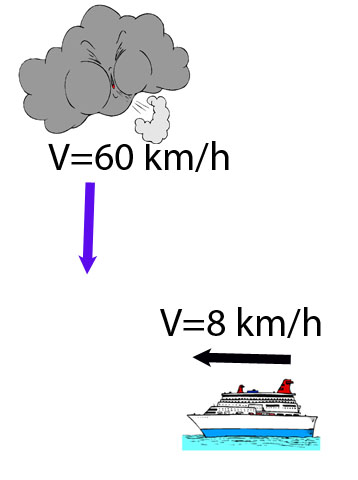
What effect does the wind have on the ship?
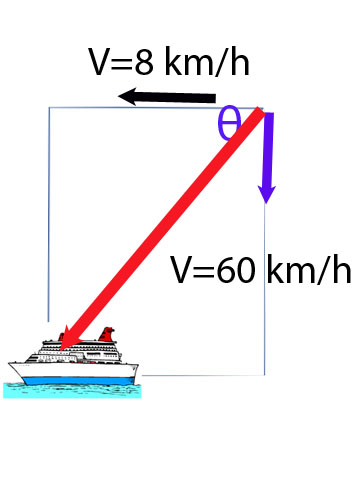
The ship is blown off course by 82.4°.
Principle of Two Forces
If an object is at rest and remains so, and is acted upon by just two forces, then:
a) The forces are equal in magnitude and opposite in direction.
b) Both forces act along the line joining their points of application.
Law of Statics
If an object acted upon by various forces is at rest and remains so, then the vector sum of all the forces acting upon it is equal to zero.
A baby is suspended from two springs in static equilibrium. What is the mass M (kg) of the baby?
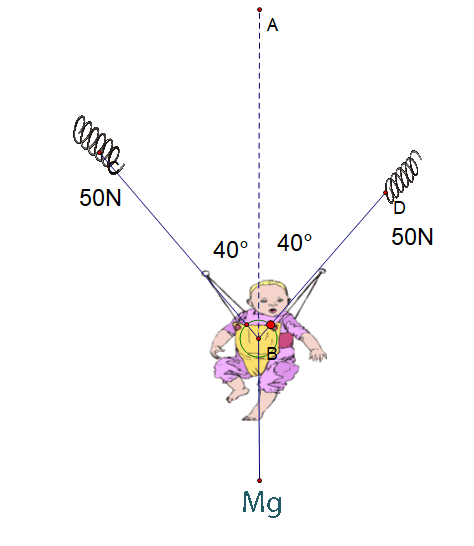
Take the acceleration due to gravity as 9.81 m/s².
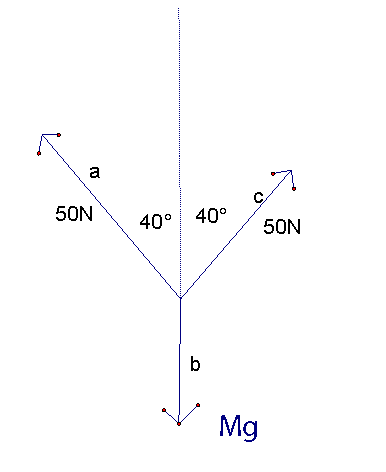
Split into components:
Vertical components:
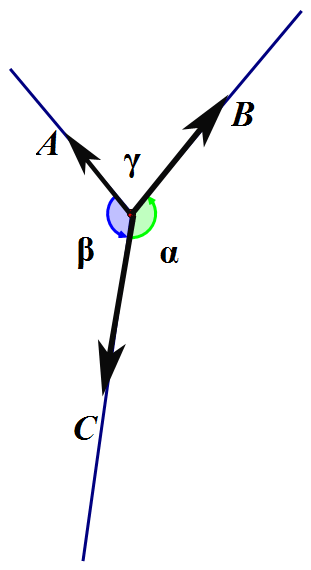
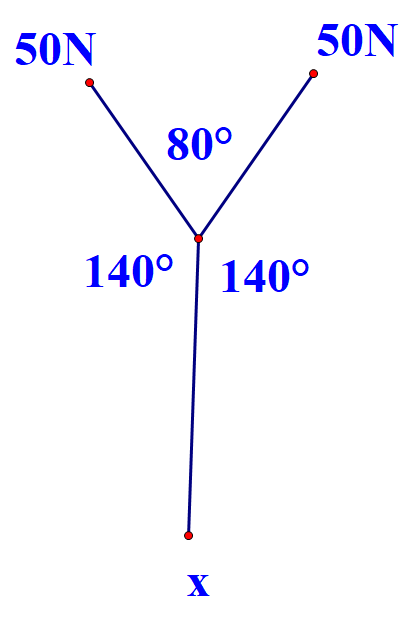
Alternatively, using Lami’s Theorem:
Frame of Reference
A frame of reference is used to fix the origin of a coordinate system that can then be used to take measurements for calculations within that frame.
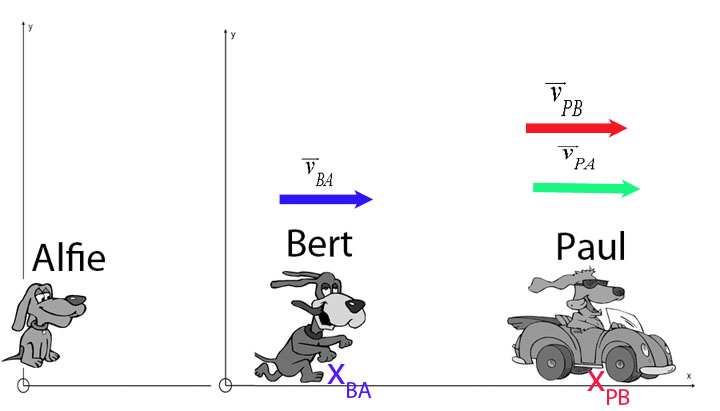
Here, Alfie is sat stationary, watching Bert run at a constant speed after Paul, who is driving away at a constant speed.
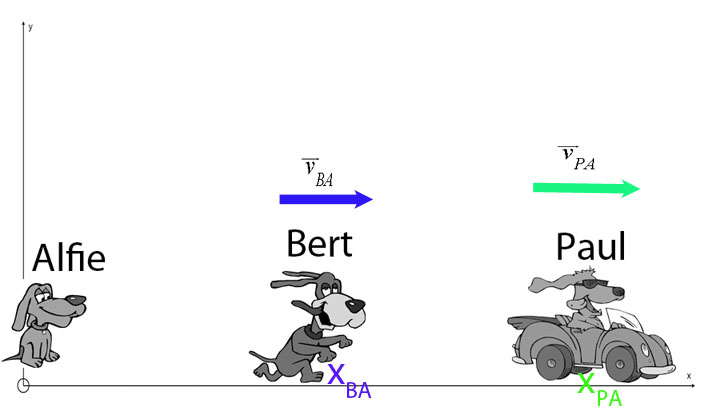
From Alfie's point of view, at any given time the coordinate of Bert is \(x_{BA}\) and the coordinate of Paul is \(x_{PA}\).
From Bert's point of view, at any given time the coordinate of Paul is \(x_{PB}\).
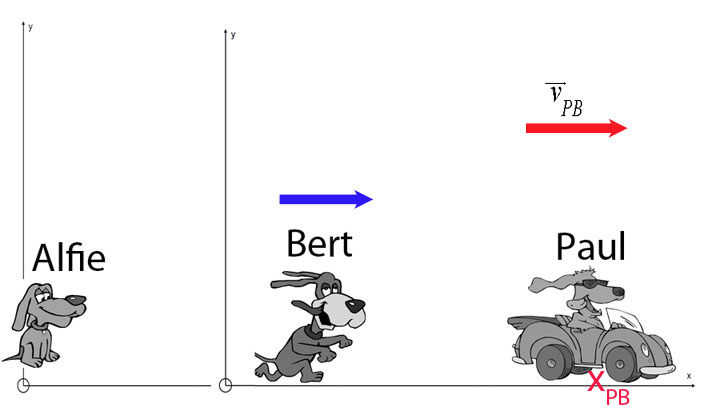
So:
\(x_{PA} = x_{PB} + x_{BA}\)
Relative position, velocity and acceleration
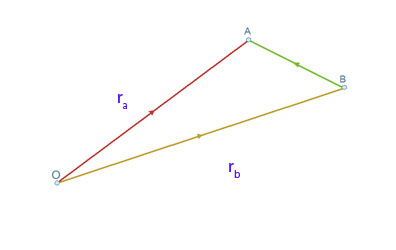
The positions of two bodies, A and B, are shown from the origin O.
The instantaneous position of A is represented by the vector \(\mathbf{r}_a\), and that of B by \(\mathbf{r}_b\).
Relative Motion
When two frames of reference, A and B, are moving relative to each other at a constant velocity, the velocity of a particle P as measured by an observer in frame A is:
Which can be written without vector arrows for motion in a single axis:
\(V_{PA} = V_{PB} + V_{BA}\)
Re‑arranging gives:
Some texts use:
\(_B V_A = V_{PB} - V_{PA}\)
to show the velocity of B relative to A.
To find the acceleration of P as measured from A and B, the velocity vectors are differentiated with respect to time:
Since \(V_{BA}\) is constant, the last term is zero:
\(a_{PA} = a_{PB}\)
Observers on different frames of reference that move at constant velocity relative to each other will measure the same acceleration for a moving particle.
Ship A is moving with speed 10 km/h due west and ship B is moving with speed 8 km/h due north. Find the magnitude and direction of the velocity of ship A relative to ship B.
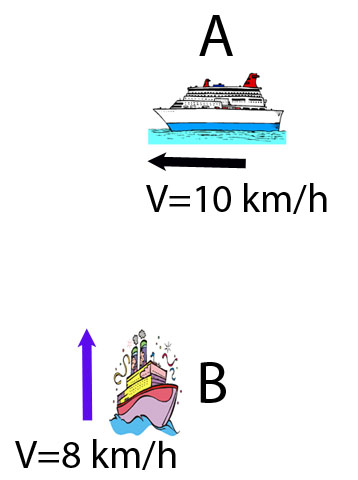
The question wants the velocity of ship A relative to ship B:
\(_A V_B = V_{PA} - V_{PB}\)
\(_A V_B = V_A - V_B\)
The direction of B is reversed for the resulting velocity diagram.
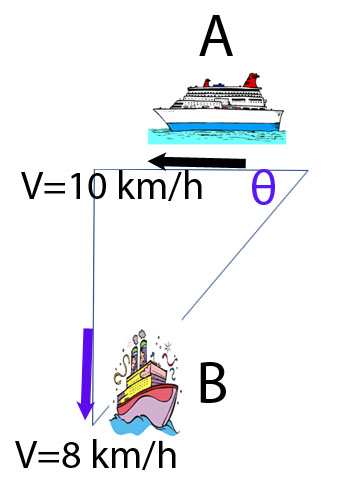
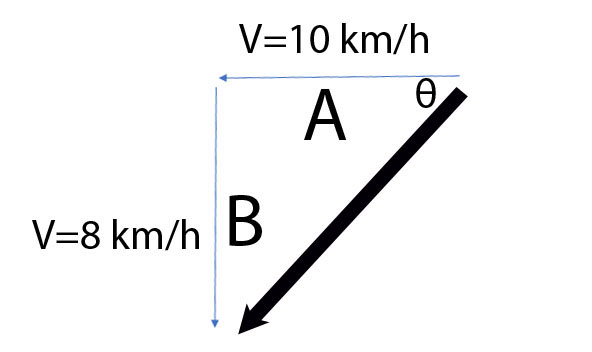
The bearing of ship A from ship B is \(270^\circ - 38.7^\circ \approx 231^\circ\).
This can also be written as W39°S (39° south from west) or S51°W (51° west of south).
The magnitude of the velocity of ship A from ship B is 12.81 km/h.