Time
Current Time
World Time Table
World Time Zones
60 seconds = 1 minute
60 minutes = 1 hour
24 hours = 1 day
7 days = 1 week
52 weeks = 1 year
Leap Year
365 days = normal year
366 days = leap year
Leap years are divisible by 4.
Centuries are not leap years unless divisible by 400.
Leap Year Calculator
Gregorian Calendar
Introduced by Pope Gregory XIII in October 1582, the Gregorian calendar replaced the Julian calendar .
Adopted in Great Britain in September 1752 — 2nd September 1752 was immediately followed by 14th September 1752.
Months of the year:
January — 31 days
February — 28 days (29 in leap year)
March — 31 days
April — 30 days
May — 31 days
June — 30 days
July — 31 days
August — 31 days
September — 30 days
October — 31 days
November — 30 days
December — 31 days
Days Between Dates
12‑hour and 24‑hour Clock
12‑hour clock times are written with:
• am to represent morning
• pm to represent afternoon
A colon is used to separate minutes.
9:30 am — half past nine in the morning.
9:37 pm — 23 minutes to ten in the evening.
24‑hour clock times are written with two digits for the hour and a colon to separate minutes.
09:30 — half past nine in the morning.
21:37 — 23 minutes to ten in the evening.
Military usage of the 24‑hour clock:
• drops the colon
• adds the word hrs
09 30 hrs — half past nine in the morning.
21 37 hrs — 23 minutes to ten in the evening.
Converting Between 12‑hour and 24‑hour Clock Times
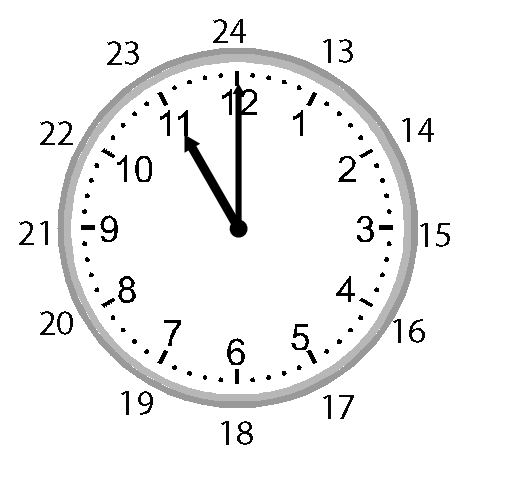
To convert from 12‑hour clock to 24‑hour clock:
- Drop the am or pm
- Add 12 to the hour if the time is in the afternoon (pm)
9:30 am → 09:30 → 09 30 hrs
3:15 pm → 15:15 → 15 15 hrs
To Convert from 24‑hour Clock to 12‑hour Clock
- Subtract 12 from the hours if the time is between 13:00 and 24:00
- Drop the hrs if it was included
- Add am if the time is between 00:00 and 11:59
- Add pm if the time is between 12:01 and 24:00
03:15 → 3:15 am
23:23 → 11:23 pm
11 27 hrs → 11:27 am
21 00 hrs → 9 pm
Calculations with Time
Calculate the number of minutes from start time to next hour, then number of complete hours, then number of minutes from final hour to end time
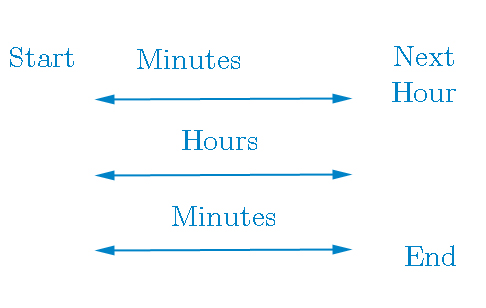
Calculate the time difference between:
a) 11:07 and 11:30 b) 11:07 and 12:00
Although tempting to use, the calculator gives the wrong answer for part b :
This is because the calculator is working in base 10 and time is base 60
Correct way
Time Difference Calculator
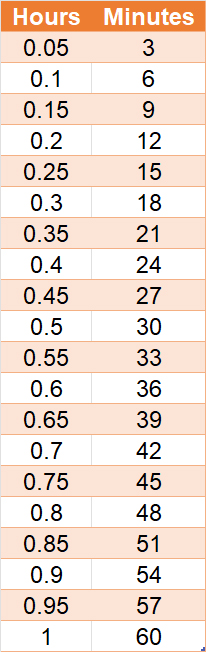
Hours to Minutes Conversion Table
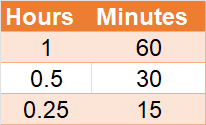
1 hour is 60 minutes.
So:
0.1 of an hour is 6 minutes.
World Time
Calendar Generator
Generate a Monthly Calendar
Clock Faces Drill Questions A Brief History of Time (Stephen Hawking)
As an Amazon Associate I earn from qualifying purchases.