Maths Mutt HOME

Perpendicular Bisector

Perpendicular means to cross at right angles.

To bisect means to cut into two parts of equal shape and size.
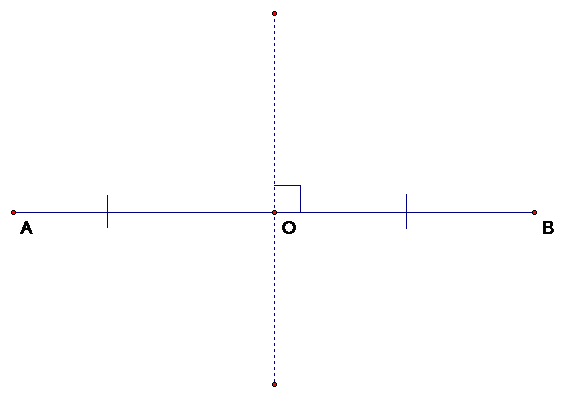
perp bisector
A perpendicular bisector cuts a line in half at 90°.
Example

Find the equation of the perpendicular bisector of the line joining A(0,3) and B(5,4).

The perpendicular bisector will cut the line ABat its midpoint.

\[ \text{The gradient of the bisector will be } -\frac{1}{m_{AB}}. \]

Find the midpoint of AB:

\[ \text{The midpoint of } AB \text{ is} \] \[ M\!\left(\frac{x_1 + x_2}{2},\; \frac{y_1 + y_2}{2}\right) \] \[ M\!\left(\frac{0 + 5}{2},\; \frac{3 + 4}{2}\right) \] \[ M\!\left(\frac{5}{2},\; \frac{7}{2}\right) \]

Use this to find the gradient:

\[ m_{AB} = \frac{y_2 - y_1}{x_2 - x_1} \] \[ = \frac{4 - 3}{5 - 0} \] \[ = \frac{1}{5} \] \[ \text{Gradient of the bisector} = -\frac{1}{m_{AB}} = -5 \]

Now find the equation:

\[ \text{Point } M\!\left(\frac{5}{2},\,\frac{7}{2}\right) \text{ is on the perpendicular bisector.} \] \[ y - b = m(x - a) \] \[ y - \frac{7}{2} = -5\!\left(x - \frac{5}{2}\right) \] \[ y - \frac{7}{2} = -5x + \frac{25}{2} \] \[ y = -5x + \frac{25}{2} + \frac{7}{2} \] \[ y = -5x + \frac{32}{2} \] \[ y = -5x + 16 \]

Concurrency

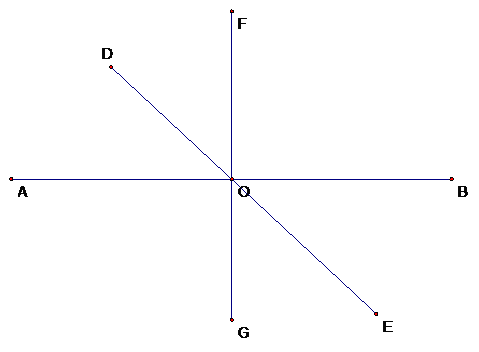
Lines are said to be concurrent if they pass through one common point.
concurrent

Lines AB, DE and FG are concurrent, sharing the common point O.

The perpendicular bisectors of a triangle are concurrent.

Circumcentre

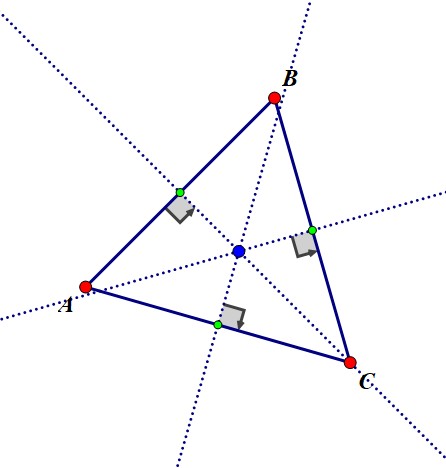
In a triangle, the point of intersection of the perpendicular bisectors is called the circumcentre.
circumcentre

The circumcentre is equidistant from the three vertices.

Circumcircle

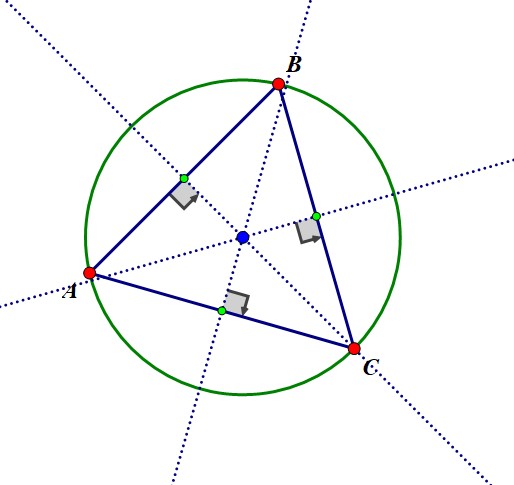
The circumcircle of a triangle is the circle which passes through all the vertices and has its centre at the circumcentre.
circumcircle
Example

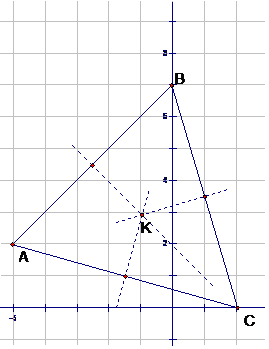
Find K, the circumcentre of triangle A(-5,2), B(0,7), C(2,0).

Steps

  • Find midpoints
  • Find gradients
  • Solve equations to find K

The midpoints are:

\[ M_{AB}\!\left(\frac{x_1 + x_2}{2},\; \frac{y_1 + y_2}{2}\right) \] \[ M_{AB}\!\left(\frac{-5 + 0}{2},\; \frac{2 + 7}{2}\right) \] \[ M_{AB}\!\left(\frac{-5}{2},\; \frac{9}{2}\right) \]
\[ M_{BC}\!\left(\frac{x_1 + x_2}{2},\; \frac{y_1 + y_2}{2}\right) \] \[ M_{BC}\!\left(\frac{0 + 2}{2},\; \frac{7 + 0}{2}\right) \] \[ M_{BC}\!\left(1,\; \frac{7}{2}\right) \]
\[ M_{AC}\!\left(\frac{x_1 + x_2}{2},\; \frac{y_1 + y_2}{2}\right) \] \[ M_{AC}\!\left(\frac{-5 + 2}{2},\; \frac{2 + 0}{2}\right) \] \[ M_{AC}\!\left(\frac{-3}{2},\; 1\right) \]

Now find the gradients:

\[ m_{AB} = \frac{y_2 - y_1}{x_2 - x_1} \] \[ = \frac{7 - 2}{\,0 - (-5)\,} \] \[ = \frac{5}{5} = 1 \] \[ m_{\perp AB} = -\frac{1}{m_{AB}} = -1 \]
\[ m_{BC} = \frac{y_2 - y_1}{x_2 - x_1} \] \[ = \frac{0 - 7}{\,2 - 0\,} \] \[ = \frac{-7}{2} \] \[ m_{\perp BC} = -\frac{1}{m_{BC}} = \frac{2}{7} \]
\[ m_{AC} = \frac{y_2 - y_1}{x_2 - x_1} \] \[ = \frac{0 - 2}{\,2 - (-5)\,} \] \[ = \frac{-2}{7} \] \[ m_{\perp AC} = -\frac{1}{m_{AC}} = \frac{7}{2} \]

Equations of the perpendicular bisectors:

\[ \text{Line } \perp AB \] \[ \text{Use } M_{AB}\!\left(\frac{-5}{2},\,\frac{9}{2}\right) \] \[ y - b = m(x - a) \] \[ y - \frac{9}{2} = -\left(x - \frac{-5}{2}\right) \] \[ y - \frac{9}{2} = -x - \frac{5}{2} \] \[ y = -x - \frac{5}{2} + \frac{9}{2} \] \[ y = -x + \frac{4}{2} \] \[ y = -x + 2 \]
\[ \text{Line } \perp BC \] \[ \text{Use } M_{BC}\!\left(1,\,\frac{7}{2}\right) \] \[ y - b = m(x - a) \] \[ y - \frac{7}{2} = \frac{2}{7}x - \frac{2}{7} \] \[ y = \frac{2}{7}x - \frac{4}{14} + \frac{49}{14} \] \[ y = \frac{2}{7}x + \frac{45}{14} \] \[ 14y = 4x + 45 \]
\[ \text{Line } \perp AC \] \[ \text{Use } M_{AC}\!\left(\frac{-3}{2},\,1\right) \] \[ y - b = m(x - a) \] \[ y - 1 = \frac{7}{2}\!\left(x - \frac{-3}{2}\right) \] \[ y - 1 = \frac{7}{2}x + \frac{21}{4} \] \[ y = \frac{7}{2}x + \frac{21}{4} + 1 \] \[ y = \frac{7}{2}x + \frac{25}{4} \] \[ 4y = 14x + 25 \]

Now solve the sets of equations:

\[ y = -x + 2 \qquad \text{(1)} \] \[ 14y = 4x + 45 \qquad \text{(2)} \] \[ 4y = 14x + 25 \qquad \text{(3)} \]
\[ \text{Sub (1) into (3)} \] \[ 4(-x + 2) = 14x + 25 \] \[ -4x + 8 = 14x + 25 \] \[ -17 = 18x \] \[ x = -\frac{17}{18} \]
\[ \text{sub this value into eqn (2)} \] \[ 14y = 4\!\left(-\frac{17}{18}\right) + 45 \] \[ 14y = -\frac{68}{18} + 45 \] \[ 14y = -\frac{68}{18} + \frac{810}{18} \] \[ 14y = \frac{742}{18} \] \[ 14y = \frac{371}{9} \] \[ y = \frac{371}{9 \times 14} \] \[ y = \frac{371}{126} \] \[ y = 2\frac{119}{126} \]
\[ \text{Check both values in (1)} \] \[ y = -x + 2 \] \[ y + x = 2 \] \[ 2\frac{119}{126} + \left(-\frac{17}{18}\right) = \frac{371}{126} - \frac{119}{126} \] \[ = \frac{252}{126} \] \[ = \frac{2}{1} \] \[ = 2 \text{ as required} \]
\[ \text{The circumcentre is } K\!\left(-\frac{17}{18},\; 2\frac{119}{126}\right) \]
circumcentre K

Altitude

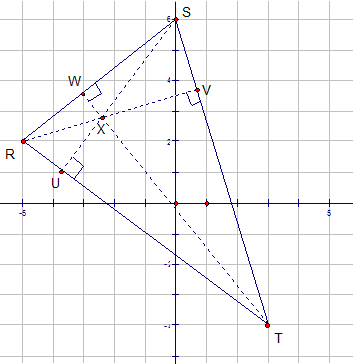
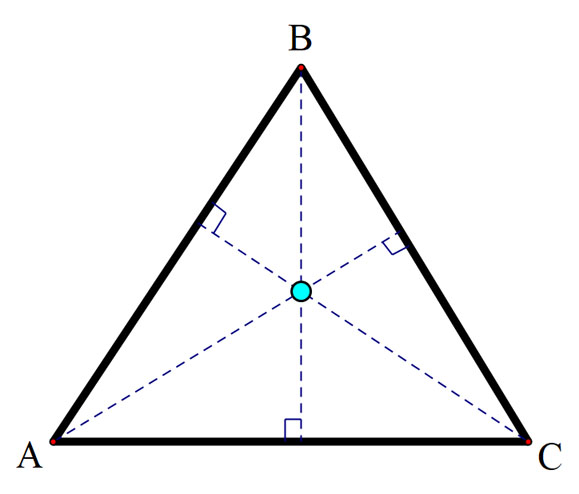
An altitude of a triangle is a line drawn from a vertex perpendicular to the opposite side.

The altitudes are concurrent and meet at the orthocentre.
orthocentre
Example
traingle

Triangle RST has coordinates R(-5,2), S(0,6), T(3,-4). Find the equation of the altitude from S.

The altitude from S is perpendicular to RT.

\[ m_{RT} = \frac{y_2 - y_1}{x_2 - x_1} \] \[ = \frac{(-4) - 2}{\,3 - (-5)\,} \] \[ = \frac{-6}{8} \] \[ = -\frac{3}{4} \] \[ m_{\perp RT} = -\frac{1}{m_{RT}} = \frac{4}{3} \]
\[ \text{The altitude has gradient } \frac{4}{3} \] \[ \text{and passes through the point } S(0,6) \] \[ y - b = m(x - a) \] \[ y - 6 = \frac{4}{3}(x - 0) \] \[ y - 6 = \frac{4}{3}x \] \[ y = \frac{4}{3}x + 6 \] \[ \text{is the equation of the altitude required} \]

Median

A median of a triangle is a line from a vertex to the midpoint of the opposite side.

The medians are concurrent and meet at the centroid.
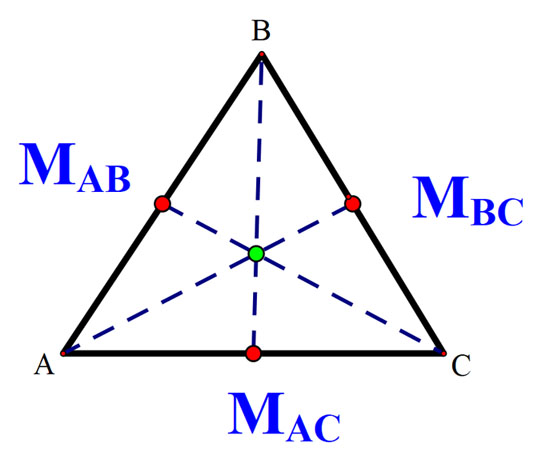
centroid
The centroid splits each median in the ratio 1:2.
Example

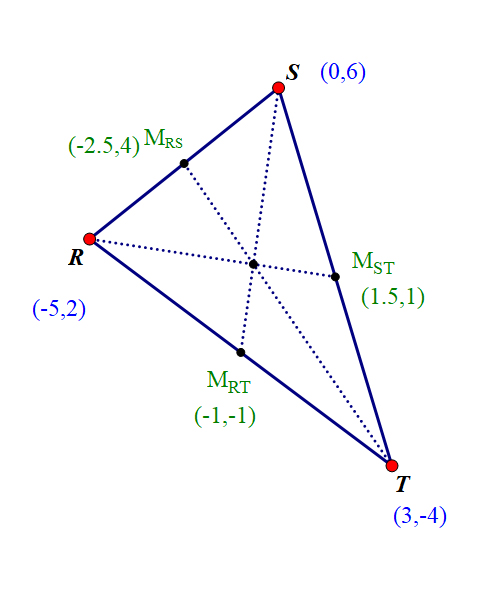
Triangle RST has coordinates R(-5,2), S(0,6), T(3,-4).

1. Find the equation of the median from R.
2. Find the equation of the median from S.
3. Find the equation of the median from T.
4. Hence find the centroid.
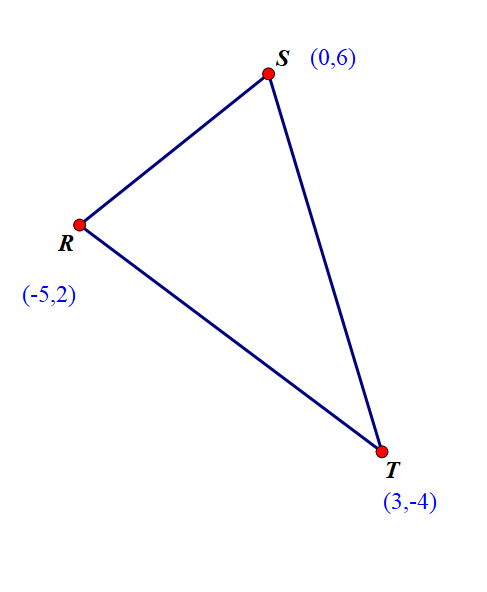
triangle

1. Median from R

Find midpoint of ST:

\[ \text{The midpoint of ST is} \] \[ M_{ST}\!\left(\frac{x_1 + x_2}{2},\; \frac{y_1 + y_2}{2}\right) \] \[ = \left(\frac{0 + 3}{2},\; \frac{6 + (-4)}{2}\right) \] \[ = \left(\frac{3}{2},\; \frac{2}{2}\right) \] \[ = \left(\frac{3}{2},\; 1\right) \]

Find gradient:

\[ m_{R M_{st}} = \frac{y_2 - y_1}{x_2 - x_1} \] \[ = \frac{1 - 2}{\,\frac{3}{2} - (-5)\,} \] \[ = \frac{-1}{\,\frac{13}{2}\,} \] \[ = -\frac{1}{13} \times 2 \] \[ = -\frac{2}{13} \]

Equation:

\[ \text{The altitude has gradient } -\frac{2}{13} \text{ and} \] \[ \text{passes through the point } M\!\left(\frac{3}{2},\,1\right) \] \[ y - b = m(x - a) \] \[ y - 1 = -\frac{2}{13}\!\left(x - \frac{3}{2}\right) \] \[ y - 1 = -\frac{2}{13}x + \frac{6}{26} \] \[ y = -\frac{2}{13}x + \frac{6}{26} + 1 \] \[ y = -\frac{2}{13}x + \frac{16}{13} \]

Median from R: 13y = -2x + 16

2. Median from S

\[ \text{The midpoint of RT is} \] \[ M_{RT}\!\left(\frac{x_1 + x_2}{2},\; \frac{y_1 + y_2}{2}\right) \] \[ = \left(\frac{-5 + 3}{2},\; \frac{2 + (-4)}{2}\right) \] \[ = \left(\frac{-2}{2},\; \frac{-2}{2}\right) \] \[ = (-1,\,-1) \]
\[ m_{S M_{RT}} = \frac{y_2 - y_1}{x_2 - x_1} \] \[ = \frac{-1 - 6}{\, -1 - 0 \,} \] \[ = \frac{-7}{-1} \] \[ = 7 \]
\[ \text{The altitude has gradient } 7 \text{ and} \] \[ \text{passes through the point } M_{RT}(-1,\,-1) \] \[ y - b = m(x - a) \] \[ y + 1 = 7(x + 1) \] \[ y + 1 = 7x + 7 \] \[ y = 7x + 6 \]

Median from S: y = 7x + 6

3. Median from T

\[ \text{The midpoint of RS is} \] \[ M_{RS}\!\left(\frac{x_1 + x_2}{2},\; \frac{y_1 + y_2}{2}\right) \] \[ = \left(\frac{-5 + 0}{2},\; \frac{2 + 6}{2}\right) \] \[ = \left(\frac{-5}{2},\; \frac{8}{2}\right) \] \[ = (-2.5,\; 4) \]
\[ m_{T M_{RS}} = \frac{y_2 - y_1}{x_2 - x_1} \] \[ = \frac{4 - (-4)}{\,(-2.5) - 3\,} \] \[ = \frac{8}{-5.5} \] \[ = -\frac{16}{11} \]
\[ \text{The altitude has gradient } -\frac{16}{11} \text{ and} \] \[ \text{passes through the point } M_{RS}(-2.5,\;4) \] \[ y - b = m(x - a) \] \[ y - 4 = -\frac{16}{11}\left(x + 2.5\right) \] \[ y - 4 = -\frac{16}{11}x - \frac{40}{11} \] \[ y = -\frac{16}{11}x - \frac{40}{11} + \frac{44}{11} \] \[ y = -\frac{16}{11}x + \frac{4}{11} \]

Median from T: 11y = -16x + 4

4. Find the centroid

Equating medians:

\[ y = 7x + 6 \] \[ y = -\frac{2x}{13} + \frac{16}{13} \] \[ 7x + 6 = -\frac{2x}{13} + \frac{16}{13} \] \[ 91x + 78 = -2x + 16 \] \[ 93x + 78 = 16 \] \[ 93x = -62 \] \[ x = -\frac{62}{93} = -\frac{2}{3} \]
\[ y = 7x + 6 \] \[ y = -\frac{16}{11}x + \frac{4}{11} \] \[ 7x + 6 = -\frac{16}{11}x + \frac{4}{11} \] \[ 77x + 66 = -16x + 4 \] \[ 93x + 66 = 4 \] \[ 93x = -62 \] \[ x = -\frac{62}{93} = -\frac{2}{3} \]
\[ y = -\frac{2x}{13} + \frac{16}{13} \] \[ y = -\frac{16}{11}x + \frac{4}{11} \] \[ -\frac{2x}{13} + \frac{16}{13} = -\frac{16}{11}x + \frac{4}{11} \] \[ -22x + 176 = -208x + 52 \] \[ 186x = -124 \] \[ x = -\frac{124}{186} = -\frac{2}{3} \]

Substitute x = -2/3:

\[ y = 7x + 6 \] \[ y = 7\left(-\frac{2}{3}\right) + 6 \] \[ y = -\frac{14}{3} + 6 \] \[ y = \frac{4}{3} \]
\[ y = -\frac{2x}{13} + \frac{16}{13} \] \[ y = \frac{-2\left(-\frac{2}{3}\right)}{13} + \frac{16}{13} \] \[ y = \frac{\frac{4}{3}}{13} + \frac{16}{13} \] \[ y = \frac{4}{39} + \frac{16}{13} \] \[ y = \frac{4}{39} + \frac{48}{39} \] \[ y = \frac{52}{39} = \frac{4}{3} \]
\[ y = -\frac{16}{11}x + \frac{4}{11} \] \[ y = \frac{-16\left(-\frac{2}{3}\right)}{11} + \frac{4}{11} \] \[ y = \frac{\frac{32}{3}}{11} + \frac{4}{11} \] \[ y = \frac{32}{33} + \frac{4}{11} \] \[ y = \frac{32}{33} + \frac{12}{33} \] \[ y = \frac{44}{33} = \frac{4}{3} \]

Centroid is at: ( -2/3 , 4/3 )

picture