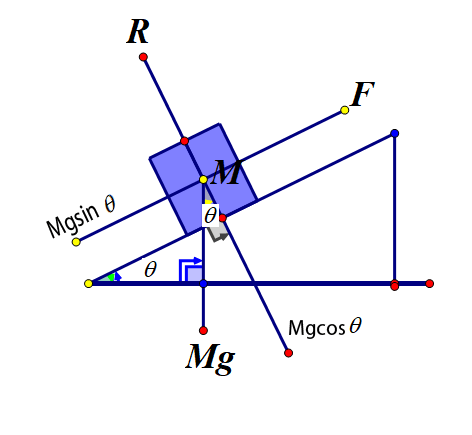
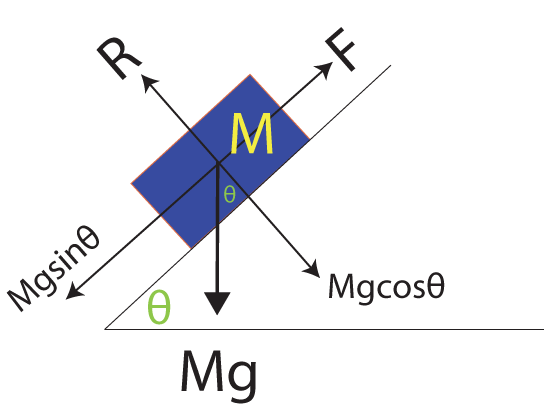
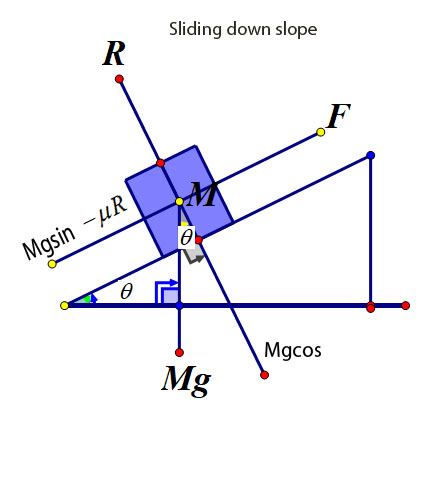
An object of mass \(M\) rests on a plane inclined at an angle \(\theta\) to the horizontal.
Since the object is at rest, the forces are in equilibrium.
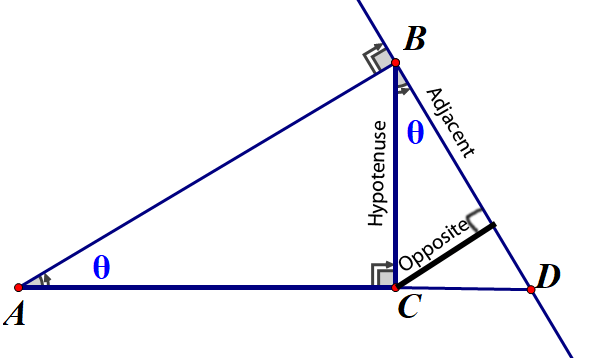
Trig Refresher
\[
\sin\theta
=
\frac{\text{Opposite}}{\text{Hypotenuse}}
\]
\[
\sin\theta
=
\frac{\text{Opposite}}{BC}
\]
\[
\text{Opposite}
=
BC\,\sin\theta
\]
\[
\cos\theta
=
\frac{\text{Adjacent}}{\text{Hypotenuse}}
\]
\[
\cos\theta
=
\frac{\text{Adjacent}}{BC}
\]
\[
\text{Adjacent}
=
BC\,\cos\theta
\]
Resolving Forces
Resolving \(Mg\) parallel and perpendicular to the plane:
\[
R = Mg\cos\theta
\]
\[
F = Mg\sin\theta
\]
The maximum friction is:
\[
\begin{aligned}
F_{\max} &= \mu R \\
&= \mu\,Mg\cos\theta
\end{aligned}
\]
where \(\mu \) is the coefficient of friction.
For equilibrium: \( F = Mg\sin\theta \)
At the position of limiting equilibrium, the object is on the point of moving and
\[
Mg\sin\theta = \mu Mg\cos\theta
\]
At limiting equilibrium:
\[
\frac{Mg\sin\theta}{ Mg\cos\theta} = \mu
\]
\[
\mu = \tan\theta
\]
For motion down the plane:
\[
\begin{aligned}
Mg\sin\theta &> \mu\,Mg\cos\theta \\
\tan\theta &> \mu
\end{aligned}
\]
Motion Up the Plane
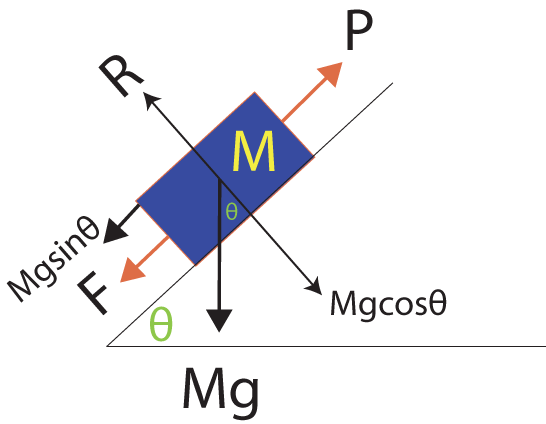
If a force greater than \(\mu R\) is applied up the plane, friction acts down the plane.
For movement up the slope :
\[
\begin{aligned}
P &> F + Mg\sin\theta \\
P &> \mu Mg\cos\theta + Mg\sin\theta \\
P &> Mg(\mu\cos\theta + \sin\theta)
\end{aligned}
\]
Example
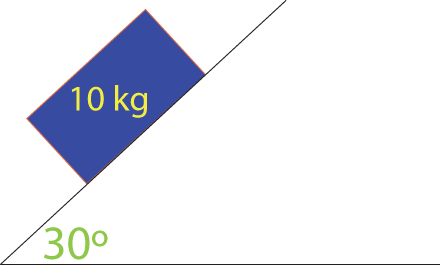
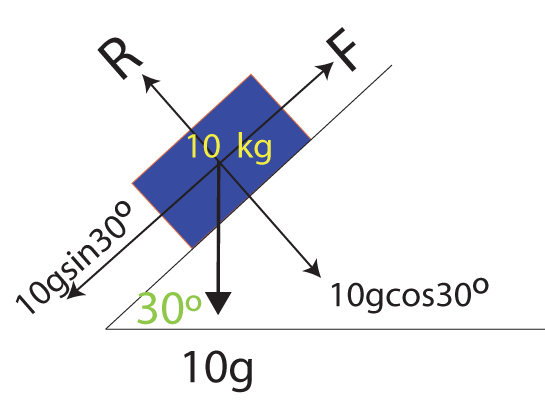
A 10 kg object is in limiting equilibrium on a slope inclined at \(30^\circ\).
Find the coefficient of friction between the object and the plane.
Find the magnitude of the forces experienced by the object at right angles to and parallel to the plane. (Take g = 9.8m/s2 )
1) Find the coefficient of friction
The object is in limiting equilibrium, so
\[
Mg\sin\theta = \mu Mg\cos\theta
\]
\[
10g\sin30^\circ = 10\mu g\cos30^\circ
\]
\[
\frac{10g\sin30^\circ}{10g\cos30^\circ} = \mu
\]
\[
\mu = \tan30^\circ
\]
\[
\mu = \frac{1}{\sqrt{3}}
\]
2) Forces perpendicular and parallel to the plane
\[
R = Mg\cos\theta
\]
\[
= 10g\cos30^\circ
\]
\[
= 10g\,\frac{\sqrt{3}}{2}
\]
\[
= 5g\sqrt{3}\ \text{N}
\]
\[
\approx 84.9\ \text{N}\ (1\text{ d.p.})
\]
\[
F = \mu R
\]
\[
= \frac{1}{\sqrt{3}} \times 5g\sqrt{3}
\]
\[
= 5g
\]
\[
= 49\ \text{N}
\]
Alternative Method
\[
F = \mu R
\]
\[
= \mu\,Mg\cos\theta
\]
\[
= \frac{1}{\sqrt{3}} \times 10g\cos30^\circ
\]
\[
= \frac{1}{\sqrt{3}} \times 10g\,\frac{\sqrt{3}}{2}
\]
\[
= 5g
\]
\[
= 49\ \text{N}
\]
Example
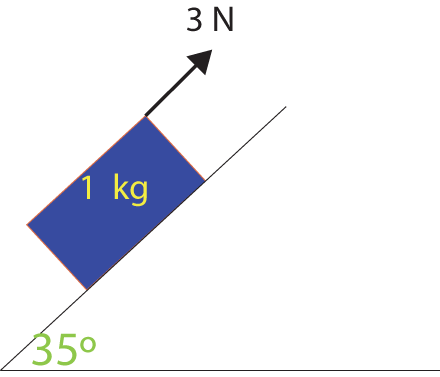
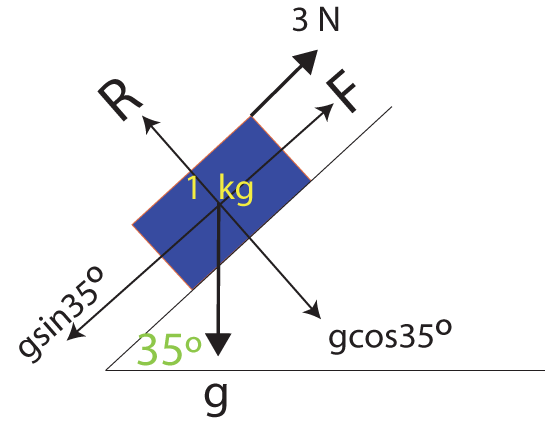
An object of mass 1kg is placed on an inclined slope of 35° to the horizontal as shown:
Applying a force of 3N up the slope and parallel to the plane puts the object in limiting equilibrium. What is the coefficient of friction ? (Take g = 9.8m/s2 )
\[
\begin{aligned}
3 + F &= Mg\sin\theta \\
F &= Mg\sin\theta - 3 \\
F &= g\sin35^\circ - 3
\end{aligned}
\]
\[ \text{but } F = \mu R = \mu Mg\cos\theta \]
\[
\begin{aligned}
\mu g\cos35^\circ &= g\sin35^\circ - 3 \\
\mu &= \frac{g\sin35^\circ - 3}{g\cos35^\circ} \\
\mu &= 0.33\ (2\text{ d.p.})
\end{aligned}
\]
Example
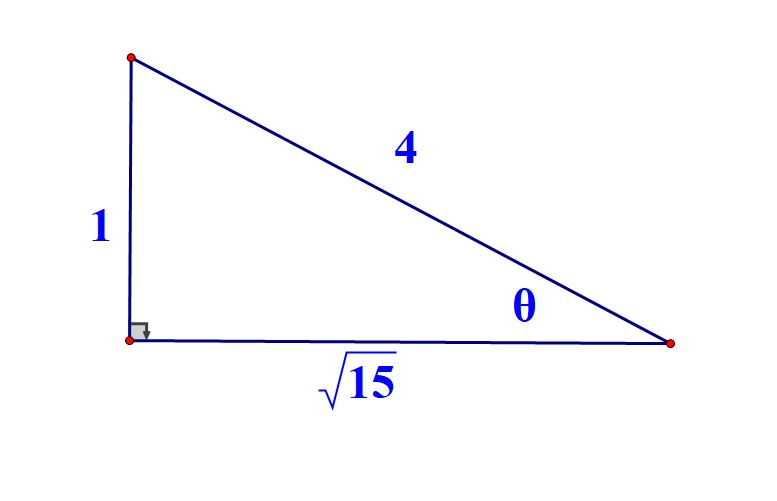
A block starts from rest and slides straight down a slope inclined at an angle θ to the horizontal, where sin θ = 0.25 and the coefficient of friction between the block and the slope is 0·125.
Find the speed of the block after it has travelled 5 metres.
Given sinθ=0.25
The block starts from rest: \(u = 0\).
Speed is the magnitude of velocity.
\[
F_{\parallel} = mg\sin\theta - \mu R
\]
\[
R = mg\cos\theta
\]
\[
F_{\parallel}
= mg\sin\theta - \mu mg\cos\theta
\]
But
\[
\begin{aligned}
F &= ma \\
F &= mg\sin\theta - \mu mg\cos\theta
\end{aligned}
\]
So
\[
\begin{aligned}
ma &= mg\sin\theta - \mu mg\cos\theta \\
a &= g\sin\theta - \mu g\cos\theta
\end{aligned}
\]
\[
ma = mg\sin\theta - \mu mg\cos\theta
\]
\[
a = g\times\frac14 - \frac18\times g\times\frac{\sqrt{15}}{4}
\]
\[
= \frac{g}{4} - \frac{g\sqrt{15}}{32}
\]
\[
= \frac{8g - g\sqrt{15}}{32}
\]
\[
= \frac{g(8 - \sqrt{15})}{32}
\]
\[
\approx 1.2638\ \text{m/s}^2
\]
Finally
\[
v^2 = u^2 + 2as
\]
\[
= 0 + 2 \times 1.2638 \times 5
\]
\[
= 12.638
\]
\[
v = \sqrt{12.638}
\]
\[
\text{Speed} = |v|
\]
\[
\text{speed} = 3.554\ \text{m/s}
\]
Youtube Aides
Flipping Physics
VIDEO
Physics Models by Kaustubhan
VIDEO
DLBmaths
VIDEO