Rounding
Rounding is the act of approximating numbers by ignoring everything after a given place value . This can make mental calculations much easier.
Rounding Whole Numbers
Usually, you will be asked to round to the nearest unit, ten, hundred or thousand.
Steps:
- Write down the number to be rounded.
- Underline the required place to round to.
- Look at the digit immediately to the right.
If it is 5 or more, increase your underlined digit by 1.
If it is less than 5, leave your underlined digit alone.
- Write out your number up to the underlined digit.
- Fill any remaining places with zeroes.
- Include brackets showing what the number has been rounded to (e.g. nearest ten).
Round 347 to the nearest ten.
\[ \text{Number: } 347 \] \[ \text{Underline the tens digit: } 3\underline{4}7 \] \[ \text{Look at the next digit: } 7 \ge 5 \] \[ \text{Increase the underlined digit: } 4 \to 5 \] \[ 347 \approx 350 \quad (\text{nearest ten}) \]Round 12,478 to the nearest hundred.
\[ \text{Number: } 12{,}478 \] \[ \text{Underline the hundreds digit: } 12{,}4\underline{7}8 \] \[ \text{Look at the next digit: } 8 \ge 5 \] \[ \text{Increase the underlined digit: } 7 \to 8 \] \[ 12{,}478 \approx 12{,}500 \quad (\text{nearest hundred}) \]Round 12,478 to the nearest thousand.
\[ \text{Number: } 12{,}478 \] \[ \text{Underline the thousands digit: } 1\underline{2}{,}478 \] \[ \text{Look at the next digit: } 4 \lt 5 \] \[ \text{Leave the underlined digit unchanged} \] \[ 12{,}478 \approx 12{,}000 \quad (\text{nearest thousand}) \]Rounding Decimals
Rounding decimals works exactly like rounding whole numbers, except the counting starts at the decimal point.
- Write down the number to be rounded.
- Count out the required number of decimal places to the right of the decimal point.
- Underline this digit.
- Look at the digit immediately to the right.
If it is 5 or more, increase your underlined digit by 1.
If it is less than 5, leave your underlined digit alone.
- Write out your number up to the underlined digit.
- Include brackets showing what the number has been rounded to (e.g. 2 d.p.).
Round 3.478 to 1 decimal place.
\[ \text{Number: } 3.478 \] \[ \text{Underline the 1st decimal place: } 3.\underline{4}78 \] \[ \text{Look at the next digit: } 7 \ge 5 \] \[ \text{Increase the underlined digit: } 4 \to 5 \] \[ 3.478 \approx 3.5 \quad (1\text{ d.p.}) \]Round 8.032 to 2 decimal places.
\[ \text{Number: } 8.032 \] \[ \text{Underline the 2nd decimal place: } 8.0\underline{3}2 \] \[ \text{Look at the next digit: } 2 \lt 5 \] \[ \text{Leave the underlined digit unchanged} \] \[ 8.032 \approx 8.03 \quad (2\text{ d.p.}) \]Round 0.999 to 2 decimal places.
\[ \text{Number: } 0.999 \] \[ \text{Underline the 2nd decimal place: } 0.9\underline{9}9 \] \[ \text{Look at the next digit: } 9 \ge 5 \] \[ \text{Increase the underlined digit: } 9 \to 10 \] \[ \text{This causes a carry: } 0.999 \approx 1.00 \quad (2\text{ d.p.}) \]Round 12.0049 to 3 decimal places.
\[ \text{Number: } 12.0049 \] \[ \text{Underline the 3rd decimal place: } 12.00\underline{4}9 \] \[ \text{Look at the next digit: } 9 \ge 5 \] \[ \text{Increase the underlined digit: } 4 \to 5 \] \[ 12.0049 \approx 12.005 \quad (3\text{ d.p.}) \]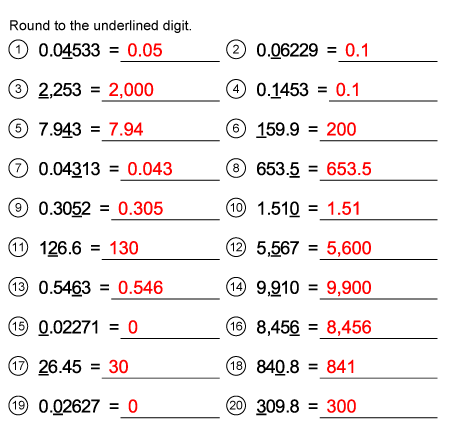
Significant Figures
Rounding to significant figures is similar to rounding decimals, but the counting starts from the first non‑zero digit on the left.
- Write down the number to be rounded.
- Ignoring leading zeroes, count out the required number of significant figures.
- Underline this digit.
- Look at the digit immediately to the right.
If it is 5 or more, increase your underlined digit by 1.
If it is less than 5, leave your underlined digit alone.
- Write out your number up to the underlined digit.
- Fill in zeroes as placeholders up to the decimal point if needed.
Include brackets showing the number of significant figures used.
Round 34,789 to 2 significant figures.
\[ \text{Number: } 34{,}789 \] \[ \text{Count 2 significant figures: } \underline{3}4{,}789 \] \[ \text{Look at the next digit: } 4 \lt 5 \] \[ \text{Leave the underlined digit unchanged} \] \[ 34{,}789 \approx 35{,}000 \quad (2\text{ s.f.}) \]Round 0.004872 to 2 significant figures.
\[ \text{Number: } 0.004872 \] \[ \text{Ignore leading zeroes: } 0.00\underline{4}8 72 \] \[ \text{Look at the next digit: } 8 \ge 5 \] \[ \text{Increase the underlined digit: } 4 \to 5 \] \[ 0.004872 \approx 0.0049 \quad (2\text{ s.f.}) \]Round 678.2 to 3 significant figures.
\[ \text{Number: } 678.2 \] \[ \text{Count 3 significant figures: } 67\underline{8}.2 \] \[ \text{Look at the next digit: } 2 \lt 5 \] \[ \text{Leave the underlined digit unchanged} \] \[ 678.2 \approx 678 \quad (3\text{ s.f.}) \]Round 98,765 to 1 significant figure.
\[ \text{Number: } 98{,}765 \] \[ \text{Count 1 significant figure: } \underline{9}8{,}765 \] \[ \text{Look at the next digit: } 8 \ge 5 \] \[ \text{Increase the underlined digit: } 9 \to 10 \] \[ \text{This causes a carry: } 98{,}765 \approx 100{,}000 \quad (1\text{ s.f.}) \]Tolerance
Tolerance describes the limits within which a measurement is considered acceptable. A measurement rounded to a certain degree of accuracy represents a range of possible true values.
A length measured as 12 cm to the nearest centimetre.
\[ \text{Reported value: } 12\text{ cm} \] \[ \text{Nearest cm means } \pm 0.5\text{ cm} \] \[ \text{Lower bound: } 12 - 0.5 = 11.5\text{ cm} \] \[ \text{Upper bound: } 12 + 0.5 = 12.5\text{ cm} \] \[ \text{True value is in the interval } [11.5,\; 12.5) \]A mass recorded as 3.4 kg to 1 decimal place.
\[ \text{Reported value: } 3.4\text{ kg} \] \[ \text{1 d.p. means } \pm 0.05\text{ kg} \] \[ \text{Lower bound: } 3.4 - 0.05 = 3.35\text{ kg} \] \[ \text{Upper bound: } 3.4 + 0.05 = 3.45\text{ kg} \] \[ \text{True value is in the interval } [3.35,\; 3.45) \]A measurement given as 120 mm to 2 significant figures.
\[ \text{Reported value: } 120\text{ mm} \] \[ \text{2 s.f. means the rounding step is } 10\text{ mm} \] \[ \text{Half of this step: } 5\text{ mm} \] \[ \text{Lower bound: } 120 - 5 = 115\text{ mm} \] \[ \text{Upper bound: } 120 + 5 = 125\text{ mm} \] \[ \text{True value is in the interval } [115,\; 125) \]A measurement stated as 4.20 m to 2 decimal places.
\[ \text{Reported value: } 4.20\text{ m} \] \[ \text{2 d.p. means } \pm 0.005\text{ m} \] \[ \text{Lower bound: } 4.20 - 0.005 = 4.195\text{ m} \] \[ \text{Upper bound: } 4.20 + 0.005 = 4.205\text{ m} \] \[ \text{True value is in the interval } [4.195,\; 4.205) \]