Probability
Probability is the chance of something happening.
All probabilities lie between 0 and 1
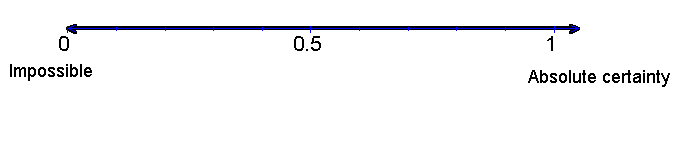
Probability can be written as a fraction, decimal or percentage.
Example
An
Even chance can be written as 0.5, 50% or
The probability of an event happening is equal to the number of ways an event can happen divided by the total number of possible outcomes.
Example
A bag contains 5 blue, 6 green and 4 red counters.
What is the probability that a counter picked at random will be green ?
Example
What is the probability that a card picked at random from a standard pack of 52 playing cards will be :-
a) A red card ?
b) An Ace ?
c) The King of Spades ?
· Mutually exclusive events cannot happen at the same time.
Example
What is the probability that a card picked at random from a standard pack of 52 playing cards will not be an Ace ?
· The addition law
This is used to find the probability of two mutually exclusive events to happen.
Example
A bag contains 5 blue, 6 green and 4 red counters.
What is the probability that a counter picked at random will be green or red ?
· The multiplication law
This is used to find the probability of two totally independent events to happen.
Example
A man is playing a game which involves spinning a wheel.
The wheel has 36 slots, numbered 1 to 36, evenly coloured red or black.
What is the probability that the ball will land on a black number which is between 10 and 20, exclusive ?
· Tree diagrams
Probabilities are written on the branches of the diagram and multiplied to give the probability of two events happening.
When there is more than one way of obtaining the desired outcome, the probabilities for each way are added together to find the total probability.
Example
A coin is tossed 3 times.
What is the probability that the coin will land:
a) heads up all three times ?
b) tails up twice only ?
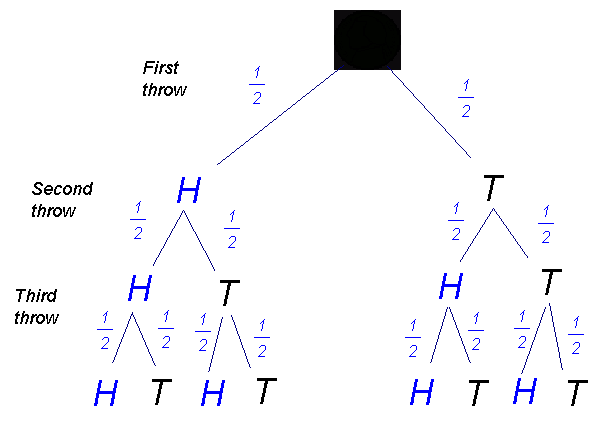
Total Possible outcomes
HHH THH
HHT THT
HTH TTH
HTT TTT