Integration and the Area Function
The area between the graph of the function \(y = f(x)\) and the x-axis, starting at \(x = 0\),
is called the area function \(A(x)\).
\[
\text{When } y = (n+1)x^{n},
\]
\[
A(x) = x^{\,n+1},
\]
\[
\text{provided } n \neq -1.
\]
Example
Find the area under the graph \(y = 2x\) between \(x = 2\) and \(x = 4\).
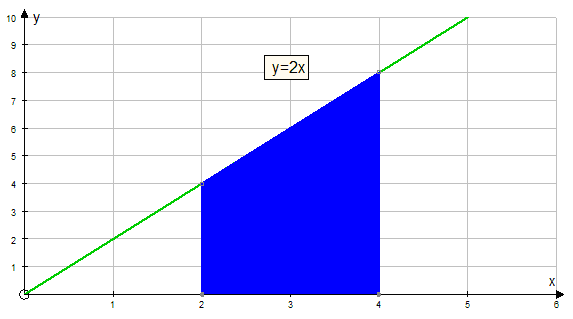
The area between 2 and 4 can be described as the area between \(x = 0\) and \(x = 4\)
minus the area between \(x = 0\) and \(x = 2\).
\[
y = 2x \quad\Rightarrow\quad A(x) = x^{2}
\]
\[
A(4) - A(2) = 4^{2} - 2^{2}
\]
\[
= 16 - 4
\]
\[
= 12\ \text{units}^{2}
\]
\[
\text{But } \int 2x\,dx = x^{2},
\]
\[
\text{so } A(x) = \int f(x)\,dx.
\]
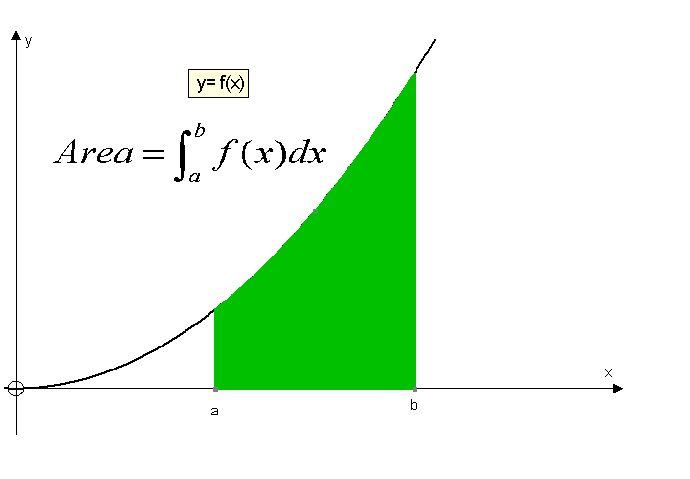
The area of the graph of \(y = f(x)\) between \(x = a\) and \(x = b\) is:
\[
\int_{a}^{b} f(x)\,dx
\quad\text{is called a definite integral.}
\]
\[
b \text{ is the upper limit of integration}
\]
\[
a \text{ is the lower limit of integration}
\]
Example
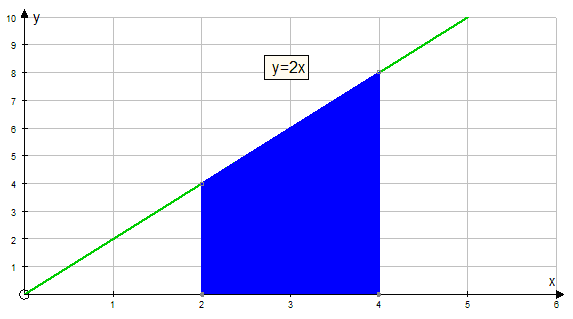
Find the shaded area as a definite integral.
\[
\text{Area} = \int_{2}^{4} 2x\,dx
\]
\[
= \left[ x^{2} \right]_{2}^{4}
\]
\[
= (4^{2}) - (2^{2})
\]
\[
= 16 - 4
\]
\[
= 12\ \text{units}^{2}
\]
Area between curve and the y-axis
It is sometimes necessary to find the area between the function and the y-axis.
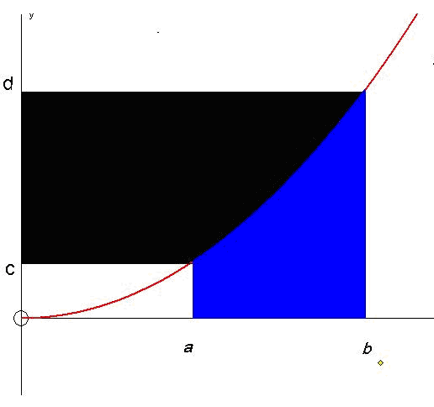
This is given as:
\[
\int_{c}^{d} f(y)\,dy
\]
\[
\text{or}
\]
\[
\int_{a}^{b} \bigl(\text{right‑hand curve} - \text{left‑hand curve}\bigr)\,dy
\]
It is not always possible to express the function \(y = f(x)\) in terms of \(x = f(y)\).
It may also be easier to calculate
\[
\int_{a}^{b} f(x)\,dx
\]
and subtract this as a composite area.
Fundamental theorem of calculus
\[
\text{If } F(x) \text{ is the anti-derivative of } f(x),
\]
\[
\int_{a}^{b} f(x)\,dx = F(b) - F(a)
\quad (a \le x \le b)
\]
Examples Using the Fundamental Theorem
Example
\[
\int_{1}^{4} 3x^{2}\,dx
\]
\[
= \left[ x^{3} \right]_{1}^{4}
\]
\[
= (4^{3}) - (1^{3})
\]
\[
= 64 - 1
\]
\[
= 63
\]
Example
\[
\int_{8}^{15} \frac{5}{x^{2}}\,dx
\]
\[
= \int_{8}^{15} 5x^{-2}\,dx
\]
\[
= \left[ -5x^{-1} \right]_{8}^{15}
\]
\[
= \left[ -\frac{5}{15} \right] - \left[ -\frac{5}{8} \right]
\]
\[
= -\frac{1}{3} + \frac{5}{8}
\]
\[
= \frac{-8 + 15}{24}
\]
\[
= \frac{7}{24}
\]
Example
Find the positive value of \(z\):
\[
\int_{2}^{z} (6x - 5)\,dx = 10
\]
\[
\Rightarrow \left[ 3x^{2} - 5x \right]_{2}^{z} = 10
\]
\[
\Rightarrow (3z^{2} - 5z) - (3\cdot 2^{2} - 5\cdot 2) = 10
\]
\[
\Rightarrow (3z^{2} - 5z) - (12 - 10) = 10
\]
\[
\Rightarrow 3z^{2} - 5z - 12 = 0
\]
\[
\Rightarrow (3z + 4)(z - 3) = 0
\]
\[
\Rightarrow z = -\frac{4}{3} \quad \text{or} \quad z = 3
\]
\[
z = 3 \text{ is the positive solution.}
\]
Areas enclosed by the graph and the x-axis
When calculating the area enclosed by a graph and the x-axis:
- Always draw a sketch.
- Calculate areas above and below the x-axis separately.
- Ignore negative signs and add.
Example: Line and the x-axis
Example
Calculate the area enclosed by the graph of \(y = x + 2\) and the x-axis for
\(-6 \le x \le 1\).
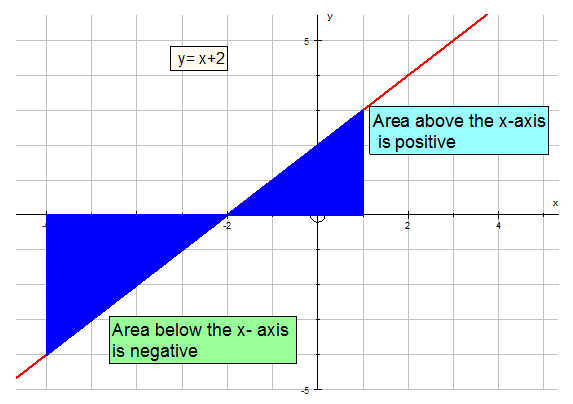
The graph cuts the x-axis at \((-2, 0)\).
Area below the x-axis:
\[
\int_{-6}^{-2} (x + 2)\,dx
\]
\[
= \left[ \frac{x^{2}}{2} + 2x \right]_{-6}^{-2}
\]
\[
= \left( \frac{(-2)^{2}}{2} + 2(-2) \right)
- \left( \frac{(-6)^{2}}{2} + 2(-6) \right)
\]
\[
= \left( \frac{4}{2} - 4 \right)
- \left( \frac{36}{2} - 12 \right)
\]
\[
= (2 - 4) - (18 - 12)
\]
\[
= -2 - 6
\]
\[
= -8\ \text{units}^{2}
\]
Area above the x-axis:
\[
\int_{-2}^{1} (x + 2)\,dx
\]
\[
= \left[ \frac{x^{2}}{2} + 2x \right]_{-2}^{1}
\]
\[
= \left( \frac{1^{2}}{2} + 2\cdot 1 \right)
- \left( \frac{(-2)^{2}}{2} + 2(-2) \right)
\]
\[
= \left( \frac{1}{2} + 2 \right)
- \left( \frac{4}{2} - 4 \right)
\]
\[
= \left( \frac{1}{2} + 2 \right)
- (2 - 4)
\]
\[
= \frac{1}{2} + 2 + 2
\]
\[
= 4\frac{1}{2}\ \text{units}^{2}
\]
\[ \text{Total area} = 8 + 4\frac{1}{2} = 12\frac{1}{2}\ \text{units}^{2} \]
The area between two graphs can be found by subtracting the area between the lower graph
and the x-axis from the area between the upper graph and the x-axis.
Example: Line and Parabola
Example
Calculate the area shaded between the graphs \(y = x + 2\) and \(y = x^2\).
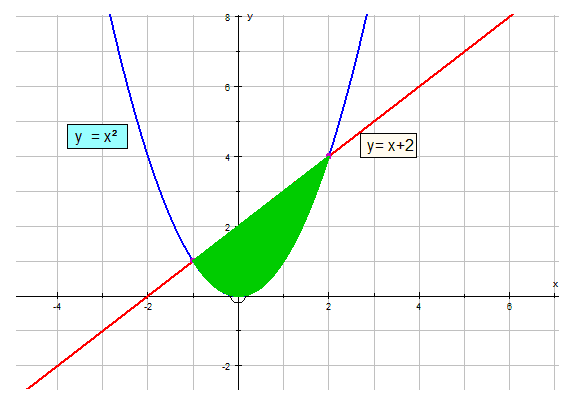
The graphs intersect at \((-1, 1)\) and \((2, 4)\).
Area between upper curve and x-axis:
\[
\int_{-1}^{2} (x + 2)\,dx
\]
\[
= \left[ \frac{x^{2}}{2} + 2x \right]_{-1}^{2}
\]
\[
= \left( \frac{2^{2}}{2} + 2\cdot 2 \right)
- \left( \frac{(-1)^{2}}{2} + 2(-1) \right)
\]
\[
= \left( \frac{4}{2} + 4 \right)
- \left( \frac{1}{2} - 2 \right)
\]
\[
= (2 + 4) - \left( \frac{1}{2} - 2 \right)
\]
\[
= 6 - \left( -\frac{3}{2} \right)
\]
\[
= 6 + \frac{3}{2}
\]
\[
= 7\frac{1}{2}\ \text{units}^{2}
\]
Area between lower curve and x-axis:
\[
\int_{-1}^{2} x^{2}\,dx
\]
\[
= \left[ \frac{x^{3}}{3} \right]_{-1}^{2}
\]
\[
= \left( \frac{2^{3}}{3} \right)
- \left( \frac{(-1)^{3}}{3} \right)
\]
\[
= \frac{8}{3} - \left( -\frac{1}{3} \right)
\]
\[
= \frac{9}{3}
\]
\[
= 3\ \text{units}^{2}
\]
\[
\text{Shaded area} = 7\frac{1}{2} - 3
= 4\frac{1}{2}\ \text{units}^{2}
\]
Altogether:
\[
\int_{-1}^{2} (\text{upper} - \text{lower})\,dx
\]
\[
\int_{-1}^{2} \bigl((x+2) - x^{2}\bigr)\,dx
\]
\[
\begin{aligned}
\int_{-1}^{2} (x + 2 - x^{2})\,dx
&= \left[ \frac{x^{2}}{2} + 2x - \frac{x^{3}}{3} \right]_{-1}^{2} \\[6pt]
&= \left( \frac{4}{2} + 4 - \frac{8}{3} \right)
- \left( \frac{1}{2} - 2 + \frac{1}{3} \right) \\[6pt]
&= \left( 2 + 4 - \frac{8}{3} \right)
- \left( -\frac{3}{2} + \frac{1}{3} \right) \\[6pt]
&= \frac{10}{3} - \left( -\frac{7}{6} \right) \\[6pt]
&= \frac{10}{3} + \frac{7}{6} \\[6pt]
&= \frac{20}{6} + \frac{7}{6} \\[6pt]
&= \frac{27}{6} \\[6pt]
&= \frac{9}{2} \\[6pt]
&= 4\frac{1}{2}\ \text{units}^{2}
\end{aligned}
\]
The area enclosed between the curves
\[
y = f(x) \quad \text{and} \quad y = g(x)
\]
from \(x = a\) to \(x = b\) is
\[
\int_{a}^{b} f(x)\,dx \;-\; \int_{a}^{b} g(x)\,dx
\]
\[
= \int_{a}^{b} \bigl(f(x) - g(x)\bigr)\,dx
\]
\[ = \int_{a}^{b} (\text{upper} - \text{lower})\,dx \]
\[
\text{provided that } f(x) \ge g(x) \quad \text{for all } a \le x \le b.
\]
Example: Area between Two Parabolas
Example
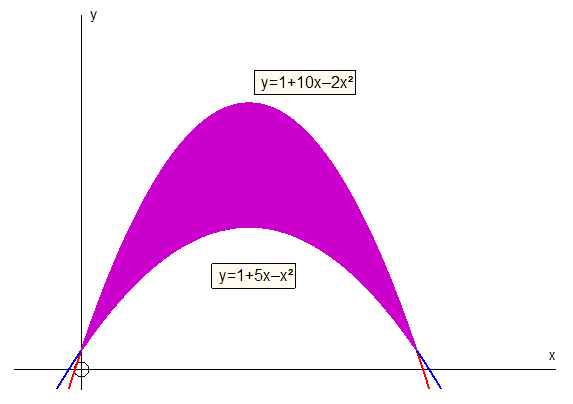
Show that the shaded area enclosed between the parabolas with equations \(y = 1 + 5x - x^2\) and \(y = 1 + 10x - 2x^2\) is \(20 \frac{5}{6} \text{units }^2 \).
For the required area, the upper curve has equation \(y = 1 + 10x - 2x^2 \) and the lower curve has equation \(y = 1 + 5x - x^2\).
\[
\text{Let } f(x) = 1 + 10x - 2x^{2}
\]
\[
\text{Let } g(x) = 1 + 5x - x^{2}
\]
Curves intersect when \(f(x) = g(x)\):
\[
1 + 10x - 2x^{2} = 1 + 5x - x^{2}
\]
\[
0 = x^{2} - 5x
\]
\[
0 = x(x - 5)
\]
\[
x = 0 \quad \text{and} \quad x = 5
\]
Area between curves is found by
\[
\int_{a}^{b} f(x)\,dx \;-\; \int_{a}^{b} g(x)\,dx
\]
\[
= \int_{a}^{b} \bigl(f(x) - g(x)\bigr)\,dx
\]
so
\[
\text{Area}
= \int_{0}^{5} \bigl((1 + 10x - 2x^{2}) - (1 + 5x - x^{2})\bigr)\,dx
\]
\[
= \int_{0}^{5} (5x - x^{2})\,dx
\]
\[
= \left[ \frac{5x^{2}}{2} - \frac{x^{3}}{3} \right]_{0}^{5}
\]
\[
= \left( \frac{5\cdot 5^{2}}{2} - \frac{5^{3}}{3} \right) - 0
\]
\[
= \frac{125}{2} - \frac{125}{3}
\]
\[
= \frac{125\cdot 3 - 125\cdot 2}{6}
\]
\[
= \frac{125}{6}
\]
\[
= 20\frac{5}{6}\ \text{units}^{2}
\]
Books
Printed resources available at Amazon
A quick revision guide to basic integration, designed for the SQA Higher Mathematics course, with additional material extending into Advanced Higher.
- Integral calculus
- Basic rules of integration
- Fundamental theorem of calculus
- Trig functions
- Logarithms and exponentials
- Integration by substitution
- Common forms
- Areas on graphs
- Newton’s equations of motion
- Areas under curves
- Integration and the area function
- Area between curve and the y‑axis
- Areas enclosed by the graph and the x‑axis
- Area between two graphs
As an Amazon Associate I earn from qualifying purchases.