Differentiating Explicit and Implicit Functions
An explicit function is one where the dependent variable is written directly in terms of the independent variable.
For example:
Here, y is the dependent variable and is expressed explicitly in terms of the independent variable x.
An implicit function involves both variables mixed together in an equation.
For example:
Sometimes it is inconvenient or impossible to rearrange a function explicitly. For example, the circle:
could be written explicitly as:
But which version should be used when differentiating?
It is often easier to differentiate an implicit function without
having to rearrange it, by differentiating each term in turn.
Implicit Differentiation
Differentiate each term with respect to $x$.
Remember: because $y$ is a function of $x$, the chain , product and quotient rules apply!
Differentiate \( x^2 + y^2 = 16 \) with respect to x.
Differentiate term‑by‑term:
Rearrange:
This is far quicker than rearranging the circle into $y = \pm\sqrt{16 - x^2}$ and differentiating explicitly.
Differentiate the equation
Differentiate each term:
Collect $\dfrac{dy}{dx}$ terms:
Solve:
Gradients and Concavity
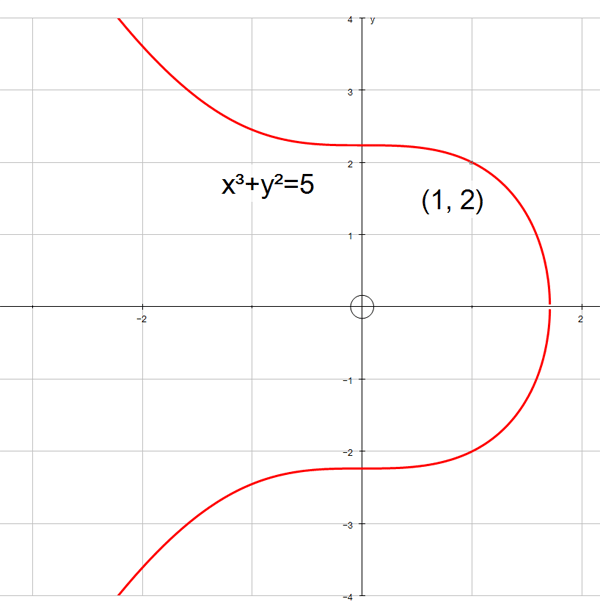
Find the gradient of the tangent at the point $R(1,2)$ on the curve
and determine whether the curve is concave up or concave down at this point.
Differentiating implicitly:
Find second derivative
Divide through by y
Now substitute $x=1$, $y=2$ to find the particular solution
To determine concavity, differentiate again (using product and chain rules):