Functions
Example
Three different ways to show how the function \(f\) links the input \(\{1,2,3,4\}\) to the output \(\{2,4,6,8\}\):
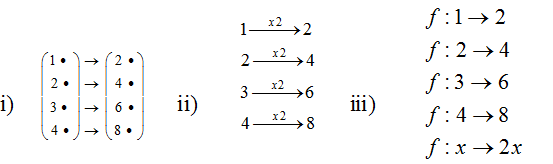
So \(f(x) = 2x\). The “\(f\) of \(x\)” equals \(2x\).
Example
The function \(f\) such that \(1 \mapsto 5\), \(2 \mapsto 10\) is described below:
\[
f: 1 \mapsto 5
\]
\[
f: 2 \mapsto 10
\]
\[
f: 3 \mapsto 15
\]
\[
f: 4 \mapsto 20
\]
\[
f: x \mapsto 5x
\]
\[
f(1) = 5 \times 1 = 5
\]
\[
f(2) = 5 \times 2 = 10
\]
\[
f(3) = 5 \times 3 = 15
\]
\[
f(a) = 5 \times a = 5a
\]
So \(f(x) = 5x\). The “\(f\) of \(x\)” equals \(5x\).
To calculate “\(f\) of \(x\)” for a given function \(f(x)\)
Example
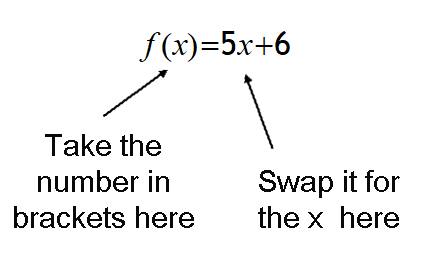
\[
f(1) = 5 \times 1 + 6 = 11
\]
\[
f(2) = 5 \times 2 + 6 = 16
\]
\[
f(3) = 5 \times 3 + 6 = 21
\]
\[
f(a) = 5 \times a + 6 = 5a + 6
\]
Working backwards:
Example
\[
f(x) = ax + b
\]
\[
f(2) = 5
\]
\[
f(1) = 4
\]
\[
\text{Find the equation for } f(x).
\]
Solution:
\[
5 = 2a + b \quad \text{(1)}
\]
\[
4 = a + b \quad \text{(2)}
\]
\[
\text{Multiply equation (2) by } -1 \text{ to get equation (3):}
\]
\[
-4 = -a - b \quad \text{(3)}
\]
\[
\text{Add equations (1) and (3):}
\]
\[
5 + (-4) = (2a + b) + (-a - b)
\]
\[
1 = a
\]
\[
\text{So } a = 1
\]
\[
\text{Substitute into equation (2):}
\]
\[
4 = a + b
\]
\[
4 = 1 + b
\]
\[
b = 3
\]
\[
\text{Therefore } a = 1 \text{ and } b = 3.
\]
\[ f(x) = x + 3 \]
This can be used to find the equation of a line if two points have been given:
Example
Find the equation of the line joining the points \((1,5)\) and \((3,11)\).
\[
x_1,\, y_1 \qquad x_2,\, y_2
\]
\[
(1,5) \qquad (3,11)
\]
\[
m = \frac{y_2 - y_1}{x_2 - x_1}
\]
\[
= \frac{11 - 5}{3 - 1}
\]
\[
= \frac{6}{2}
\]
\[
= 3
\]
\[
y = mx + c
\]
\[
m = 3 \quad\Rightarrow\quad y = 3x + c
\]
\[
\text{when } x = 1,\; y = 5
\]
\[
5 = 3 \times 1 + c
\]
\[
5 = 3 + c
\]
\[
c = 2
\]
\[
\text{check: when } x = 3,\; y = 11
\]
\[
11 = 3 \times 3 + c
\]
\[
11 = 9 + c
\]
\[
c = 2
\]