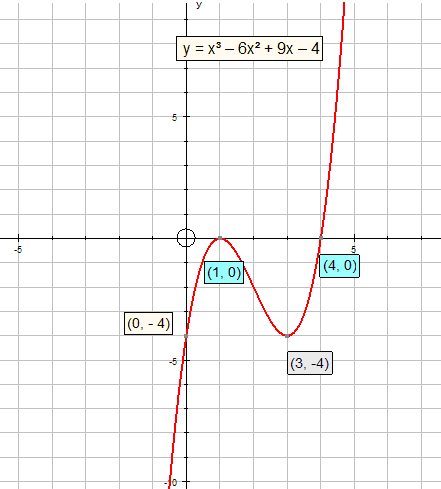
Curve Sketching
To sketch the graph of a function:
- Find the y‑intercept by setting \(x = 0\). Mark the point.
- Find the x‑intercepts by setting \(y = 0\). Mark the points.
- Find stationary points by differentiating \(f(x)\).
- Investigate the nature of each stationary point:
- Increasing then decreasing gradient → maximum tp.
- Decreasing then increasing gradient → minimum tp.
- Decreasing then decreasing again, or increasing then increasing → point of inflection.
- Mark stationary points and sketch the local shape.
- Investigate end‑behaviour:
- At the ends of a closed interval, or
- As \(x \to \infty\) and \(x \to -\infty\).
- Join the curve smoothly.
Example
Sketch the graph of the function \( f(x) = x^3 - 6x^2 + 9x - 4. \)
\[
\
f(x) = x^{3} - 6x^{2} + 9x - 4
\]
This cuts the \(y\)-axis when \(x = 0\) at \((0, -4)\)
and cuts the \(x\)-axis when \(y = 0\).
\[
\
0 = x^{3} - 6x^{2} + 9x - 4
\]
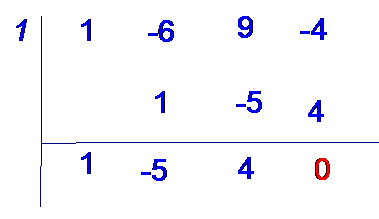
factorise
\[
\begin{aligned}
x^{3} - 6x^{2} + 9x - 4 &= (x-1)(x^{2}-5x+4) \\[6pt]
0 &= (x-1)(x^{2}-5x+4) \\[6pt]
&= (x-1)(x-4)(x-1) \\[12pt]
\text{so}\qquad
x-1 &= 0 \qquad\qquad\qquad x-4 = 0 \\[6pt]
x &= 1 \qquad\qquad\qquad\qquad\qquad x = 4 \\[12pt]
\text{Cuts the \(x\)-axis at } (1,0)\ \text{and}\ (4,0)
\end{aligned}
\]
\[
\begin{aligned}
y &= x^{3} - 6x^{2} + 9x - 4 \\[10pt]
\frac{dy}{dx} &= 3x^{2} - 12x + 9 \\[14pt]
\text{Stationary points occur when } \frac{dy}{dx} = 0
\end{aligned}
\]
\[
\begin{aligned}
0 &= 3x^{2} - 12x + 9 \\[6pt]
&= 3(x^{2} - 4x + 3) \\[6pt]
&= 3(x-3)(x-1) \\[12pt]
\text{so} \qquad
x-3 &= 0 \qquad\qquad\qquad x-1 = 0 \\[6pt]
x &= 3 \qquad\qquad\qquad\qquad\qquad x = 1
\end{aligned}
\]
\[
\begin{aligned}
y &= x^{3} - 6x^{2} + 9x - 4 \\[8pt]
\text{when } x = 3 \\[6pt]
y &= 3^{3} - 6\cdot 3^{2} + 9\cdot 3 - 4 \\[6pt]
&= 27 - 54 + 27 - 4 \\[6pt]
&= -4 \\[10pt]
\text{Stationary point: } (3,-4)
\end{aligned}
\]
\[
\begin{aligned}
y &= x^{3} - 6x^{2} + 9x - 4 \\[8pt]
\text{when } x = 1 \\[6pt]
y &= 1^{3} - 6\cdot 1^{2} + 9\cdot 1 - 4 \\[6pt]
&= 1 - 6 + 9 - 4 \\[6pt]
&= 0 \\[10pt]
\text{Stationary point: } (1,0)
\end{aligned}
\]
\[
\begin{aligned}
y &= x^{3} - 6x^{2} + 9x - 4 \\[10pt]
f'(x) &= 3x^{2} - 12x + 9 \\[10pt]
f''(x) &= 6x - 12 \\[14pt]
f''(1) &= -6 \quad\Rightarrow\ \text{maximum} \\[10pt]
f''(3) &= 6 \quad\Rightarrow\ \text{minimum}
\end{aligned}
\]
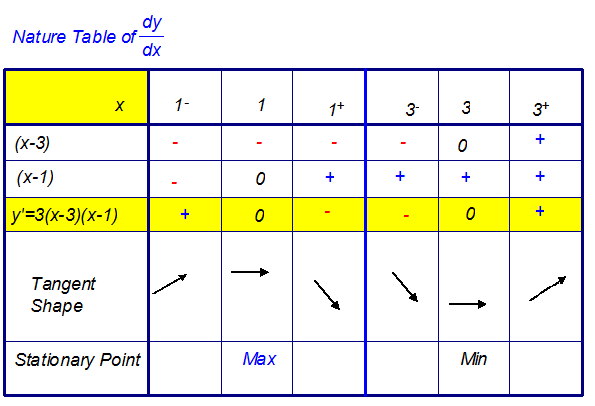
Hence \( \text{Stationary points: } (1,0)\text{ maximum},\quad (3,-4)\text{ minimum}. \)
This is an open interval, since no restrictions have been placed.
\[
\begin{aligned}
f(x) &= x^{3} - 6x^{2} + 9x - 4 \\[10pt]
\text{as } x &\to \infty,\quad x^{3} - 6x^{2} + 9x - 4 \to x^{3} \to \infty \\[6pt]
\text{as } x &\to -\infty,\quad x^{3} - 6x^{2} + 9x - 4 \to -x^{3} \to -\infty
\end{aligned}
\]