These occur when the limits of integration or the integrand become infinite.
The limits of integration become infinite.
Let \(F'(x) = f(x)\) for all \(x > a\),
where \(a\) is a finite real number.
\[
\int_{a}^{\infty} f(x)\,dx
= \lim_{X \to \infty} \int_{a}^{X} f(x)\,dx
\]
\[
= \lim_{X \to \infty} \left[ F(x) - F(a) \right]_{x=a}^{x=X}
\quad\text{when this limit exists}
\]
\[
\int_{-\infty}^{b} f(x)\,dx
= \lim_{X \to -\infty} \int_{X}^{b} f(x)\,dx
\]
\[
= F(b) - \lim_{X \to -\infty} \left[ F(x) \right]_{x=X}^{x=b}
\quad\text{when this limit exists}
\]
If the limit exists, the integral is convergent.
Otherwise, it is divergent.
Examples: Infinite Limits
Example
Is
\(
\int_{1}^{\infty} \frac{3}{x}\,dx
\)
convergent?
\[
\int_{1}^{\infty} \frac{3}{x}\,dx
= \lim_{X \to \infty} \int_{1}^{X} \frac{3}{x}\,dx
\]
\[
= \lim_{X \to \infty} \left[ 3\ln x \right]_{1}^{X}
\]
\[
= \lim_{X \to \infty} \left( 3\ln X - 3\ln 1 \right)
\]
\[
= \lim_{X \to \infty} 3\ln X
= \infty
\]
This limit does not exist,
so the integral is divergent.
Example
\[
\text{Evaluate }\int_{1}^{\infty} e^{-kx}\,dx,\quad k>0
\]
\[
\int_{0}^{\infty} e^{-kx}\,dx
= \lim_{X \to \infty} \int_{0}^{X} e^{-kx}\,dx
\]
\[
= \lim_{X \to \infty} \left[ e^{-kx}\cdot\frac{-1}{k} \right]_{0}^{X}
= \lim_{X \to \infty} \left[ \frac{-e^{-kx}}{k} \right]_{0}^{X}
\]
\[
= \lim_{X \to \infty} \left( \frac{-e^{-kX}}{k} + \frac{e^{0}}{k} \right)
= \lim_{X \to \infty} \left( \frac{1}{k}\bigl(1 - e^{-kX}\bigr) \right)
= \frac{1}{k}
\]
When the Integrand Becomes Infinite
\[
\text{If the integrand } f(x) \text{ becomes infinite at the endpoints of the interval }
a \lt x \lt b,
\]
\[
\text{then the (ordinary) integral does not exist.}
\]
\[
\text{However, the improper integral may exist.}
\]
\[
\text{Let } F'(x)=f(x)\quad\text{for } a \lt x \lt b.
\]
\[
\text{If both } F(a+0)\ \text{and}\ F(b-0)\ \text{tend to finite limits, then}
\]
\[
\int_{a}^{b} f(x)\,dx
= F(b-0) - F(a+0).
\]

Infinite Endpoint
Example
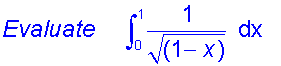
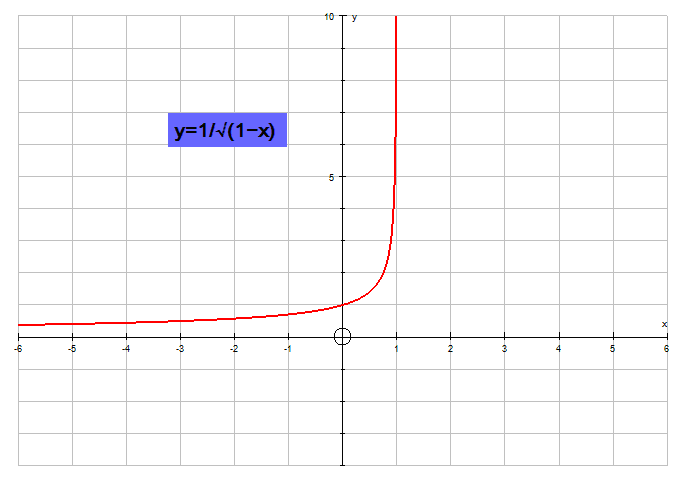
\[
\text{Consider}
\]
\[
\int_{0}^{\,1-\varepsilon}
\frac{1}{\sqrt{\,1-x\,}}\;dx
=
\lim_{\varepsilon\to 0}
\int_{0}^{\,1-\varepsilon}
\frac{1}{\sqrt{\,1-x\,}}\;dx
\]
\[
=
\lim_{\varepsilon\to 0}
\int_{0}^{\,1-\varepsilon}
(1-x)^{-1/2}\,dx
\]
\[
=
\lim_{\varepsilon\to 0}
\left[
-2(1-x)^{1/2}
\right]_{0}^{\,1-\varepsilon}
\]
\[
=
\lim_{\varepsilon\to 0}
\left(
-2\sqrt{\varepsilon} + 2
\right)
\]
\[
= 2.
\]
\[
\text{The limit exists,}
\]
\[
\int_{0}^{1} \frac{1}{\sqrt{\,1-x\,}}\;dx = 2
\]
Infinite Point Within the Integrand
Example
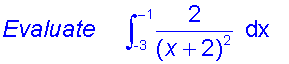
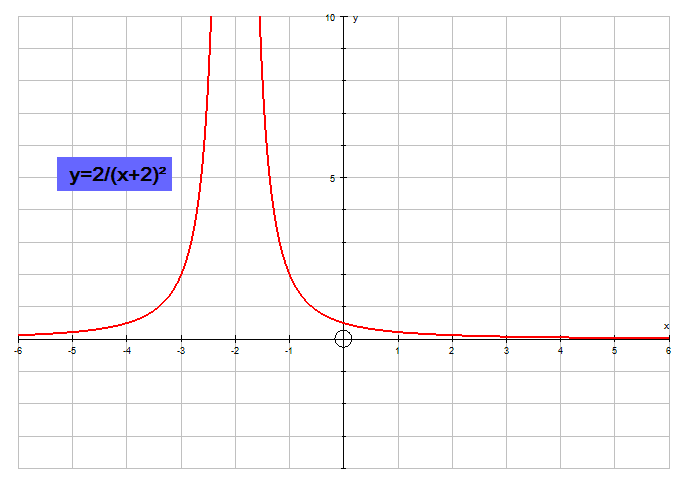
Clearly, the function is undefined at \(x = -2\).
The interval must be split and inspected.
Consider the right–hand side of \(x = -2\).
\[
\int_{-2+\varepsilon}^{-1}
\frac{2}{(x+2)^{2}}\,dx
=
\lim_{\varepsilon\to 0}
\int_{-2+\varepsilon}^{-1}
\frac{2}{(x+2)^{2}}\,dx
\]
\[
=
\lim_{\varepsilon\to 0}
2\int_{-2+\varepsilon}^{-1}
(x+2)^{-2}\,dx
\]
\[
=
\lim_{\varepsilon\to 0}
\left(
-2\,(x+2)^{-1}
\right)\Bigg|_{\,x=-2+\varepsilon}^{\,x=-1}
\]
\[
=
\lim_{\varepsilon\to 0}
\left[
-2\left(\frac{1}{-1+2}\right)
\;-\;
\left(-2\frac{1}{\varepsilon}\right)
\right]
\]
\[
=
\lim_{\varepsilon\to 0}
\left(
-2\left[1 - \frac{1}{\varepsilon}\right]
\right)
\]
\[
\frac{1}{\varepsilon}\to\infty
\quad\text{as}\quad
\varepsilon\to 0
\]
The right–hand limit does not exist.
Consider the left–hand side of \(x = -2\).
\[
\int_{-3}^{-2-\varepsilon}
\frac{2}{(x+2)^2}\,dx
\]
\[
=
\lim_{\varepsilon\to 0}
\,2\int_{-3}^{-2-\varepsilon} (x+2)^{-2}\,dx
\]
\[
=
\lim_{\varepsilon\to 0}
\left(
-2\,(x+2)^{-1}
\right)\Bigg|_{x=-3}^{\,x=-2-\varepsilon}
\]
\[
=
\lim_{\varepsilon\to 0}
\left[
-2\left(\frac{1}{-2-\varepsilon+2}\right)
-
\left(-2\frac{1}{-3+2}\right)
\right]
\]
\[
=
\lim_{\varepsilon\to 0}
\left[
-2\left(\frac{1}{-\varepsilon}\right)
+2
\right]
\]
\[
= \lim_{\varepsilon \to 0}
\left[
-2\left( \frac{1}{-\varepsilon} + 1 \right)
\right]
\]
\[
=
\lim_{\varepsilon\to 0}
\left(
-2\left[\,1 - \frac{1}{\varepsilon}\,\right]
\right)
\]
\[
\frac{1}{\varepsilon}\to\infty
\quad\text{as}\quad
\varepsilon\to 0
\]
The left–hand limit does not exist.
The area is unbounded.
The integral is divergent.