Compound Angle Examples
Example
\[ \alpha \text{ and } \beta \text{ are acute angles such that } \tan\alpha = \frac{5}{12}, \qquad \tan\beta = \frac{3}{4}. \]
\[ \text{1. Find the exact value of } \cos(\alpha - \beta) \]
\[ \text{2. Find the exact value of } \sin(\alpha - \beta) \]
Sketch triangles for α and β , then use Pythagoras to get missing side. Substitute into equations.
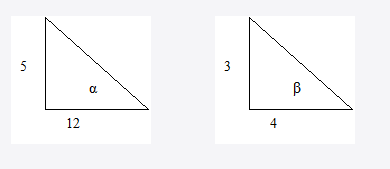
\[
\cos(\alpha - \beta)
= \cos\alpha\cos\beta + \sin\alpha\sin\beta
\]
\[
= \frac{12}{13}\cdot\frac{4}{5}
+ \frac{5}{13}\cdot\frac{3}{5}
\]
\[
= \frac{48}{65} + \frac{15}{65}
\]
\[
= \frac{63}{65}
\]
\[
\sin(\alpha - \beta)
= \sin\alpha\cos\beta - \cos\alpha\sin\beta
\]
\[
= \frac{5}{13}\cdot\frac{4}{5}
- \frac{12}{13}\cdot\frac{3}{5}
\]
\[
= \frac{20}{65} - \frac{36}{65}
\]
\[
= -\frac{16}{65}
\]
Example
\[
\text{Solve the equation } 3\cos(2x)^\circ = -\cos x^\circ - 1
\]
\[
\text{in the interval } 0 \le x \le 360^\circ.
\]
- Rearrange to set equation to zero.
- Eliminate the Cos2x˚ term, turning the equation into a quadratic.
- Factorise
- Solve each set of brackets.
- Remember to combine answer at end !
\[
3\cos(2x)^\circ + \cos x^\circ + 1 = 0
\]
\[
3(2\cos^2 x^\circ - 1) + \cos x^\circ + 1 = 0
\]
\[
6\cos^2 x^\circ - 3 + \cos x^\circ + 1 = 0
\]
\[
6\cos^2 x^\circ + \cos x^\circ - 2 = 0
\]
\[
(2\cos x^\circ - 1)(3\cos x^\circ + 2) = 0
\]
\[
2\cos x^\circ - 1 = 0
\qquad\text{and}\qquad
3\cos x^\circ + 2 = 0
\]
\[
\cos x^\circ = \frac12
\qquad\text{and}\qquad
\cos x^\circ = -\frac23
\]
\[
x^\circ = 60^\circ,\; 300^\circ
\qquad\text{and}\qquad
x^\circ \approx 131.8^\circ,\; 228.2^\circ
\]
\[
\boxed{
x^\circ = 60^\circ,\; 131.8^\circ,\; 228.2^\circ,\; 300^\circ
}
\]
Example
\[
\text{Prove that }
\cos\!\left(\frac{\pi}{4} + \theta\right)
\;-\;
\sin\!\left(\frac{\pi}{4} - \theta\right)
= 0.
\]
\[
\cos\!\left(\frac{\pi}{4}+\theta\right)
- \sin\!\left(\frac{\pi}{4}-\theta\right)
\]
\[
= \cos\frac{\pi}{4}\cos\theta - \sin\frac{\pi}{4}\sin\theta
\;-\;
\left(
\sin\frac{\pi}{4}\cos\theta - \cos\frac{\pi}{4}\sin\theta
\right)
\]
\[
= \cos\frac{\pi}{4}\cos\theta
- \sin\frac{\pi}{4}\sin\theta
- \sin\frac{\pi}{4}\cos\theta
+ \cos\frac{\pi}{4}\sin\theta
\]
\[
= \frac{1}{\sqrt{2}}\cos\theta
- \frac{1}{\sqrt{2}}\sin\theta
- \frac{1}{\sqrt{2}}\cos\theta
+ \frac{1}{\sqrt{2}}\sin\theta
\]
\[
= 0
\]
Example
\[
\text{Find the exact value of } \cos 75^\circ.
\]
\[
\cos 75^\circ
= \cos(30^\circ + 45^\circ)
\]
\[
= \cos 30^\circ \cos 45^\circ - \sin 30^\circ \sin 45^\circ
\]
\[
= \frac{\sqrt{3}}{2}\cdot\frac{1}{\sqrt{2}}
- \frac{1}{2}\cdot\frac{1}{\sqrt{2}}
= \frac{\sqrt{3}}{2\sqrt{2}} - \frac{1}{2\sqrt{2}}
= \frac{\sqrt{3}-1}{2\sqrt{2}}
\]
\[
\cos 75^\circ
= \frac{\sqrt{3}-1}{2\sqrt{2}}
\cdot \frac{\sqrt{2}}{\sqrt{2}}
= \frac{\sqrt{6}-\sqrt{2}}{4}
\]
\[
\boxed{\cos 75^\circ = \frac{\sqrt{6}-\sqrt{2}}{4}}
\]