Centre of Mass
The centre of mass of a system of particles is the point that moves as though all of the system’s mass were concentrated there and all external forces acted at that point.
For a symmetrical, homogeneous object, the centre of mass lies at its geometric centre.
For a collection of objects, treat each object as a particle located at its own centre of mass.
A dumbbell consists of two identical spheres connected by a cylindrical rod.
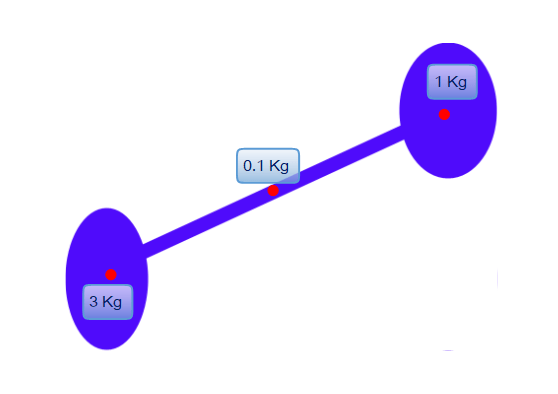
The spheres have the same radius and all items are homogeneous.
The first sphere is located at the origin and has mass 3 Kg. The second sphere has a mass of 1 Kg and is centered at the point with position vector \[ \vec{r}_2 = 0.3\mathbf{i} + 0.4\mathbf{j}. \] . The rod has a mass of 0.1 Kg and its centre lies halfway between the spheres.
Find the position of the centre of mass of the dumbell.
Centre of Mass Calculation
Let masses be \(m_1, m_2, m_3\) and position vectors \(\vec{r}_1, \vec{r}_2, \vec{r}_3\).
Laminae
A lamina is a 2 dimensional object whose thickness can be ignored.
A llama cannot be ignored.
 © Alexander Forrest